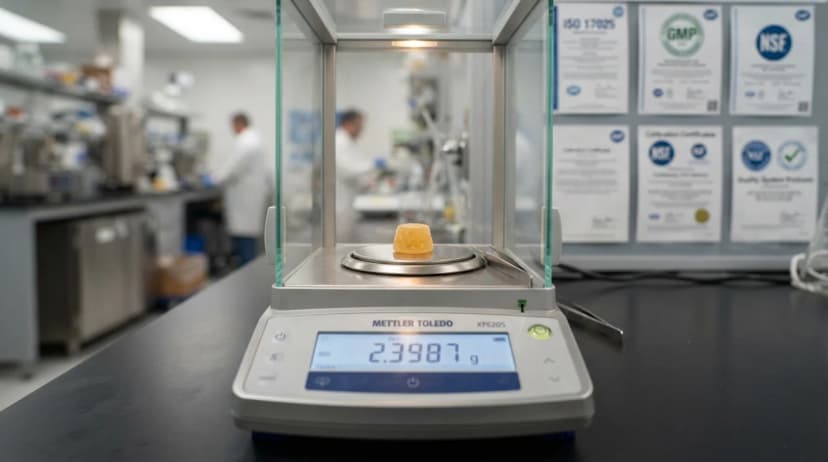
Total Landed Cost Analysis: Indian Gummy Manufacturing for Australia and Canada Markets

Total Landed Cost Analysis: Indian Gummy Manufacturing for Australia and Canada Markets
For nutraceutical executives managing brands in Australia and Canada, the math of scaling is brutal. Retailers demand high margins, domestic manufacturing costs are exorbitant, and the regulatory barriers to entry (TGA and NNHPD) require significant ongoing investment in Quality Assurance.
To survive and thrive, these brands must radically optimize their Cost of Goods Sold (COGS). The most effective lever available is transitioning production to elite Indian Contract Manufacturing Organizations (CMOs).
However, a raw unit-price comparison is misleading. Procurement teams must master the Total Landed Cost analysis. This guide breaks down the true landed cost Indian gummies present when exporting to these highly regulated markets, proving the overwhelming Indian CMO cost benefit export strategy.
1. The Ex-Works (EXW) Manufacturing Cost
The calculation begins at the factory door in India.
Domestic vs. Offshore Inefficiencies
- Australia/Canada Domestic CMOs: These facilities face astronomical real estate, energy, and labor costs. More critically, they are geographically isolated from the source of the raw materials. If a Canadian CMO makes an Ashwagandha gummy, they must import that extract from India, pay a markup to a distributor, and then apply their own manufacturing margin.
- The Indian Advantage: An Indian CMO is vertically integrated with the global botanical supply chain. They procure raw materials domestically at the source, eliminating the middleman markup. Combined with highly efficient, scaled labor (Quality Control chemists, machine operators), the Ex-Works (EXW) unit cost from an Indian facility is frequently 40% to 50% lower than a domestic equivalent.
2. Ocean Freight and Logistics Costs
The cost of moving the goods across the globe must be factored into the unit price.
The Pectin Freight Arbitrage
- If a brand mistakenly formulates with gelatin, they must ship via expensive refrigerated (reefer) ocean containers to prevent melting.
- Because elite Indian facilities (like Probiota Innovations) formulate strictly with thermo-irreversible, high-heat stable pectin, the gummies can be shipped in standard Dry Van (DV) containers.
- The Math: Shipping a Full Container Load (FCL) of dense, high-value gummies from Nhava Sheva (India) to Sydney or Vancouver typically adds only pennies (e.g., $0.05 - $0.15) to the per-bottle cost. This minor freight addition does not significantly dent the massive EXW savings.
3. Tariffs, Duties, and Trade Agreements
Importing goods triggers customs scrutiny and potential taxation. This is where strategic geography plays a massive role in import margins gummies Canada and Australia.
Australia (ECTA)
- The Australia-India Economic Cooperation and Trade Agreement (ECTA) has fundamentally reshaped gummy manufacturing cost Australia dynamics. ECTA eliminates tariffs on an enormous range of manufactured goods and pharmaceutical products imported from India. For Australian brands, this means they can often import high-quality supplements duty-free, maximizing their margin expansion.
Canada (Tariff Classification)
- While Canada does not have a comprehensive free trade agreement with India equivalent to ECTA, dietary supplements and natural health products often fall under favorable Harmonized System (HS) codes.
- Depending on the specific formulation (e.g., vitamin preparation vs. sugar confectionery), the Most-Favoured-Nation (MFN) tariff rate is often low (0% to 5%). A skilled Canadian customs broker will ensure the correct, most favorable classification is applied, keeping landed costs minimized.
4. The Hidden Costs: Quality Assurance and Compliance
The final, and often overlooked, variable in nutraceutical supply chain economics is the cost of regulatory compliance.
- If an Australian brand chooses a cheap, unverified overseas manufacturer, they will spend tens of thousands of dollars on third-party consultants attempting to get the facility cleared by the TGA, only to likely fail.
- The Premium Indian Value: By partnering with a top-tier Indian CMO that already holds FSSC 22000, NSF-ready QMS, and robust stability data, the brand essentially "outsources" the cost of compliance. The flawless documentation provided by the Indian CMO allows the brand to secure their TGA AUST L or Health Canada NPN licenses rapidly and without expensive delays.
The Verdict: Unlocking Massive Margin Expansion
When the Total Landed Cost calculation is complete—factoring in EXW price, ocean freight, import duties, and compliance validation—the result is undeniable.
Brands in Australia and Canada partnering with elite Indian facilities routinely realize a reduction in Total Landed Cost of 25% to 35% compared to domestic manufacturing. This allows the brand to aggressively outspend competitors on marketing, offer better promotions to retailers, and scale their enterprise with healthy, robust profitability.
Explore our Export-Ready Turnkey Manufacturing Solutions
Frequently Asked Questions (FAQ)
1. Is it cheaper to ship via Air Freight or Sea Freight from India? Sea freight (ocean freight) is exponentially cheaper and is the only viable method for scaling a commercial gummy brand. Air freight is incredibly fast (days instead of weeks) but is prohibitively expensive for heavy, dense products like gummies, destroying profit margins. Air freight should only be used for emergencies or initial small trial runs.
2. What is Ex-Works (EXW)? EXW is an international trade term (Incoterm). It means the seller (the manufacturer) makes the goods available at their premises (the factory in India). The buyer (the brand) is responsible for all costs and risks involved in taking the goods from the factory to the final destination (Australia/Canada), including loading, freight, and customs.
3. Does the cost of third-party testing significantly increase the landed cost? It adds a minor cost. While a comprehensive third-party lab test (heavy metals, active assay, microbes) upon arrival in Canada or Australia might cost $1,000 to $1,500, when spread across a commercial batch of 20,000 to 50,000 bottles, it adds merely a few cents to the unit cost, which is negligible compared to the liability protection it provides.
4. How does the exchange rate affect landed costs? Contracts with Indian CMOs are typically negotiated in US Dollars (USD). Therefore, Australian and Canadian brands must monitor the exchange rate between their local currency (AUD or CAD) and the USD, as currency fluctuations will impact the final landed cost in their domestic currency.
Recommended Manufacturing Solution
Discover our turnkey white label probiotic supplement solutions
Want to discuss your formulation?
Our experts help brands launch technically complex probiotic and functional gummies.