NSF/ANSI 455-2 vs USP: Which Certification Matters Most for US Supplement Retailers
NSF/ANSI 455-2 vs USP: Which Certification Matters Most for US Supplement Retailers
For dietary supplement brands targeting mass retail distribution in the United States, securing shelf space at giants like Target, CVS, Walgreens, or Whole Foods requires far more than a sleek label and a good marketing pitch. These retailers have implemented draconian quality assurance protocols to protect themselves from liability and FDA scrutiny.
To pass these retailer vendor-qualification programs, brands must prove that their manufacturing partners operate at the highest echelon of compliance. This typically boils down to a choice between two prestigious, globally recognized third-party audits.
The debate of NSF 455-2 vs USP is critical for procurement teams. Understanding the differences in NSF vs USP certification gummies will dictate your manufacturing strategy and market access.
The Baseline: Why Third-Party Certification is Mandatory
The FDA regulates dietary supplements under 21 CFR Part 111 (cGMP). However, the FDA does not "certify" facilities; they only inspect them, and often infrequently. Major US retailers know this. They cannot rely on a simple "FDA Registered" claim because it offers no continuous proof of compliance.
To mitigate risk, retailers require brands to use Contract Manufacturing Organizations (CMOs) that have been audited by independent, specialized third parties.
USP Verification (United States Pharmacopeia)
The USP is an independent, scientific nonprofit organization that sets rigorous public standards for medicines and supplements.
How USP Certification Works
The USP Dietary Supplement Verification Program is highly respected, particularly in the pharmaceutical and legacy vitamin sectors.
- The Audit: USP conducts a rigorous facility audit to ensure cGMP compliance.
- Product-Specific Testing: The USP program is unique because it heavily emphasizes product-specific testing. They will pull finished products off the shelf and test them in USP laboratories to ensure they meet the exact potency claims on the label, disintegrate properly (for tablets/capsules), and are free from contaminants.
- The Mark: Products that pass can bear the "USP Verified" mark on their label, which carries immense consumer trust, especially in the older demographic.
USP Certified Gummies Comparison Challenges
While excellent for tablets and capsules, USP verification can be challenging and expensive for complex gummy matrices. Because gummies are a food-like matrix, their disintegration and active ingredient distribution (homogeneity) are vastly different from a compressed tablet, making USP's rigid monographs sometimes difficult to apply to innovative gummy formulations.
NSF/ANSI 455-2 Certification
The National Sanitation Foundation (NSF) is a global public health organization. The NSF/ANSI 455-2 standard was developed in 2018 specifically for the dietary supplement industry, replacing the older NSF cGMP certification.
How NSF/ANSI 455-2 Works
This standard is widely considered the most comprehensive facility audit in the modern nutraceutical industry.
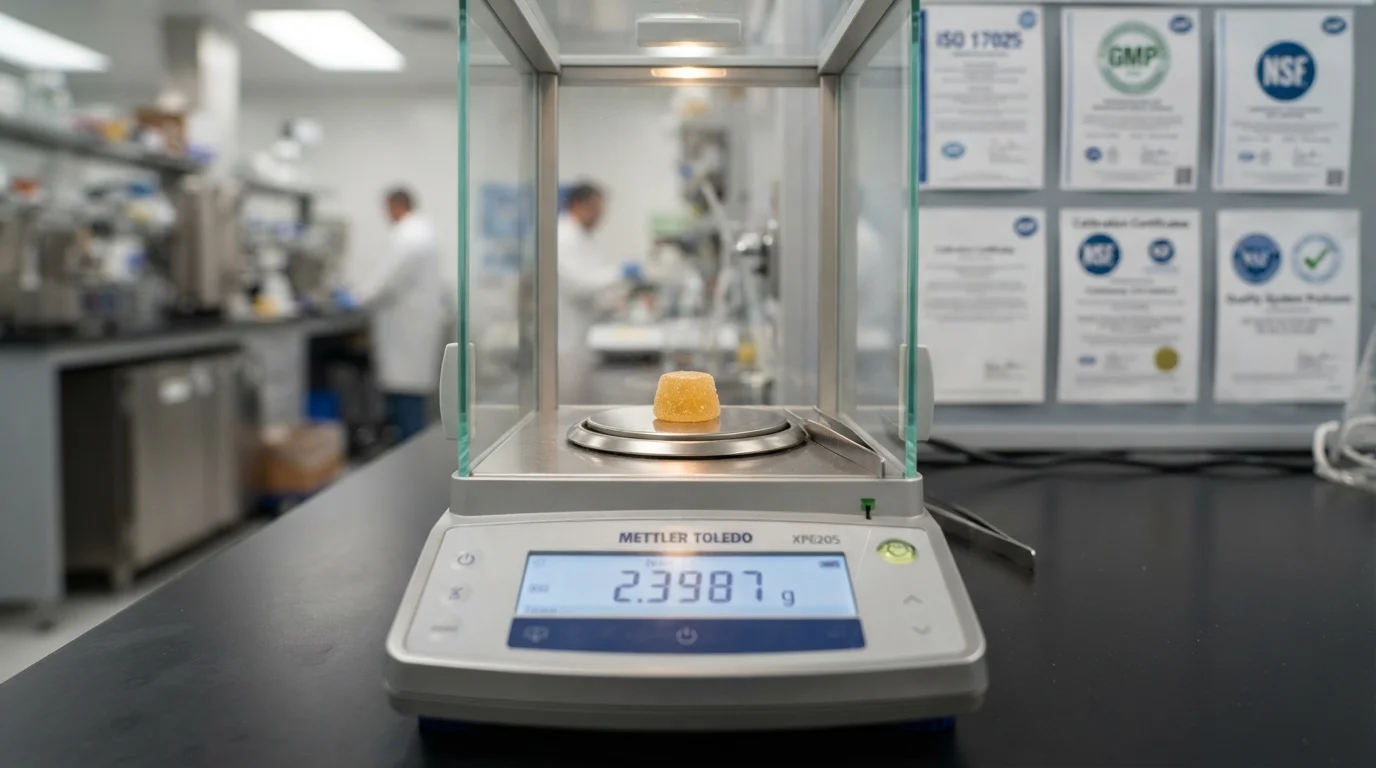
- Exhaustive QMS Audit: NSF focuses intensely on the facility's Quality Management System (QMS). They audit everything from supplier qualification protocols and raw material identity testing to advanced environmental controls and electronic batch records (EBR).
- Dietary Supplement Specific: Unlike broad ISO standards, NSF 455-2 was written specifically for supplements, incorporating FDA 21 CFR 111 requirements and adding best practices from the pharmaceutical industry.
- The Unannounced Audit: The most significant advantage of NSF is that audits can be unannounced. This guarantees to retailers that the facility operates in a state of perpetual compliance, not just when an auditor is scheduled to arrive.
Which Certification for US Supplements Retailers?
So, which certification for US supplements matters most to the buyer at a major retail chain?
- Universal Acceptance: Both NSF 455-2 and USP are universally accepted by every major US retailer. If your CMO holds either, you will pass the manufacturer-qualification portion of the retailer's compliance program.
- The Modern Standard: For innovative formats like pectin gummies, NSF/ANSI 455-2 is increasingly viewed as the more applicable and comprehensive standard. It provides the retailer with absolute assurance that the facility's underlying systems—from preventing allergen cross-contamination (crucial for gummies) to managing raw material identity—are flawless.
NSF 455-2 Gummy Advantages for Brand Owners
For a brand owner vetting a foreign CMO (e.g., an Indian manufacturing facility), NSF 455-2 is the ultimate safeguard.
- If an Indian facility holds NSF 455-2, the US brand knows the facility has been subjected to a grueling, independent audit by American standards experts.
- It completely nullifies any perceived risk of offshore manufacturing, providing the US brand with a turnkey, export-ready compliance package to hand to their retail buyers.
Elevate Your Compliance with Probiota Innovations
At Probiota Innovations, we understand that our manufacturing standards are the foundation of your retail success. Our world-class facility is engineered to meet the strictest global certifications, operating at a level that satisfies the most demanding US retailers.
We provide the impeccable documentation, analytical CoAs, and rigorous QMS protocols required to ensure your functional gummies capture and retain premium shelf space across the United States.
Explore our Turnkey Private Label Solutions
Frequently Asked Questions (FAQ)
1. Will a retailer reject my product if my manufacturer is only "FDA Registered"? Increasingly, yes. Major retail chains (like Target, CVS, and Amazon) have instituted strict dietary supplement policies. They often require proof of third-party cGMP certification (like NSF, USP, or UL) or require the brand to pay for expensive third-party audits of the uncertified facility before they will accept the product.
2. Can I put the NSF logo on my product label? NSF offers a facility certification (which proves the factory is compliant) and a product certification (which proves the specific product has been tested by NSF). You can only put the NSF mark on the label if you go through the specific product certification program. However, simply having the facility certification is usually enough to satisfy the B2B retail buyers.
3. Why is NSF 455-2 considered better for international facilities? Because the NSF 455-2 standard is highly prescriptive and aligned with US FDA expectations, it forces international facilities to adopt American regulatory best practices (like strict raw material identity testing). This provides US brands with absolute confidence that the imported product will pass FDA scrutiny.
4. Does an NSF audit cover heavy metals and Prop 65 compliance? The NSF facility audit ensures the manufacturer has a robust system in place to test for heavy metals and verify supplier CoAs. While it proves the facility is capable of compliant manufacturing, the brand must still work with the manufacturer to ensure the specific formulation meets the strict California Prop 65 limits.
Recommended Manufacturing Solution
Build your next product with our expert gummy formulation team
Want to discuss your formulation?
Our experts help brands launch technically complex probiotic and functional gummies.