Importing Gummies from India vs US CMOs: Total Landed Cost, Lead Time, and Quality Comparison 2026

Importing Gummies from India vs US CMOs: Total Landed Cost, Lead Time, and Quality Comparison 2026
As the US dietary supplement market matures, brand owners face relentless pressure. Retailers demand lower wholesale prices, marketing costs on platforms like Amazon and Meta are skyrocketing, and consumers expect premium, plant-based, scientifically backed formulations.
To survive and scale, brands must fiercely protect their profit margins without compromising on quality. This economic reality has triggered a massive supply chain migration. The debate of importing gummies from India vs US CMO (Contract Manufacturing Organization) is no longer a fringe strategy; it is the central boardroom discussion for 2026.
This comprehensive guide breaks down the true India vs USA gummy manufacturing cost, lead times, and quality parity to help brands make an informed strategic pivot.
1. Quality and Compliance Parity
Historically, the argument against offshoring was the perception of lower quality. In 2026, this narrative is obsolete regarding top-tier Indian facilities.
The Rise of the Global Standard Indian CMO
Premium Indian gummy manufacturers do not operate to local standards; they are purpose-built for global export.
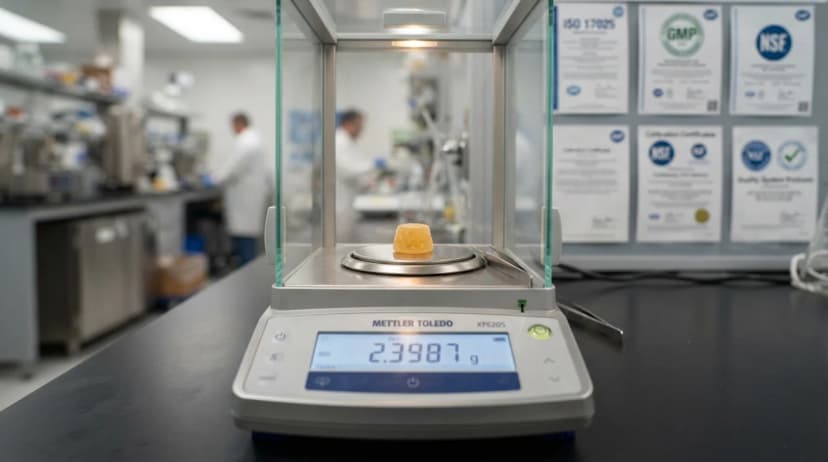
- Certification Parity: Leading Indian contract manufacturer vs domestic US facilities often hold the exact same certifications. An Indian facility holding US FDA registration, 21 CFR 111 cGMP compliance, NSF/ANSI 455-2, and FSSC 22000 operates at a quality assurance level identical to (and often exceeding) a facility in Utah or New Jersey.
- Technological Superiority: Because many Indian facilities are newly built to capture the export market, they are equipped with the latest technology. This includes advanced starchless mogul systems (silicone molds) and automated continuous-cooking pectin lines, whereas many older US facilities are still running legacy starch moguls that are prone to cross-contamination.
- Formulation R&D: India boasts a massive pool of highly educated polymer scientists and pharmacists. Their ability to formulate complex, high-brix, heat-stable, sugar-free pectin gummies is world-class.
2. The Total Landed Cost Analysis
The primary driver for moving production to India is cost arbitrage. However, procurement teams must look beyond the initial unit price and calculate the landed cost gummies India, which includes freight, insurance, and customs duties.
Manufacturing Cost (COGS)
- Labor and Overhead: The cost of skilled pharmaceutical labor, facility overhead, and energy in India is a fraction of the cost in the US.
- Raw Material Proximity: India is the global epicenter for botanical extracts (Ashwagandha, Curcumin, Bacopa). An Indian CMO sources these ingredients domestically, eliminating the massive markup US CMOs pay to import those same raw materials before putting them into a gummy.
The Freight Factor
- Shipping ocean freight from major Indian ports (like Nhava Sheva) to the US East or West Coast adds transit time and cost.
- However, because gummies are relatively dense and high-value, the freight cost per bottle (when shipping Full Container Loads - FCL) is typically measured in cents.
The Bottom Line: Even after factoring in ocean freight, insurance, and US import tariffs, the gummy import comparison 2026 heavily favors India. US brands routinely see a reduction in Total Landed Cost of 25% to 40% compared to domestic US manufacturing. This massive margin expansion can be reinvested into customer acquisition, driving exponential brand growth.
3. Lead Times and Supply Chain Resilience
The most common concern regarding importing is the lead time.
Production Lead Times
- US CMOs: Due to massive domestic demand and labor shortages, many top US gummy CMOs have production backlogs ranging from 12 to 24 weeks just to get a product on the manufacturing line.
- Indian CMOs: Elite Indian facilities operate at massive scale with multiple automated lines running 24/7. Their production lead time (from PO to finished goods ready for shipment) is often 6 to 8 weeks.
Transit Times
- Ocean freight from India to the US adds approximately 4 to 6 weeks of transit time.
- Therefore, the total lead time (Production + Transit) from India is frequently equal to or faster than the production backlog of a US CMO.
Supply Chain Security
Relying on a single domestic supplier is risky. By diversifying the supply chain and establishing a strong relationship with a reliable Indian CMO, US brands create a resilient, high-capacity pipeline capable of scaling rapidly if a product goes viral.
Conclusion: The Strategic Imperative
For American nutraceutical brands, maintaining a competitive edge in 2026 requires ruthlessly optimizing the supply chain. Partnering with a top-tier Indian CMO offers absolute quality parity (backed by US-recognized certifications like NSF 455-2), often faster total lead times, and a transformative reduction in landed costs.
At Probiota Innovations, we are the premier Indian manufacturing partner for US brands. We provide FDA-compliant, heat-stable, premium pectin gummies designed specifically for the American market, delivered seamlessly to your US 3PL.
Explore our Export-Ready Turnkey Manufacturing Solutions
Frequently Asked Questions (FAQ)
1. Won't the gummies melt during ocean freight from India to the US? No, provided they are formulated correctly. Gelatin gummies will melt and require expensive refrigerated (reefer) containers. However, we formulate strictly with plant-based pectin. Pectin is thermo-irreversible and boasts a melting point above 60°C (140°F). They safely cross the ocean in standard dry containers without melting or losing shape.
2. How do I verify the quality of a facility in India without traveling there? Look for third-party, US-recognized certifications. If the facility holds NSF/ANSI 455-2, FSSC 22000, and is registered with the US FDA, they have already been rigorously audited by independent global experts to standards that meet or exceed US domestic requirements.
3. Do I have to pay heavy tariffs when importing gummies from India? Dietary supplements generally have very favorable HTS (Harmonized Tariff Schedule) codes, often entering the US duty-free or with very low tariffs. However, brands should always consult with a licensed US Customs Broker to verify the exact tariff classification for their specific formulation.
4. Can an Indian CMO handle complex formulations like sugar-free probiotics? Yes. In fact, advanced Indian CMOs often lead the industry in complex polymer science. We specialize in low water activity (aw), sugar-free pectin matrices that successfully protect and deliver live, microencapsulated probiotic strains.
Recommended Manufacturing Solution
Scale internationally with our export-focused gummy production
Want to discuss your formulation?
Our experts help brands launch technically complex probiotic and functional gummies.