Comparing cGMP Facilities: Indian NSF 455-2 vs Domestic US Gummy Contract Manufacturers

Comparing cGMP Facilities: Indian NSF 455-2 vs Domestic US Gummy Contract Manufacturers
For a Chief Operating Officer (COO) or Procurement Director of a US nutraceutical brand, selecting a Contract Manufacturing Organization (CMO) is a high-stakes decision that dictates the brand's scalability, profitability, and regulatory risk.
For decades, the default strategy was to source domestically. However, the globalization of pharmaceutical-grade manufacturing has fundamentally altered the landscape. Today, elite Indian facilities holding prestigious global certifications are aggressively competing for US market share.
This deep dive offers a rigorous cGMP comparison India USA gummies, directly comparing Indian NSF 455-2 vs US domestic CMO facilities across the critical vectors of compliance, technology, and cost.
1. Regulatory Compliance and Auditing
The baseline requirement for any facility producing supplements for the US market is compliance with FDA 21 CFR 111 (Current Good Manufacturing Practices).
The Domestic US CMO Experience
- FDA Oversight: Domestic US facilities are subject to periodic, unannounced inspections by the FDA.
- The Reality: The FDA is chronically under-resourced. A US facility might go years without seeing an FDA inspector. To prove their compliance to potential clients, top US CMOs voluntarily undergo third-party audits (like NSF or USP). However, many mid-tier US CMOs rely solely on their "FDA Registered" status, which provides very little actual assurance of day-to-day cGMP compliance.
The Elite Indian CMO Experience
- The Burden of Proof: To overcome geographical bias, premium Indian CMOs recognize they must operate at a standard of absolute, irrefutable excellence.
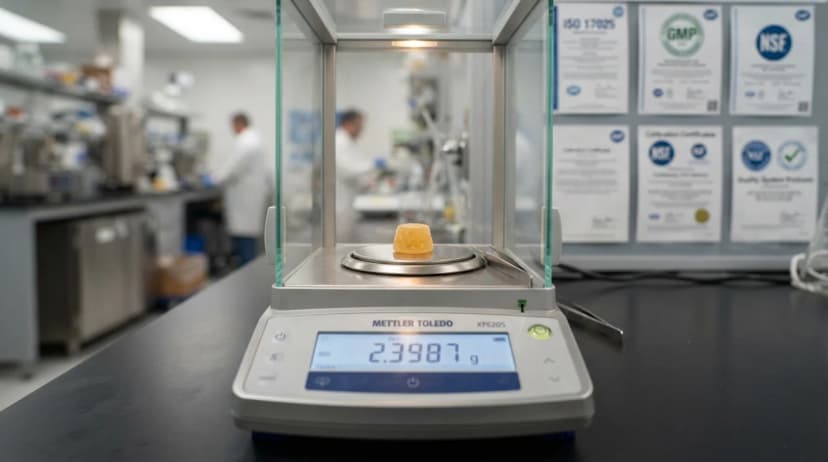
- NSF/ANSI 455-2 Certification: Elite Indian cGMP facilities USA market operators do not rely on basic FDA registration. They invest heavily to achieve NSF/ANSI 455-2 certification. This grueling, unannounced third-party audit ensures the Indian facility adheres to standards that often exceed basic FDA requirements. When an Indian facility holds an NSF 455-2 certification, the US buyer has independent validation that the facility's quality management system (QMS) is identical to, or better than, a premium US facility.
2. Manufacturing Technology and Pectin Expertise
The US gummy market is rapidly abandoning animal-derived gelatin in favor of plant-based pectin, driven by consumer demand for vegan, clean-label products.
US Domestic CMOs
- Legacy Infrastructure: Many established US CMOs built their infrastructure around gelatin and traditional starch moguls decades ago.
- The Pectin Learning Curve: Transitioning these legacy lines to pectin—which is thermo-irreversible, sets incredibly fast, and requires precise pH/Brix control—is difficult. Many US facilities struggle with high scrap rates and inconsistent gummy textures when running complex pectin formulas. Furthermore, legacy starch moguls pose massive cross-contamination and allergen risks.
Advanced Indian CMOs
- Purpose-Built for Pectin: The top-tier Indian facilities built over the last five years were designed specifically for the modern nutraceutical era. They bypassed legacy starch systems entirely.
- Starchless Mogul Technology: These facilities deploy state-of-the-art starchless mogul technology (silicone molds). This allows for continuous, high-heat CIP (Clean-In-Place) sanitation, eliminating the cross-contamination risks of starch. Combined with India's deep pool of polymer scientists, these facilities output flawless, high-brix, highly stable pectin gummies with near-zero scrap rates.
3. The Gummy Manufacturing Cost Quality Comparison
The most profound difference between Indian vs US gummy contract manufacturers lies in the financial architecture of the supply chain.
Domestic US Economics
- High Overhead: US CMOs face massive costs for labor, facility maintenance, and regulatory overhead.
- Supply Chain Markups: Furthermore, US CMOs import the vast majority of their active botanical ingredients (like Ashwagandha, Turmeric, or Boswellia) from India. The US CMO pays a markup to the importer, and then adds their own manufacturing markup on top of that before selling the final gummy to the US brand.
The Indian Arbitrage
- Vertical Integration: An Indian CMO is located at the source of these raw materials. They source premium botanical extracts domestically, completely bypassing the international importer markup.
- Labor and Scale: The cost of highly skilled pharmaceutical labor (Quality Control chemists, formulators, machine operators) in India is a fraction of the US cost.
- The Result: Even after factoring in the cost of ocean freight to the US and import tariffs, a US brand partnering with an NSF 455-2 certified Indian facility routinely realizes a 25% to 40% reduction in Total Landed Cost compared to a domestic US CMO, without sacrificing a single metric of quality or compliance.
Conclusion: The New Strategic Baseline
For a US brand, clinging to domestic manufacturing out of habit is a strategic vulnerability. When a brand can secure the identical, rigorous quality assurance of NSF 455-2, leverage advanced starchless pectin technology, and simultaneously expand their profit margins by 30%, the choice becomes mathematically obvious.
At Probiota Innovations, we represent the pinnacle of Indian cGMP manufacturing. We provide US brands with the absolute highest tier of quality, transparency, and formulation science, empowering them to dominate the American market profitably.
Explore our Export-Ready Turnkey Manufacturing Solutions
Frequently Asked Questions (FAQ)
1. Is it risky to formulate complex products (like probiotics) overseas? It is only risky if the facility lacks expertise. Advanced Indian CMOs employ PhD-level formulators who specialize in complex matrices. For probiotics, they utilize microencapsulation and precise water activity (aw) control within the pectin matrix to ensure the live strains survive the manufacturing process and the ocean transit to the US.
2. How do I protect my intellectual property (IP) when manufacturing in India? Top-tier Indian CMOs accustomed to dealing with US and European clients operate under strict, internationally binding Non-Disclosure Agreements (NDAs) and Non-Compete clauses. Their business model relies on protecting client IP to maintain long-term, high-volume manufacturing contracts.
3. Can an Indian CMO handle US-specific labeling regulations? Yes. Elite export-focused facilities maintain in-house regulatory affairs teams that are intimately familiar with FDA 21 CFR 101 (the regulations governing the formatting of Supplement Facts panels, allergen declarations, and structure/function claims). They review artwork prior to production to ensure flawless US compliance.
4. What happens if there is a quality issue with a shipment from India? A reputable Indian CMO holding NSF 455-2 certification will have a robust CAPA (Corrective and Preventive Action) protocol in place. They will conduct a full root-cause analysis. Standard commercial contracts typically dictate that the CMO is financially responsible for replacing any batch that fails to meet the agreed-upon, objectively measured specifications in the Certificate of Analysis (CoA).
Recommended Manufacturing Solution
Explore our export-ready nutraceutical manufacturing solutions
Want to discuss your formulation?
Our experts help brands launch technically complex probiotic and functional gummies.