Switching Gummy Manufacturers: A Transition Checklist for Brand Owners

The breaking point usually looks the same. A batch is delayed by 8 weeks with no communication. A shipment arrives with the gummies melted into a solid block because the water activity was miscalculated. Or, the manufacturer suddenly raises prices by 30% right before your busiest retail season.
You know you need to switch gummy manufacturers. But the fear of the transition paralyzes you.
Will the new manufacturer be able to replicate the exact taste and texture? Do you own the IP for your formula? How long will your supply chain be offline during the switch?
Changing supplement CMOs safely is a high-stakes operation. A botched transition can lead to out-of-stock scenarios, furious retail buyers, and permanent brand damage. If you are preparing to move your production, this switching gummy manufacturers checklist outlines the exact technical and legal steps required for a seamless tech transfer.
1. The Legal and IP Audit (Before You Tell Your Current CMO)
Before you notify your current manufacturer that you are leaving, you must establish exactly what you own.
Do you own the Master Formulation Record (MFR)?
In the contract manufacturing world, IP ownership is highly contentious.
- If you brought a fully developed recipe to the CMO (Toll Manufacturing), you own the IP.
- If the CMO developed the recipe for you, check your Master Manufacturing Agreement (MMA). Did you pay an upfront R&D fee to own the custom formula? Or does the CMO retain the rights to the base pectin recipe while you only own the rights to the specific active blend?
If you do not own the formula: You cannot legally ask your new manufacturer to perfectly copy the ingredient deck. The new manufacturer will have to conduct a "reverse-engineering" R&D phase to create a functional equivalent. Budget 8 to 12 weeks for this formulation matching process.
Check your termination clauses
Does your current contract require 90 days’ written notice? Are there minimum purchase obligations you haven’t met? Ensure you fulfill the legal requirements to avoid a breach-of-contract lawsuit holding up your transition.
2. The Supply Chain Buffer (Inventory Management)
The number one mistake brands make during a transition is running out of stock.
A tech transfer gummy formulation process takes time. Even if you hand a perfect recipe to a world-class new facility, they must run a pilot batch and initiate stability testing before they run a commercial scale batch.
The Golden Rule: Secure at least 6 months of inventory from your current manufacturer before initiating the switch. This buffer protects your revenue and your retail listings while the new manufacturer dials in the production parameters.
3. The Tech Transfer Checklist (Information Handoff)
To recreate your gummy perfectly, the new manufacturer needs data. Do not just send them a bottle and say, "Make this." You must build a comprehensive tech transfer package.
Gather these documents from your current CMO:
- The Exact Ingredient List: Including the specific forms of vitamins (e.g., Ascorbic Acid vs. Sodium Ascorbate) and the exact probiotic strains.
- Raw Material Specifications: A list of the current suppliers for the active ingredients. (A change in raw material supplier often changes the taste or colour of the final gummy).
- Current Certificates of Analysis (CoA): For the last 3 batches. This shows the new CMO the actual physical specs (weight, Aw, pH) they need to hit.
- Stability Data: The historical data proving your 24-month shelf life.
- Packaging Specifications: The exact dimensions, materials, and supplier of your current bottles, caps, induction seals, and desiccants.
Explore Functional Gummy Manufacturing
4. Vetting the New Manufacturer
You are switching to solve a problem. Ensure the new facility doesn't have the same blind spots as your old one.
Match the Technology
If your current gummy is pectin-based, do not switch to a CMO whose primary business is gelatin. Pectin requires different cooking kettles and depositing parameters. Ensure the new CMO has specialized, starchless depositing lines if you are producing premium, clean-label gummies.
Audit the Compliance Infrastructure
If your previous CMO struggled with export paperwork, make sure the new one is genuinely export-ready. Ask to see a sample export dossier. Verify their US-FDA registration, GMP certificates, and ISO 17025 lab accreditations.
Test the R&D Depth
Send the new CMO your tech transfer package and ask them: "Where do you see the primary stability risks in this formula?" A premium R&D team will instantly identify potential issues (like Vitamin C degradation or moisture migration) and propose process improvements. A basic "toll manufacturer" will just say, "No problem, we can make it."
Explore Export-Ready Manufacturing
5. The Pilot and Validation Phase
Do not sign a contract for a 100,000-unit commercial run with the new manufacturer until you have validated their work.
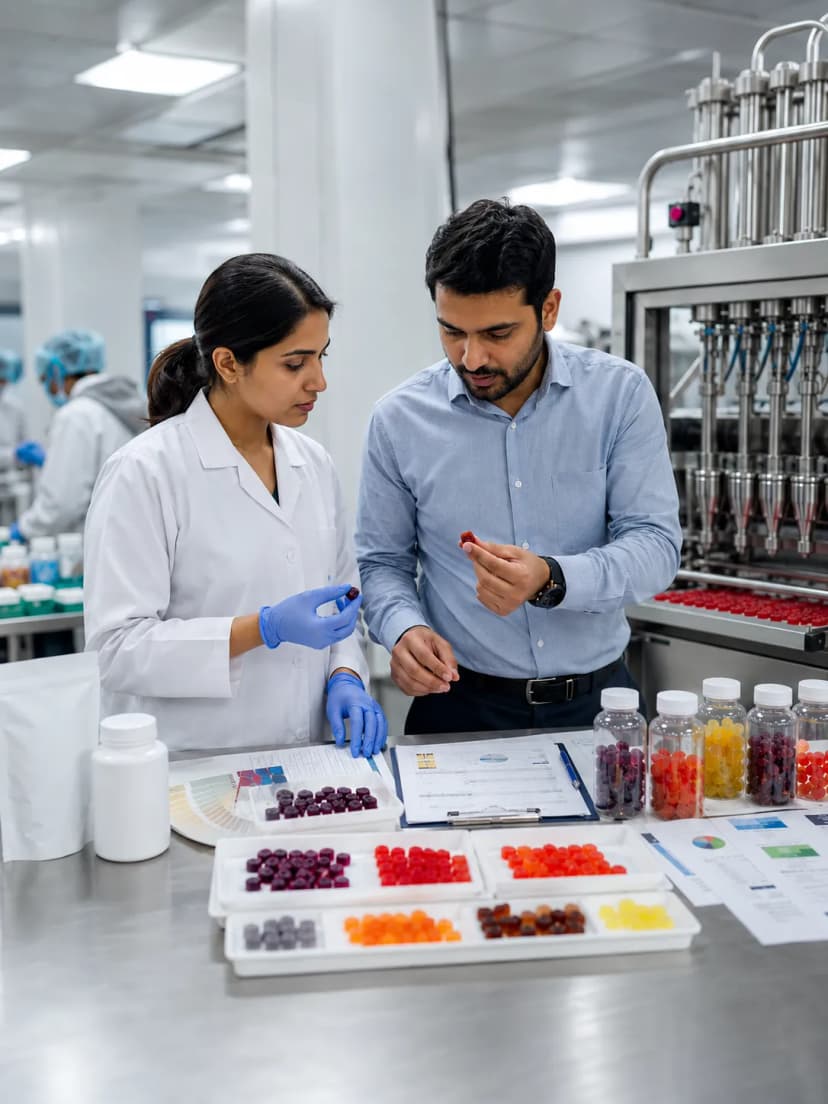
- The Lab Sample: The new CMO will produce benchtop samples to match taste, texture, and colour. This may take 2 to 3 iterations.
- The Pilot Batch (Crucial): Once the lab sample is approved, the CMO must run a pilot batch (typically 5,000 units) on their commercial equipment. A lab bench is very different from a 1,000-gallon kettle. The pilot batch proves they can scale the recipe.
- Stability Initiation: Samples from the pilot batch must be placed in a 40°C/75% RH environmental chamber to begin accelerated stability testing.
- Commercial Production: Only after you have approved the pilot batch (and ideally have 1-month stability data) should you pull the trigger on the massive commercial run.
FAQ
Do I have to change my label when I switch manufacturers? Usually, yes. Even if the active ingredients are identical, the new manufacturer will likely use different natural flavours, colours, or processing aids. The "Other Ingredients" list on your Supplement Facts panel will almost certainly change. Furthermore, if you are exporting to the US, you must update the manufacturer details in your Foreign Supplier Verification Program (FSVP) files.
Can the new manufacturer use my existing packaging inventory? If you own the bottles and labels (and they are physically located at a third-party warehouse or your own facility), you can ship them to the new CMO. However, if the old CMO procured them, they may refuse to release them. Ensure the bottle dimensions are compatible with the new CMO’s automated filling lines.
How much does it cost to transition a gummy formulation? The new CMO will typically charge a one-time R&D or Tech Transfer fee to cover the lab time, pilot batch setup, and stability testing initiation. This can range from a few thousand dollars to significantly more, depending on the complexity of the reverse-engineering required. This is a necessary investment to secure a stable supply chain.
Ready for a Reliable Supply Chain?
If your current gummy manufacturer is holding back your brand’s growth through delays, poor communication, or quality failures, it is time to transition.
Probiota Innovations specializes in rescuing stalled gummy projects. Our R&D team excels at reverse-engineering and optimizing complex pectin formulations, transitioning brands into our highly reliable, export-ready facility in Mysuru.
Request a Project Brief Learn about Vegan & Pectin Gummies
Recommended Manufacturing Solution
Discover our turnkey white label probiotic supplement solutions
Want to discuss your formulation?
Our experts help brands launch technically complex probiotic and functional gummies.