Probiotic Gummy Contract Manufacturing: MOQs, Tiered Pricing & Landed Cost Breakdown

Key Takeaway / Executive Summary (Position 0): Probiotic gummy contract manufacturing typically starts at 50,000–100,000 units MOQ with tiered pricing that drops 20–40% at higher production volumes. Sourcing from Indian NSF/ANSI 455-2 certified and US-FDA registered facilities delivers a 40–60% lower landed cost compared to domestic US/EU CMOs while guaranteeing full 21 CFR 111 cGMP compliance and shelf-life CFU viability.
For nutraceutical founders, chief procurement officers, and D2C brand managers, moving a probiotic gummy from laboratory formulation to full-scale commercial distribution is fundamentally an exercise in unit economics, capital efficiency, and supply chain predictability.
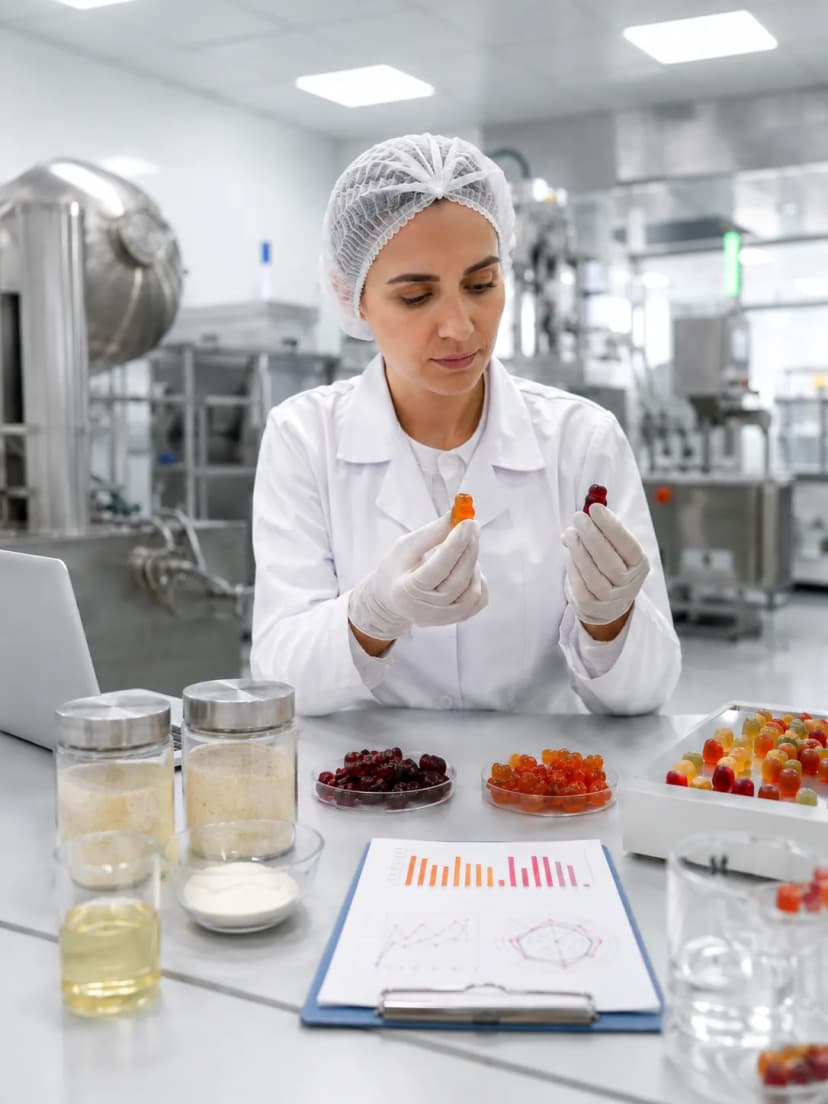
Unlike standard vitamin gummies, probiotic gummies demand strict environmental humidity control, temperature-managed starchless depositing, validated spore survival kinetics, and end-of-shelf-life CFU overage calculations. Sourcing managers must balance minimum order quantities (MOQs) against cash flow, while ensuring that the selected Contract Manufacturing Organization (CMO) maintains global regulatory compliance (US FDA 21 CFR 111, NSF/ANSI 455-2, GMP, Halal, and ISO 22000).
This procurement guide breaks down exact industry MOQ thresholds, tiered price curves, cost-driver variables, and a comprehensive landed cost comparison between Indian export facilities and domestic US/European manufacturers.
1. Typical MOQs for Probiotic Gummies by Format & Packaging
Minimum Order Quantities in probiotic gummy contract manufacturing are dictated primarily by batch kettle capacity, continuous depositing line speeds, and packaging automation changeover costs.
┌─────────────────────────────────────────────────────────────────────────────────────────┐
│                     TYPICAL INDUSTRY MOQ THRESHOLDS (UNITS)                            │
├──────────────────────────────────────┬────────────────────┬─────────────────────────────┤
│ Packaging Format / Tier              │ Standard CMO MOQ   │ Probiota Agile MOQ Program │
├──────────────────────────────────────┼────────────────────┼─────────────────────────────┤
│ Pilot Validation Batch               │ 25,000 units       │ 10,000 – 15,000 units       │
│ Bulk Packed (Cartons / Liners)       │ 50,000 units       │ 25,000 units                │
│ Finished Bottles (60 Count)          │ 50,000 – 100,000   │ 30,000 – 50,000 units       │
│ Stand-Up Pouches / Doypacks          │ 75,000 – 100,000   │ 50,000 units                │
│ Custom Custom Molds / 3D Shapes      │ 150,000+ units     │ 75,000 units                │
└──────────────────────────────────────┴────────────────────┴─────────────────────────────┘
Key Factors Determining Your MOQ:
- Pectin vs. Gelatin Matrix: High-methoxyl (HM) and low-methoxyl (LM) citrus pectin slurries require precise continuous cooking cycles. Minimum batch sizes for high-shear cooking vessels typically start at 500 kg to 1,000 kg of finished gummy mass.
- Probiotic Strain Availability: Standard spore-formers like Bacillus coagulans or Bacillus subtilis carry standard pack sizes from primary strain fermenters, influencing initial formulation batch minimums.
- Custom Flavoring & Natural Color Systems: Clean-label botanical extracts (e.g., anthocyanins, beta-carotene, spirulina) often require minimum lot runs to prevent microbial contamination and cross-flavor residue.
2. Tiered Pricing Structures & Core Cost Drivers
Unit costs in probiotic gummy manufacturing follow an aggressive scale curve. The primary cost drivers fall into four distinct categories:
- Active Ingredient Loading & Overage: Because vegetative bacteria degrade under ambient heat and moisture, formulators must incorporate stable spore-forming strains (Bacillus coagulans) or apply a 15–25% input overage to guarantee label-claim CFU at the 24-month expiration mark.
- Gelling Agent Base (E440 Pectin vs. E441 Gelatin): 100% plant-based citrus pectin carries a slight raw material premium over porcine gelatin, but eliminates thermal melting in transit and opens global Halal, Kosher, and Vegan markets.
- Sugar vs. Sugar-Free Polyol Matrices: Formulations utilizing Maltitol, Erythritol, Allulose, or Soluble Tapioca Fiber (FOS) require specialized thermal evaporation controls to manage Brix levels ($\approx 78–82^\circ\text{Bx}$) and water activity ($a_w < 0.60$).
- Primary & Secondary Packaging: Induction-sealed HDPE/PET bottles with child-resistant caps, desiccants, and multi-ply foil barrier pouches protect probiotic hygroscopic stability.
3. Landed Cost Comparison: India NSF/ANSI 455-2 Facility vs. US Domestic CMO
To evaluate the total financial advantage of international contract manufacturing, brands must calculate Total Landed Cost (TLC), encompassing production COGS, third-party analytical testing, export freight (ocean/air), import tariffs, and customs clearance.
Comprehensive Cost Model (Example: 60-Count Bottle, 2 Billion CFU Bacillus coagulans + FOS Prebiotic)
| Cost Component (Per Bottle) | US Domestic CMO (50k Units) | Probiota India NSF Facility (50k Units) | US Domestic CMO (250k Units) | Probiota India NSF Facility (250k Units) |
|---|---|---|---|---|
| Gummy Base & Active CFU | $2.10 | $0.95 | $1.75 | $0.78 |
| Pectin & Natural Flavors | $0.55 | $0.28 | $0.45 | $0.22 |
| Bottle, Cap, Induction Seal & Label | $0.85 | $0.42 | $0.65 | $0.32 |
| cGMP QA, In-Process & Microbial Testing | $0.30 | $0.12 | $0.18 | $0.08 |
| Ocean Freight & Marine Insurance | $0.00 | $0.14 | $0.00 | $0.09 |
| US Customs Duty & Clearance (HS 2106.90) | $0.00 | $0.16 | $0.00 | $0.12 |
| Total Landed Cost Per Bottle | $3.80 | $2.07 | $3.03 | $1.61 |
| Net Cost Savings (%) | Baseline | -45.5% | Baseline | -46.9% |
4. Quality Assurance & Regulatory Verification Checklist
When contracting an overseas manufacturing partner, procurement leads must audit the following regulatory standards to guarantee seamless customs clearance and Amazon/retailer acceptance:
- US FDA Facility Registration & FEI Number: Active registration with US FDA food and dietary supplement directory.
- NSF/ANSI 455-2 Certification: The global gold standard for dietary supplement Good Manufacturing Practices (cGMP), incorporating 21 CFR Part 111 requirements.
- FSVP (Foreign Supplier Verification Program) Dossier: Validated Hazard Analysis, Standard Operating Procedures (SOPs), and Master Batch Records (MBRs).
- Finished Product Certificate of Analysis (COA): Heavy metals (Lead, Arsenic, Cadmium, Mercury via ICP-MS), microbial pathogen screen (USP <2021/2022>), and verified CFU count at release.
Frequently Asked Questions (FAQ)
What is the standard MOQ for private-label probiotic gummies?
Most commercial CMOs require 50,000 to 100,000 finished packaged bottles. Agile contract manufacturers with high-speed starchless depositing lines can accommodate pilot validation runs starting at 10,000 to 30,000 units.
How much lower are Indian landed manufacturing costs compared to the US?
Indian facilities certified under NSF/ANSI 455-2 and registered with the US FDA typically provide a 40% to 60% total landed cost advantage compared to US-based contract manufacturers, even after factoring in ocean freight, insurance, and import duties.
Do tiered price quotes include finished product stability and CFU testing?
Full-service contract manufacturers include in-process testing, release COAs, and water activity ($a_w$) verification in the base price. Accelerated stability testing and 24-month shelf-life verification protocols can be added to your custom master service agreement.
Ready to evaluate your product formulation or request a transparent tiered pricing quote? Explore our Private Label Probiotic Gummy Solutions or contact our scientific formulation team directly.
Recommended Manufacturing Solution
Explore our private label probiotic gummy manufacturing capabilities
Want to discuss your formulation?
Our experts help brands launch technically complex probiotic and functional gummies.