
Quality Control for Functional Botanicals: Ensuring Homogeneity in Gummy Suspensions
Quality Control for Functional Botanicals: Ensuring Homogeneity in Gummy Suspensions
When formulating a highly functional dietary supplement, the active ingredients—such as heavy botanical root extracts, medicinal mushrooms, or dense mineral isolates—present a massive physical challenge to the manufacturer.
Unlike a simple water-soluble Vitamin C powder, these dense botanicals are highly insoluble. They do not dissolve into the liquid gummy slurry; they must be physically suspended within it.
If a Contract Manufacturing Organization (CMO) lacks advanced engineering, the heavy botanicals will sink to the bottom of the holding tank. The result? The first 10,000 gummies produced will contain zero active ingredients, and the last 10,000 gummies will contain a massive, potentially toxic overdose.
This violates the FDA’s core mandate for Dosage Uniformity. Here is how elite CMOs engineer perfect homogeneity for functional botanical suspensions.
The Physics of Suspension: Stokes' Law
The settling of particles in a liquid is governed by Stokes' Law. The speed at which a heavy botanical particle sinks is dictated by:
- The size of the particle.
- The difference in density between the particle and the liquid.
- The viscosity (thickness) of the liquid.
To stop the botanical from sinking, the CMO must manipulate these variables through physical engineering.
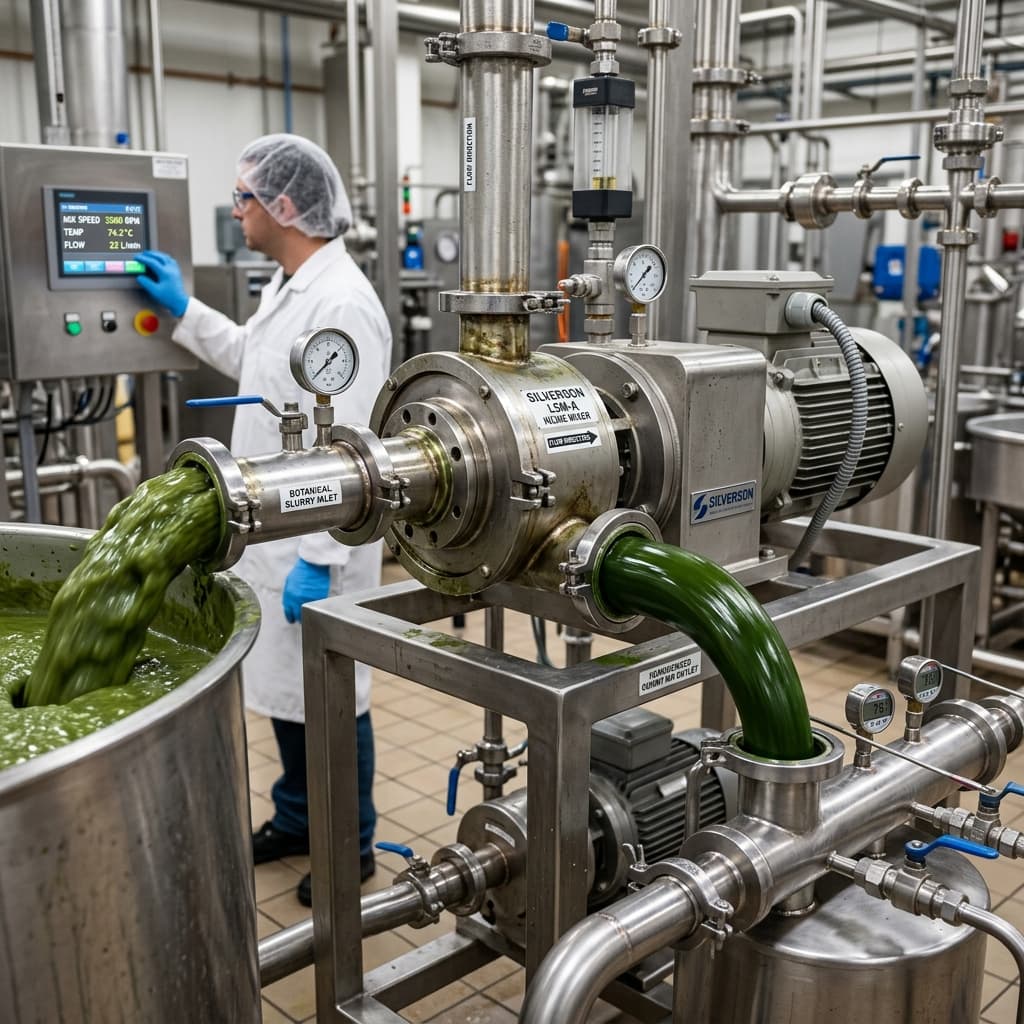
Solution 1: High-Shear Inline Mixing (Reducing Particle Size)
Legacy CMOs use massive holding tanks with slow-moving paddle mixers. A paddle mixer simply moves the liquid around; it cannot break apart clumps of heavy botanical powder.
The Advanced Solution: Elite CMOs utilize High-Shear Inline Mixers.
- Before the slurry reaches the depositing nozzles, it is pumped through a stator/rotor array spinning at thousands of RPMs.
- The intense mechanical shear literally tears the botanical clumps apart, pulverizing them into microscopic particles (microns in size).
- According to Stokes' Law, drastically reducing the particle size exponentially slows the rate at which it sinks, allowing it to remain perfectly suspended in the thick pectin matrix long enough to be deposited into the mold.
Solution 2: Rheology Control (Managing Viscosity)
The thicker the liquid (viscosity), the harder it is for a particle to sink through it.
High-Methoxyl (HM) Pectin is exceptionally useful for suspending heavy botanicals because it forms a highly viscous, robust matrix very quickly. However, loading a pectin slurry with a massive payload of insoluble mushroom powder drastically increases the viscosity, turning the liquid into a thick paste that can clog standard piping.
The Advanced Solution: The CMO must carefully manage the temperature of the continuous cooker. By holding the slurry at the precise optimal high temperature, the viscosity is kept just low enough to pump rapidly through the pipes, but high enough to prevent the microscopic botanical particles from settling out before the gummy sets in the mold.
Solution 3: Starchless Depositing (Speed and Precision)
Even with perfect high-shear mixing, gravity eventually wins. The faster the slurry moves from the mixing tank into the final gummy mold, the less time the botanical has to settle.
- Legacy Starch Moguls: Often rely on massive, slow-moving batch tanks where slurry sits for hours, increasing the risk of settling.
- Starchless Continuous Lines: Operate at extreme velocities. The botanical is injected via high-shear mixing, and seconds later, the pressurized manifold forces the perfectly homogeneous slurry into the silicone molds, locking the botanical particles in place as the gummy rapidly cools in the tunnel.
The QA Validation (Proving Homogeneity)
Under 21 CFR Part 111 cGMPs, the CMO must prove they achieved homogeneity.
During a commercial run, the Quality Assurance (QA) team will pull physical samples of the gummies at distinct intervals (e.g., from the beginning, middle, and end of the multi-hour run). These samples are sent to the HPLC lab. If the lab detects 50mg of Ashwagandha in the beginning sample, but 120mg in the end sample, the batch fails homogeneity and must be destroyed.
Partnering with a CMO like Probiota Innovations, equipped with high-shear engineering and continuous starchless depositors, is the only way brands can confidently launch heavily loaded, highly functional botanical gummies that meet rigorous FDA uniformity standards.
Frequently Asked Questions (FAQ)
1. Does microencapsulation help with suspension? Yes. Sometimes active ingredients (like fish oil or certain vitamins) are microencapsulated in a protective lipid coating. This not only masks bad flavors but can also alter the density of the particle, sometimes making it easier to suspend in the gummy matrix.
2. Why does my gummy look cloudy or opaque? A standard pectin gummy is highly translucent. When you add a clinical dose (e.g., 300mg) of an insoluble botanical powder, that powder physically blocks light from passing through the gummy, making it look matte or opaque. This is a sign of a heavily loaded functional product, not a defect.
3. Can all botanicals be suspended in a gummy? There are physical limits. If a brand requests 1,000mg of a dense, gritty botanical in a standard 3-gram gummy, the physical volume of the powder will overwhelm the pectin, causing the gummy to fall apart or become impossible to chew. The CMO will usually recommend increasing the serving size (e.g., to 3 or 4 gummies) to distribute the payload safely.
Recommended Manufacturing Solution
Want to discuss your formulation?
Our experts help brands launch technically complex probiotic and functional gummies.