FTIR and HPLC: Why Supplier COAs Are Not Enough for GMP Gummy Compliance
FTIR and HPLC: Why Supplier COAs Are Not Enough for GMP Gummy Compliance
The most frequent and devastating violation cited by the FDA during facility audits (resulting in Form 483s and Warning Letters) is a failure to properly verify the identity of incoming raw materials.
Many amateur Contract Manufacturing Organizations (CMOs) operating on razor-thin margins engage in a highly illegal practice known as "dry-labbing." When a barrel of raw material arrives from overseas, they simply look at the piece of paper taped to the barrel—the supplier's Certificate of Analysis (COA)—assume it is accurate, and dump the powder into the mixing tank.
Under 21 CFR Part 111, relying solely on a supplier's COA for identity verification is illegal. Here is why elite CMOs ignore the paper and rely on hard physics (FTIR and HPLC) to protect their private label brands.
The Epidemic of "Economically Motivated Adulteration"
The global botanical supply chain is fraught with fraud.
If a brand wants to formulate a premium gummy with expensive Panax Ginseng, unscrupulous suppliers might cut the Ginseng with cheap maltodextrin, or worse, substitute it entirely with a cheaper, unstudied root that looks and tastes similar. They will then forge a beautiful, official-looking COA claiming the barrel is 100% pure Ginseng.
If the CMO doesn't catch it, the brand owner sells a fake product, destroying consumer trust and inviting catastrophic FDA enforcement.
Step 1: FTIR (The Molecular Fingerprint)
To comply with federal law, the CMO must conduct at least one specific test to verify the Identity of every single dietary ingredient before it is used. The gold standard for this is Fourier Transform Infrared Spectroscopy (FTIR).
- The Process: A QA technician pulls a sample from the quarantined barrel and places it on the FTIR sensor. The machine blasts the powder with infrared light.
- The Absorption Spectrum: Different molecular bonds absorb infrared light at different frequencies. The machine generates a highly complex graph (an absorption spectrum) representing the unique molecular bonds of the powder.
- The Verification: The software compares this graph against a known, verified library standard of pure Panax Ginseng. If the "fingerprint" does not match perfectly, the barrel is rejected, regardless of what the supplier's paper COA claims.
Step 2: HPLC (Quantifying the Payload)
While FTIR confirms that the powder is Ginseng, it does not confirm the strength or purity of the active compounds.
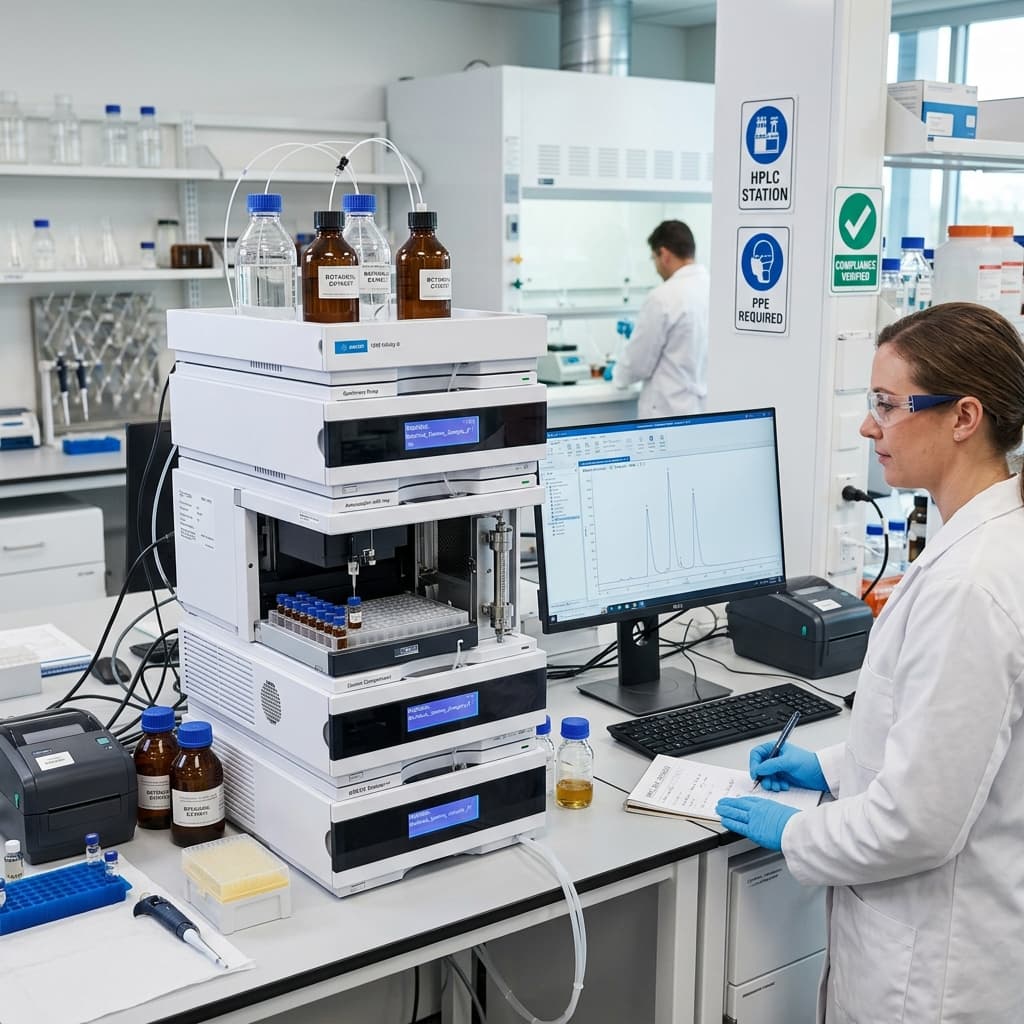
If your gummy label claims "50mg of Ginsenosides" (the active compound in Ginseng), the CMO must verify that the raw material actually contains that high concentration. This requires High-Performance Liquid Chromatography (HPLC).
- The Process: The raw botanical is dissolved in a solvent and pumped at extremely high pressure through a column packed with adsorbent material.
- The Separation: The different chemical compounds in the botanical interact differently with the material in the column, causing them to separate and exit the machine at different times.
- The Quantification: A UV detector reads the separated compounds, allowing the chemist to pinpoint and calculate the exact percentage of Ginsenosides present in the raw material.
If the HPLC determines the extract only contains 2% Ginsenosides instead of the 5% promised by the supplier, the CMO must either reject the batch or adjust the Master Manufacturing Record (MMR) to dose a higher volume of the powder to ensure the finished gummy meets the label claim.
The Cost of Compliance
Maintaining a fully equipped analytical lab with FTIR and HPLC machines, operated by degreed chemists, is incredibly expensive. This is why cheap, non-compliant CMOs skip this step.
However, for a brand owner, partnering with a CMO that rigorously executes these analytical tests is the only way to guarantee that the premium gummies you sell are safe, effective, and legally unassailable.
Frequently Asked Questions (FAQ)
1. Does the FDA require identity testing on inactive ingredients (excipients)? Yes. While the FDA requires 100% identity testing for dietary ingredients (the actives), they also require manufacturers to qualify and test their inactive ingredients (like pectin, citric acid, and flavorings) to ensure they are the correct substance and free from contamination.
2. What is Third-Party Testing? While the CMO should do inbound FTIR/HPLC testing, many premium brands also pay an independent, ISO-accredited "Third-Party" lab to test the finished gummies before they are released to the public. This provides a secondary layer of unassailable proof that the product meets label claims.
3. Can I sue a supplier for a fake COA? It is extremely difficult, especially if the supplier is based overseas. The FDA holds the US-based brand owner and the US-based CMO responsible for the safety of the product, regardless of supplier fraud. The only defense is rigorous inbound testing.
Recommended Manufacturing Solution
Discover regulatory-compliant nutraceutical contract manufacturing
Want to discuss your formulation?
Our experts help brands launch technically complex probiotic and functional gummies.