Minimum Order Quantities in Probiotic and Functional Gummy Manufacturing

Minimum Order Quantities in Probiotic and Functional Gummy Manufacturing
When negotiating a manufacturing contract for a standard Vitamin C gummy, the Minimum Order Quantity (MOQ) is usually straightforward, dictated primarily by the physical size of the CMO’s mixing tanks.
However, when a brand shifts to Probiotic or highly Functional Gummies (loaded with postbiotics, nootropics, or advanced botanicals), the MOQ discussion changes entirely. Brands often experience "sticker shock" when a CMO demands a much higher MOQ for a functional gummy compared to a basic vitamin gummy.
Here is the commercial and technical explanation for why functional gummies carry unique MOQ requirements.
1. The Cost of Clean-In-Place (CIP) Validation
Functional ingredients are volatile. If a CMO runs a gummy loaded with 500mg of KSM-66® Ashwagandha, the sticky, highly potent botanical resin coats the interior of the stainless steel pipes, the holding tanks, and the depositing nozzles.
If the CMO’s next run is a children's multivitamin, they must guarantee that zero traces of Ashwagandha cross-contaminate the children's line.
- The Regulatory Hurdle: To prove this to the FDA, the CMO cannot just rinse the equipment; they must execute a validated Clean-In-Place (CIP) protocol, swabbing the equipment and testing the swabs in the lab to prove complete eradication of the functional ingredient.
- The Commercial Impact: This intensive CIP process can stall a multi-million-dollar manufacturing line for 8 to 12 hours. The CMO must enforce a massive MOQ (e.g., 50,000 to 100,000 bottles) to ensure the revenue from the run justifies the massive downtime required to clean it up.
2. Raw Material Minimums (The Supplier Bottleneck)
Often, the CMO is not the bottleneck; the raw material supplier is.
Premium functional ingredients—like patented postbiotic strains, specialized chelated minerals, or branded nootropic extracts—are not sold in small quantities. A raw material supplier might require the CMO to purchase a minimum of 250 kilograms of the branded ingredient.
- If your formulation only calls for 50mg of that ingredient per gummy, 250 kilograms is enough to manufacture millions of gummies.
- The CMO cannot absorb the cost of the unused raw material. Therefore, they must enforce a massive finished-product MOQ on the brand owner to consume the minimum volume dictated by the raw material supplier.
3. The Precision of Starchless Manufacturing
Functional gummies require precision. A standard legacy starch mogul cannot reliably handle high-viscosity botanical slurries or guarantee the precise dosing required for clinical probiotic claims.
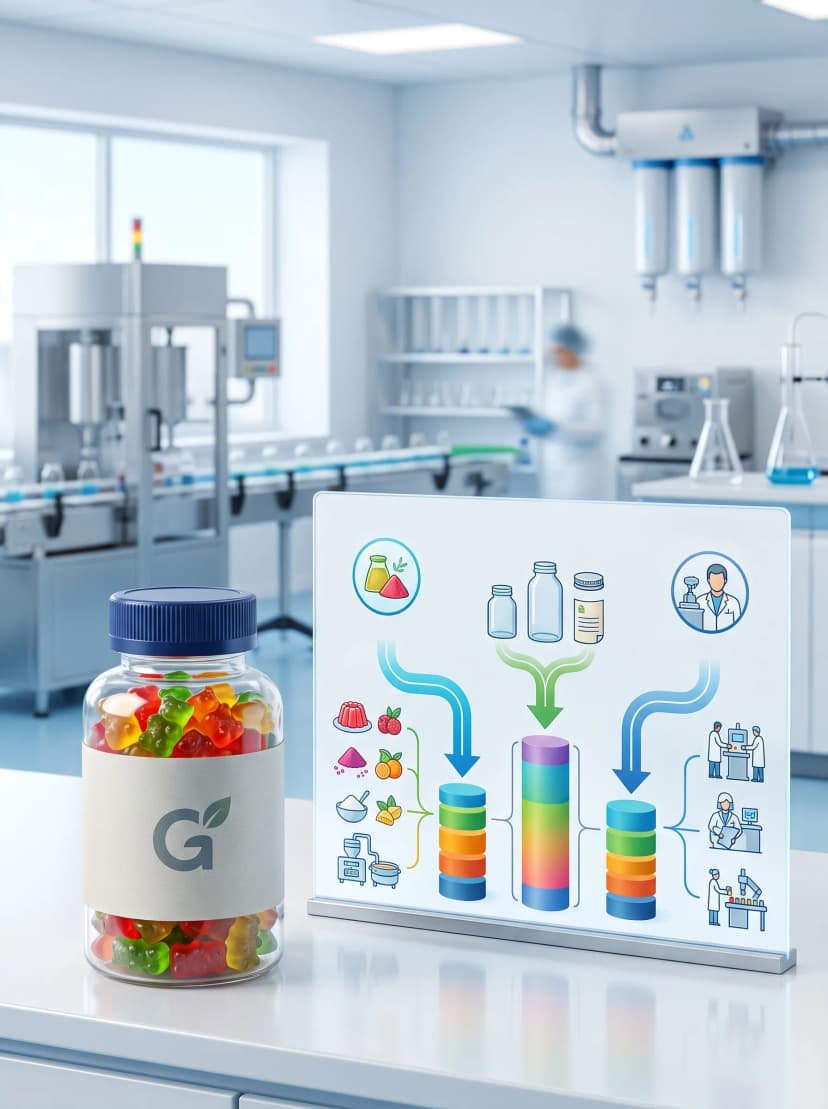
Functional gummies must be manufactured on advanced Starchless Mogul Technology.
- The Commercial Reality: Starchless lines are high-speed, hyper-efficient machines engineered for massive global brands. They are designed to run continuously for days. Starting a starchless line to produce just 5,000 bottles is like chartering a Boeing 747 to fly across town. The fixed overhead costs of operating the line demand a high MOQ to achieve profitable unit economics.
Strategic Navigation for Brands
If you are launching a highly functional, custom gummy, do not view a high MOQ as a barrier; view it as a filter. A CMO offering a 5,000-bottle MOQ for a custom probiotic gummy is likely cutting corners on mixing homogeneity, QA testing, or CIP sanitation—putting your brand at massive regulatory risk.
Partner with a CMO like Probiota Innovations that operates transparently. We explain the economics of our starchless lines and the realities of raw material sourcing, helping brands map their capital deployment to achieve safe, compliant, and highly profitable scale.
Frequently Asked Questions (FAQ)
1. Can I pay a setup fee to lower the MOQ? Sometimes. Some CMOs will allow you to run a smaller batch if you agree to pay a substantial "line setup and CIP fee" (often $5,000 to $10,000) to cover their downtime. However, this drastically increases your per-bottle Cost of Goods Sold (COGS).
2. Is the MOQ lower for postbiotics compared to live probiotics? Usually, yes. Live probiotics require highly specialized, segregated handling and massive overages to survive, which drives up MOQs. Postbiotics are inanimate and highly stable, making them easier to integrate into standard high-volume pectin runs.
3. Does the shape of the gummy affect the MOQ? Yes. If you request a custom 3D shape (e.g., a logo or a unique mascot), the CMO must machine custom silicone molds for the entire starchless line. This capital expense requires a massive MOQ (often 250,000+ bottles) to amortize the cost of the tooling.
Recommended Manufacturing Solution
Explore our private label probiotic gummy manufacturing capabilities
Want to discuss your formulation?
Our experts help brands launch technically complex probiotic and functional gummies.