
The Science of Gummy Polishing: Preventing Clumping in High-Humidity Climates
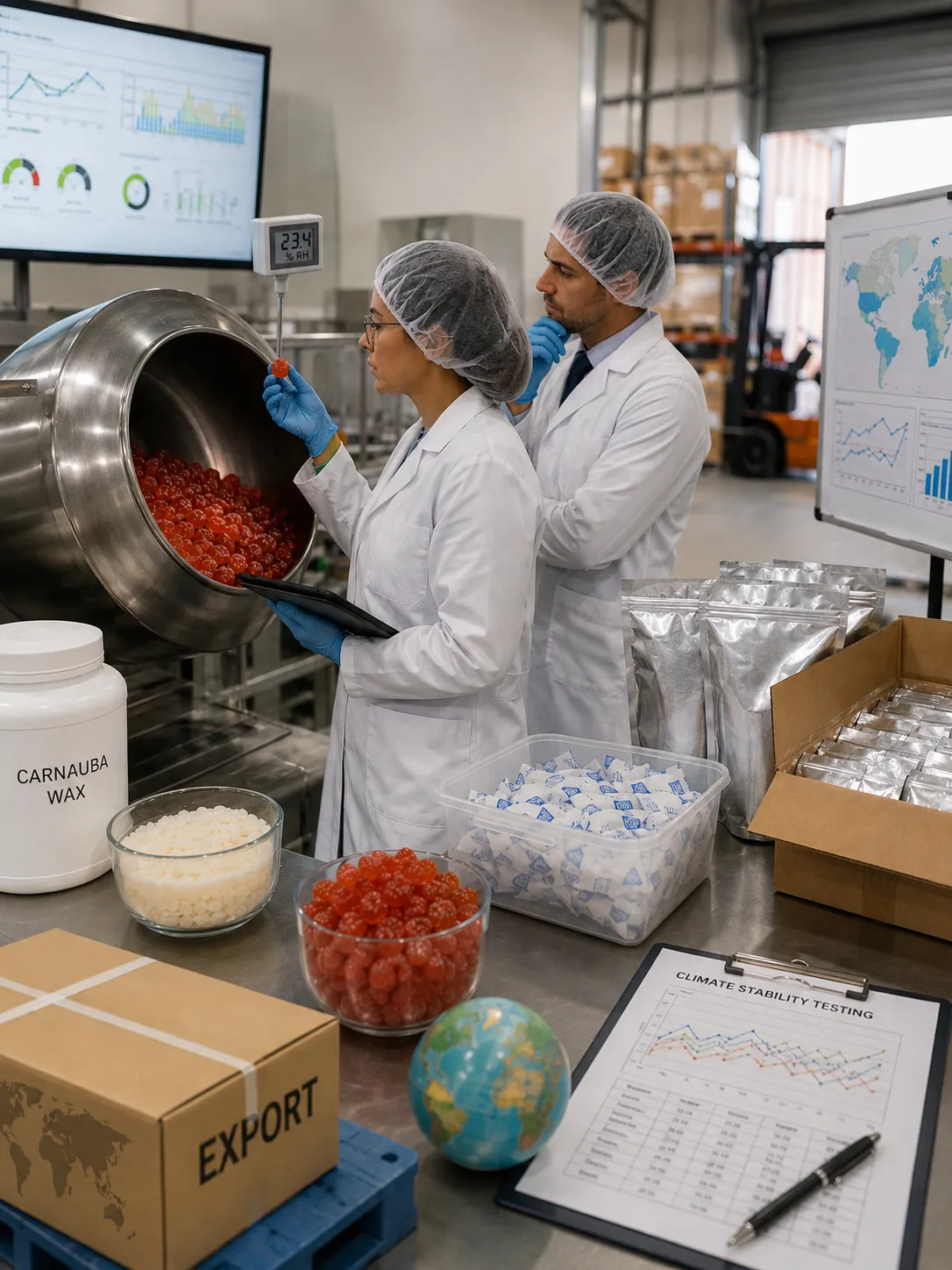
The Science of Gummy Polishing: Preventing Clumping in High-Humidity Climates
For a commercial gummy manufacturer, the actual "cooking" of the gummy is often the easiest part of the process. The true test of manufacturing excellence occurs after the gummy has been demoulded and cured. This final stage - the polishing or coating phase - dictates whether the product will survive the global supply chain or arrive as a useless, fused brick of sugar and pectin.
This challenge is magnified exponentially when exporting to high-humidity climates like Southeast Asia (Singapore, Malaysia), the Gulf region during summer (Dubai, Qatar), or the American South (Florida, Texas). In these environments, ambient moisture relentlessly attacks the surface of the gummy.
If you are a supplement brand experiencing clumping issues, or a founder preparing for international export, understanding the intense science behind gummy polishing is mandatory.
1. Why Do Gummies Clump? The Physics of Hygroscopy
To solve clumping, you must understand why it happens. Both gelatin and pectin gummies contain significant amounts of sugar, glucose syrup, or soluble fibers. These ingredients are highly hygroscopic - meaning they actively attract and absorb water molecules from the surrounding air.
When a gummy absorbs moisture, its surface becomes tacky. If multiple tacky gummies are compressed inside a retail bottle, they fuse together.
The Curing Prerequisite
Before polishing can even begin, the manufacturer must ensure the gummy has been properly cured. Curing is the process of drying the gummy in a climate-controlled room until it reaches a specific Water Activity (aw), typically between 0.55 and 0.65. If a manufacturer attempts to polish an under-cured gummy (one that still holds too much internal moisture), the moisture will eventually migrate to the surface underneath the polish, rendering the coating useless and causing catastrophic clumping in the bottle.
2. The Oil Polish: Carnauba Wax and MCT Blends
The most common method for preventing clumping in premium, modern functional gummies is an oil and wax polish. This provides a beautiful, translucent shine and a highly effective moisture barrier.
The Mechanism of Action
The gummies are tumbled in a massive rotating drum (often ribbed or baffled to ensure even distribution). A highly calibrated mist of polishing agent is sprayed onto the tumbling mass. This agent is typically a proprietary blend of:
- A Carrier Oil: Usually Medium-Chain Triglyceride (MCT) oil or refined sunflower oil. This allows the wax to spread evenly.
- A Hard Wax: Carnauba wax (derived from palm leaves) is the gold standard for vegan pectin gummies, though beeswax is sometimes used for gelatin.
Surviving High Humidity
Carnauba wax is incredibly hard and highly hydrophobic (water-repelling). When a micro-thin layer of carnauba wax completely encases the gummy, it seals the hygroscopic sugars inside. Even if the ambient humidity in a Miami warehouse reaches 90%, the moisture cannot penetrate the wax shell.
The Manufacturer's Tightrope
Applying this polish is an act of extreme precision:
- Too Little: The wax barrier is incomplete. The gummies will eventually stick together in hot climates.
- Too Much: The gummies become greasy. The excess oil pools at the bottom of the bottle and rapidly oxidizes (goes rancid), destroying the flavour profile and causing customer complaints.
Learn about Vegan & Pectin Gummies
3. Sanding: The "Sacrificial" Barrier
If a brand is exporting to extremely hostile, high-humidity environments and wants absolute certainty against clumping, "sanding" is the ultimate defensive strategy.
Sugar Sanding
Instead of an oil polish, the gummies are tumbled in fine-grain crystalline sucrose. The sugar crystals adhere to the tacky surface of the gummy, creating a physical barrier.
- How it Defeats Humidity: In a high-humidity environment, the sugar crystals act as a sacrificial layer. They will absorb ambient moisture before the actual gummy matrix does. While the sugar coating may become slightly sticky over time, the physical crystals prevent the gummies from fusing into a solid block.
Sour Dusting (The Danger Zone)
Brands often request a sour-dusted coating (sugar mixed with Citric or Malic acid) for flavour masking. Warning: Sour dusting is highly dangerous in high-humidity climates. Citric acid is intensely hygroscopic. It will aggressively pull moisture out of the air and out of the gummy itself, causing the gummy to "weep" (sweat) and turn into a sticky sludge. If a sour dusting is required for export, the manufacturer must use micro-encapsulated acids to prevent this chemical reaction.
Explore Export-Ready Manufacturing
4. The Role of Packaging in High Humidity
Even the most perfectly polished gummy will eventually succumb to 100% humidity if left exposed. The polish is the first line of defense; the packaging is the fortress.
For export to tropical or Gulf climates, standard PET bottles with basic screw caps are insufficient.
- Induction Sealing: Every bottle must feature a foil induction seal. This creates a hermetic, airtight barrier that physically blocks ambient warehouse humidity from entering the bottle before it is opened by the consumer.
- Desiccants: Including a food-grade silica gel pack inside the bottle absorbs any residual moisture trapped during the packaging process and helps maintain the internal micro-climate after the consumer opens the seal.
FAQ
Can I use a sugar-free sanding for humid climates? Yes. You can sand gummies with crystallized sugar alcohols like Erythritol. However, Erythritol has a distinct "cooling" effect on the palate and can still absorb moisture over time, though generally less aggressively than standard sugar.
Why did my gummies clump even though they were oiled? If they were properly oiled and still clumped, the manufacturer likely failed the curing phase. The gummies were packaged with an internal Water Activity (aw) that was too high. The moisture migrated from the center of the gummy to the surface, breaking through the oil barrier and causing the sugars to fuse.
Is Carnauba wax safe for daily consumption? Yes. Carnauba wax is a natural, plant-derived ingredient (E903) recognized as safe by all major global food authorities (FDA, EFSA, FSANZ). It is used in microscopic quantities - often representing less than 0.2% of the gummy's total weight.
Engineer Your Gummies for the Real World
Formulating a great-tasting gummy in an air-conditioned laboratory is easy. Engineering a gummy that maintains its texture, shape, and separation after sitting in a shipping container crossing the equator is a feat of advanced manufacturing science.
At Probiota Innovations, we specialize in high-stability, export-ready formulations. Our proprietary curing protocols and precision Carnauba wax polishing systems ensure that your premium pectin gummies arrive in perfect condition, whether they are being shipped to London, Los Angeles, or Dubai.
Request a Project Brief Explore Functional Gummy Manufacturing
Recommended Manufacturing Solution
Build your next product with our expert gummy formulation team
Want to discuss your formulation?
Our experts help brands launch technically complex probiotic and functional gummies.