BioFresh™ Municipal Sewage & Lift Station Ammonia Elimination: Biological Nitrification Case Studies
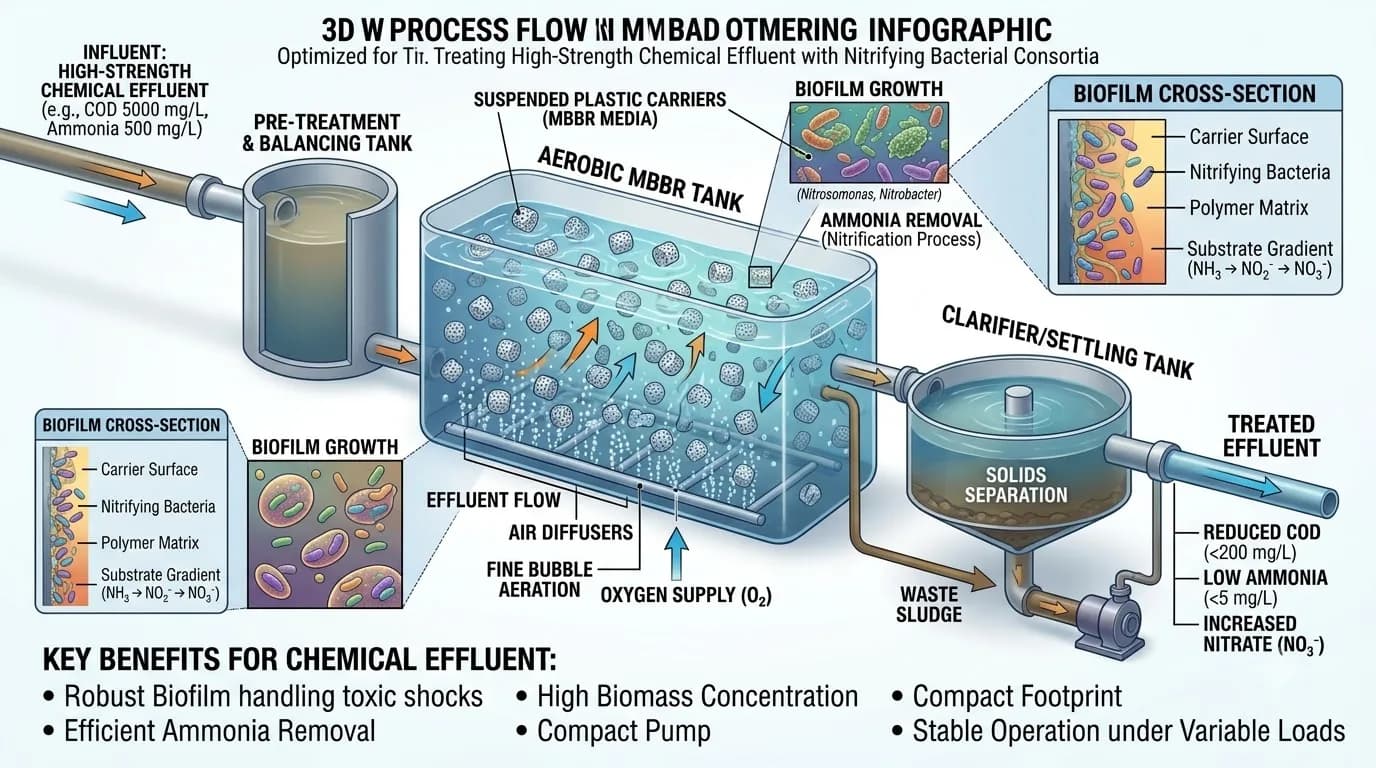
Key Takeaway / Executive Summary (Position 0): BioFresh™ biological ammonia elimination utilizes an autotrophic nitrifying consortium (Nitrosomonas europaea and Nitrobacter) combined with robust organic-degrading Bacillus strains to oxidize dissolved ammonia ($\text{NH}_3\text{-N}$) and hazardous volatile organic malodors in municipal sewage networks and wastewater lift stations. Real-world municipal case studies demonstrate $> 75%$ ammonia reduction within 72 hours and complete restoration of biological nitrification without hazardous chemical dosing.
Municipal wastewater authorities, industrial effluent managers, and sanitation engineers face escalating environmental fines and community complaints driven by ammonia off-gassing and volatile sulfur malodors generated in sewer lift stations, equalization basins, and sludge holding tanks.
When raw municipal sewage sits in collection wet wells under low dissolved oxygen (DO) conditions, urease-positive bacteria decompose urea and proteins into free aqueous and gaseous ammonia ($\text{NH}_3$), while sulfate-reducing bacteria generate highly toxic hydrogen sulfide ($\text{H}_2\text{S}$).
Traditional mitigation relies on chemical oxidizers (hydrogen peroxide, sodium hypochlorite, ferric chloride, or caustic soda). However, chemical addition is hazardous, corrosive to infrastructure, expensive, and frequently kills off downstream activated sludge biomass.
Developed by Probiota Innovations, BioFresh™ provides a proven biological alternative. This technical case-study report reviews the enzymatic nitrification kinetics, municipal deployment protocols, and real-world field validation data across municipal sewage lift stations and wastewater treatment facilities.
1. The Biochemistry of Biological Ammonia Oxidation
BioFresh™ restores and accelerates the two-step biological nitrification process directly within sewer infrastructure:
graph LR
    A[Toxic Dissolved Ammonia NH3 / NH4+] -->|Nitrosomonas europaea AMO + HAO Enzymes| B[Intermediate Nitrite NO2-]
    B -->|Nitrobacter / Nitrococcus NXR Enzyme| C[Harmless Non-Volatile Nitrate NO3- & Water]
    D[Organic Grease & Sludge Matrix] -->|Bacillus Multi-Enzymes Protease/Lipase| E[Solubilized Nutrients & Biofilm Digestion]
1. Step 1: Ammonia Oxidation to Nitrite (Nitritation)
$$2\text{NH}_3 + 3\text{O}_2 \xrightarrow{\text{Nitrosomonas AMO/HAO}} 2\text{NO}_2^- + 2\text{H}^+ + 2\text{H}_2\text{O} \quad (\Delta G^\circ = -274.7,\text{kJ/mol})$$
2. Step 2: Nitrite Oxidation to Nitrate (Nitratation)
$$2\text{NO}_2^- + \text{O}_2 \xrightarrow{\text{Nitrobacter NXR}} 2\text{NO}_3^- \quad (\Delta G^\circ = -74.1,\text{kJ/mol})$$
By introducing active, high-density autotrophic nitrifiers along with extracellular-enzyme-secreting Bacillus strains, BioFresh™ converts noxious volatile gases into non-volatile, odorless nitrates while digesting the thick organic grease blankets that shelter anaerobic, odor-producing microbes.
2. Field Case Study: High-Traffic Municipal Sewage Lift Station
┌─────────────────────────────────────────────────────────────────────────────────────────┐
│                 CASE STUDY 1: MUNICIPAL SEWAGE WET WELL & LIFT STATION                  │
├──────────────────────────────┬──────────────────────────────────────────────────────────┤
│ Facility Location            │ Urban Municipal Transit District Wet Well ($120\,\text{m}^3$ daily flow)│
│ Baseline Challenge           │ Severe ambient $\text{NH}_3$ ($> 85\,\text{PPM}$) & heavy FOG grease crust│
│ Treatment Protocol           │ Automated metered shock dose of BioFresh™ ($10\,\text{L}$) followed by │
│                              │ continuous maintenance dosing ($1.5\,\text{L/day}$)      │
│ Deployment Equipment         │ Low-pressure aeration tube + peristaltic dosing pump     │
└──────────────────────────────┴──────────────────────────────────────────────────────────┘
Measured Performance Timeline:
| Operational Milestone | Influent Ammonia ($\text{NH}_3\text{-N}$) | Headspace Air $\text{NH}_3$ (PPM) | Grease Cap Thickness | Community Odor Complaints |
|---|---|---|---|---|
| Day 0 (Baseline) | $64.5,\text{mg/L}$ | $88.0,\text{PPM}$ (Severe Hazard) | $35,\text{cm}$ Solid Crust | 18 Complaints / Week |
| Day 2 (48 Hours) | $38.2,\text{mg/L}$ | $21.5,\text{PPM}$ (-75.5%) | $18,\text{cm}$ (Softening) | 2 Complaints |
| Day 5 (120 Hours) | $14.8,\text{mg/L}$ | $4.0,\text{PPM}$ (-95.4%) | $< 5,\text{cm}$ Emulsified | Zero Complaints |
| Day 30 (Maintenance) | $< 8.5,\text{mg/L}$ | $< 1.0,\text{PPM}$ (Background) | Zero Grease Accumulation | Zero Complaints |
3. Comparison: Chemical Dosing vs. BioFresh™ Biological Bioremediation
| Operational Dimension | Chemical Scavengers (Caustic / Bleach / Iron) | BioFresh™ Biological Bioremediation |
|---|---|---|
| Operating Mode | Continuous high-volume chemical consumption | Self-replicating biological colonization |
| Ammonia Destruction | Temporary masking / precipitation | Complete biological oxidation to nitrate |
| Grease & Biofilm Removal | None (FOG continues to accumulate) | Actively digests grease blankets & scale |
| Infrastructure Impact | Highly corrosive to concrete & pumps | 100% Non-corrosive; protects equipment |
| Worker Safety Hazards | Toxic chemical fumes, eye/skin burn risk | Biosafety Level 1 (BSL-1); 100% Non-Toxic |
| Downstream Plant Impact | Disrupts biological wastewater kinetics | Enhances downstream activated sludge |
| Total Operating Cost | High recurring chemical purchase costs | 40% to 60% lower total operating expense |
4. Engineering Deployment & Technology Transfer Licensing
BioFresh™ is supplied as a concentrated biological liquid or stabilized dry microbial powder ready for municipal and industrial scaling:
- Dosing Optimization: Standard continuous dosing rates range from $5\text{ to }20,\text{mg/L}$ of influent flow, tailored to biological oxygen demand (BOD) and nitrogen loads.
- Turnkey Technology Transfer: Probiota Innovations provides municipal contractors, regional sanitation utilities, and environmental engineering CDMOs with complete master strain cultures, fermentation scale-up SOPs, and field application dossiers under international technology licensing agreements.
Frequently Asked Questions (FAQ)
How rapidly does BioFresh™ reduce ammonia levels in sewage systems?
In documented municipal lift station deployments, BioFresh™ achieves a measurable $70%\text{ to }80%$ reduction in headspace ammonia ($\text{NH}_3$) within 48 to 72 hours, with complete odor elimination maintained under continuous maintenance dosing.
Does BioFresh™ function effectively during seasonal temperature fluctuations?
Yes. The specialized Nitrosomonas and Bacillus strains in BioFresh™ maintain active metabolic nitrification across a broad water temperature range from $12^\circ\text{C}$ to $42^\circ\text{C}$ ($53–108^\circ\text{F}$), with customized cold-weather microbial blends available for temperate winter climates.
Is the BioFresh™ technology available for municipal and commercial out-licensing?
Yes. Probiota Innovations licenses the proprietary BioFresh™ consortium formulation, fermentation recipes, and field engineering dossiers to environmental contractors, municipal utilities, and CDMOs globally.
Interested in piloting BioFresh™ for municipal wastewater or licensing the bioremediation technology? Explore our Biotechnology Transfer & Licensing Solutions or request an engineering technical dossier.
Recommended Manufacturing Solution
Request data room access for our proprietary microbial technologies
Want to discuss your formulation?
Our experts help brands launch technically complex probiotic and functional gummies.