
Preventing Gummy Syneresis (Weeping): Advanced Formulation Strategies for Hot Climates
Preventing Gummy Syneresis (Weeping): Advanced Formulation Strategies for Hot Climates
In the high-stakes world of international nutraceutical export, there is no failure more visually disastrous or commercially devastating than syneresis.
A brand ships a container of beautifully formed, translucent functional gummies from their Contract Manufacturing Organization (CMO). When the container arrives in a hot, humid market like Dubai, Sydney, or Miami, the bottles are opened to reveal a sticky, fused, unmarketable mass.
The gummies have "wept." This phenomenon is known in polymer chemistry as syneresis. Preventing gummy syneresis is arguably the most critical benchmark separating amateur manufacturers from elite global exporters.
This guide dissects the thermodynamics of syneresis and the advanced gummy weeping solutions required to guarantee gummy stability hot climates.
What is Syneresis?
Syneresis is the expulsion or extraction of a liquid from a gel.
In a gummy matrix, the hydrocolloid (pectin or gelatin) forms a 3-dimensional, microscopic sponge-like network that traps water and dissolved sugars inside. Under certain physical or chemical stresses, this network contracts or collapses, physically squeezing the free water out to the surface of the gummy.
The Commercial Impact
When a gummy weeps, the expelled moisture dissolves the outer coating (whether it is an oil polish or a sugar sanding). The surface becomes incredibly sticky, causing all the gummies in the bottle to fuse into a single block. Furthermore, the expelled water creates a high Water Activity (aw) micro-environment on the surface, making the gummy highly susceptible to rapid mold growth.
The Primary Causes of Export Gummy Syneresis
To implement fixing sticky gummies strategies, a brand must understand why the gel network collapsed.
1. pH Imbalance (The Acid Shock)
In vegan, pectin-based gummies, the gel network is formed by dropping the pH using an acid (like Citric Acid).
- The Flaw: If the formulator adds too much acid (dropping the pH below the critical 3.2 threshold), the pectin chains bond too aggressively. The gel network contracts too tightly, shrinking in volume and violently squeezing the moisture out of the matrix.
2. Sugar Crystallization (Graining)
If the ratio of sugars in the gummy is unbalanced (e.g., using too much sucrose and not enough glucose syrup), the sucrose will attempt to return to its solid, crystalline state over time.
- The Flaw: As these hard sugar crystals grow inside the soft gel matrix, they act like microscopic razors, tearing the fragile pectin network apart and allowing the trapped water to escape to the surface.
3. Thermal Cycling (The Logistics Nightmare)
This is the leading cause of syneresis in export gummy syneresis scenarios.
- The Flaw: As a shipping container crosses the ocean or sits in a port, it undergoes massive temperature fluctuations—scorching hot during the day, cold at night.
- As the gummy heats up, the matrix expands and the solubility of the sugars changes. As it cools rapidly, the matrix contracts. This continuous pumping action (thermal cycling) fatigues the gel network, eventually forcing moisture to the surface.
Advanced Formulation Strategies for Hot Climates
Preventing syneresis requires building a thermodynamic fortress. Elite CMOs employ specific, highly technical interventions.
1. Precision Buffering
To prevent the acid from shocking the pectin and causing a too-tight network, formulators use buffers, primarily Sodium Citrate. Sodium citrate slows the pH drop, giving the pectin chains time to align smoothly and form a relaxed, highly elastic matrix that securely holds moisture without contracting.
2. The Doctoring Ratio (Sugar Management)
To prevent crystallization and the subsequent tearing of the gel network, the formulator must optimize the "doctoring ratio." This involves balancing sucrose with interfering agents like glucose syrup. In sugar-free matrices, it means carefully blending highly soluble polyols (like Maltitol) with long-chain soluble fibers (like FOS or Polydextrose) to prevent the polyols from crystallizing under thermal stress.
3. High-Methoxyl Pectin Dominance
Gelatin gummies are highly susceptible to syneresis in hot climates because gelatin simply melts when temperatures approach 35°C, completely releasing all trapped moisture. Exporting to hot climates mandates the use of High-Methoxyl (HM) Pectin. Because HM pectin is thermo-irreversible, the gel network does not melt or significantly expand/contract under intense heat (up to 60°C), drastically reducing the impact of thermal cycling during ocean freight.
Prove Your Stability with Probiota Innovations
At Probiota Innovations, we do not hope your gummies survive the journey; we prove it in the lab.
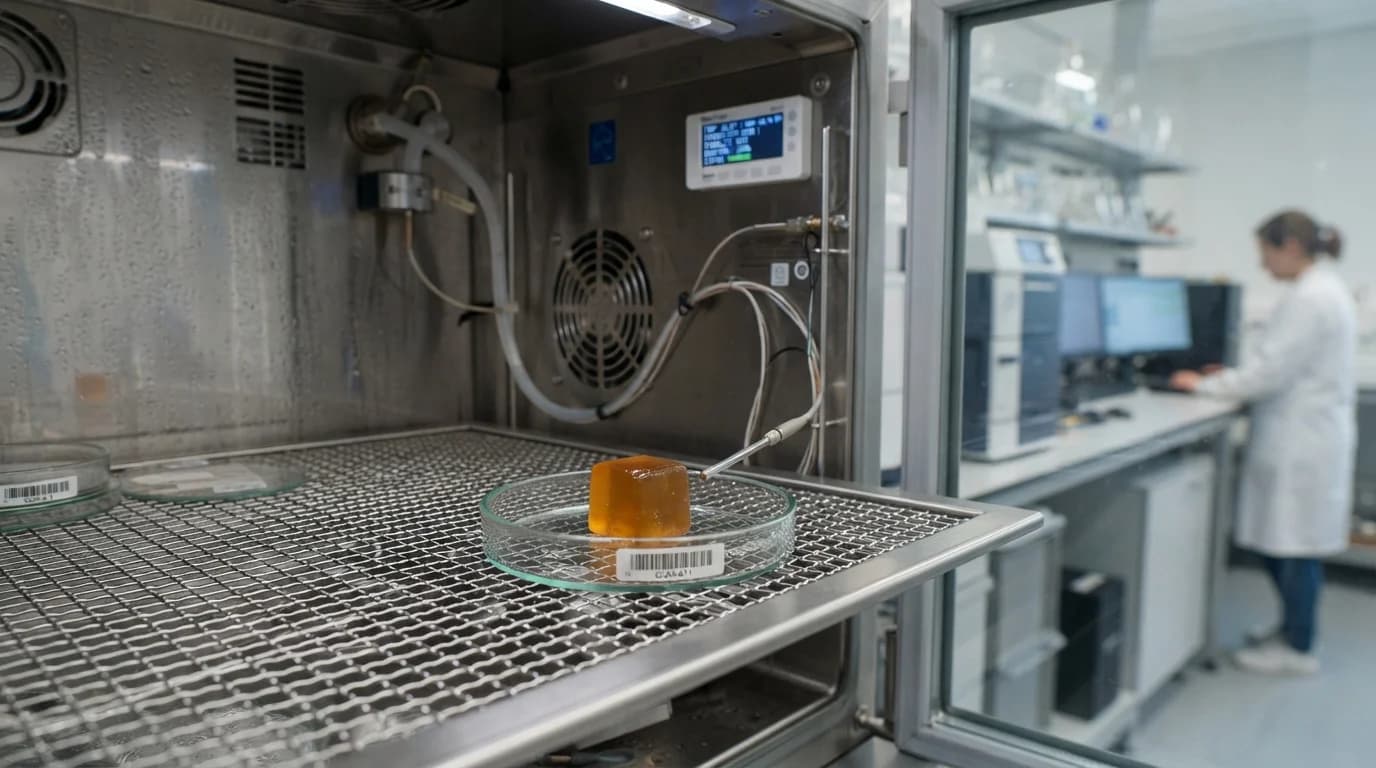
Our world-class facility is equipped with ICH-compliant climatic chambers. We subject every export formulation to grueling Accelerated Stability Testing (40°C / 75% RH for 6 months) to simulate the thermal shock of global logistics. By mastering precise pH buffering and advanced pectin polymer science, we guarantee your functional gummies will arrive in the harshest climates flawlessly formed, perfectly dry, and ready for retail dominance.
Explore our Advanced Stability Testing and QA Capabilities
Frequently Asked Questions (FAQ)
1. Is "sweating" the same as syneresis? Yes, in the industry vernacular, sweating and weeping are colloquial terms for syneresis. It is the visible manifestation of the gel network failing and expelling moisture.
2. Can I fix syneresis by just adding more carnauba wax to the outside of the gummy? No. While oil and wax polishing provides a temporary barrier, it cannot stop a collapsing gel network. If the syneresis is severe, the expelled water will push right through the wax layer, resulting in a gummy that is both sticky and greasy. The fix must happen internally in the formulation.
3. Does high humidity cause syneresis? High ambient humidity can exacerbate the problem, but it is technically a different mechanism. If a gummy has a low Water Activity but is placed in a high-humidity environment (without proper packaging), it will absorb moisture from the air (hygroscopicity), causing the surface to become sticky. True syneresis is moisture being pushed out from the inside.
4. Are sugar-free gummies more prone to syneresis? Yes, they can be. Many sugar alcohols (polyols) used in sugar-free gummies have different solubility and crystallization profiles than traditional sugars. If not blended expertly with soluble fibers, they can crystallize rapidly under thermal stress, triggering severe syneresis.
Recommended Manufacturing Solution
Discover our turnkey white label probiotic supplement solutions
Want to discuss your formulation?
Our experts help brands launch technically complex probiotic and functional gummies.