Scientist-Led Formulation Strategies for Complex Oil-Based Probiotic + Bioactive Supplements

Scientist-Led Formulation Strategies for Complex Oil-Based Probiotic + Bioactive Supplements
The global wellness market is demanding increasingly complex formulations. Wellness brands are no longer satisfied with standard single-ingredient vitamins. The trend is moving toward complex, multi-active products that combine hydrophobic (oil-based) bioactives — such as Omega-3 fish oils, Vitamin D3, Astaxanthin, or Coenzyme Q10 — alongside live hydrophilic probiotics.
Integrating these two distinct phases into a single delivery system, such as a pectin gummy or softgel, requires advanced colloidal chemistry.
If your brand is navigating this complexity, partnering with a generalist manufacturer will inevitably lead to phase separation, greasy textures, and rapid active ingredient oxidation. Success requires the expertise of a scientist led probiotic formulation contract manufacturer.
In this technical guide, we will analyze the chemistry of oil-in-water emulsions, outline the best practices for formulating oil-based probiotic supplements, and detail the workflow for co-developing custom formulations with scientific partners.
The Chemical Challenge of Oil-Water Interfaces
In a standard gummy matrix, the bulk continuous phase is water-based, consisting of dissolved sugars, gelling agents (like pectin), and water. Introducing hydrophobic oils into this hydrophilic matrix violates basic thermodynamic principles; the oil droplets will naturally coalesce and separate, rising to the surface during cooking.
To prevent this separation, a custom probiotic formulation scientist India specialist must engineer a stable emulsion. This is achieved through two main chemical mechanics:
- Surfactant Optimization: Introducing surfactants (such as sunflower lecithin or polysorbate-80) that contain both a hydrophilic head and a lipophilic tail. These molecules align at the oil-water interface, lowering the interfacial tension and preventing the oil droplets from merging.
- Viscosity Management: The viscosity of the continuous pectin phase must be high enough to resist droplet migration, which is governed by Stokes' Law:
$$v = \frac{2 \cdot g \cdot r^2 \cdot (\rho_p - \rho_f)}{9 \cdot \eta}$$
Where:
- $v$ = Creaming (separation) velocity.
- $r$ = Oil droplet radius.
- $\rho_p, \rho_f$ = Densities of the oil and fluid phases.
- $\eta$ = Dynamic viscosity of the fluid.
- $g$ = Acceleration due to gravity.
To reduce the separation velocity to zero, scientists focus on reducing the droplet radius ($r$) to the nano-scale using high-pressure homogenizers and increasing the continuous phase viscosity ($\eta$) through precise pectin buffering.
Best Practices for Emulsifying Oil-Based Actives
What are best practices for emulsifying probiotics with bioactives in gummies or softgels?
When developing emulsified probiotic + bioactive contract manufacturing products, formulation scientists follow these core guidelines to protect live probiotic cultures:
- Low-Shear Probiotic Introduction: While the oil-based bioactive phase must undergo high-shear emulsification to minimize droplet size, the heat-sensitive probiotics must never go through the homogenizer. High shear stress will mechanically destroy the bacterial cell walls. Probiotics must be introduced in a secondary, low-shear mixing step after the primary emulsion is formed and cooled to below 50°C.
- Oxidation Barriers: Oil-based bioactives (especially polyunsaturated fatty acids like Omega-3s) oxidize rapidly when exposed to air. This oxidation produces free radicals that attack the neighboring probiotic cells. Scientists introduce natural antioxidants — such as mixed tocopherols (Vitamin E) or rosemary extract — into the oil phase to act as sacrificial oxygen scavengers, preserving both the bioactive and the probiotic.
- Acid-Resistant Pectin Blends: Standard gelatin melts at low temperatures but has poor chemical resistance. Pectin, a plant-based hydrocolloid, forms a stable structural mesh that holds both the emulsified oil droplets and the live probiotic spores securely, even under elevated storage temperatures.
Read about our Pectin and Clean-Label Formulation Science
Partnering with Scientists: The R&D Workflow
How can D2C brands partner with formulation scientists for complex probiotic products?
Developing a custom, complex supplement is an iterative scientific process. Brands must move past the transactional "catalog sourcing" model and adopt a collaborative R&D workflow. Below is the standard stage-gate process used by leading scientist-led CMOs:
[Phase 1: Feasibility Check] ──> [Phase 2: Benchtop R&D] ──> [Phase 3: Pilot Run (100kg)] ──> [Phase 4: Commercial Scale-Up]
Here is what occurs during each phase:
- Feasibility Check: The scientific team evaluates the brand's active ingredient matrix (e.g., Astaxanthin + Bacillus coagulans + Zinc) to identify chemical incompatibilities, pH targets, and potential taste barriers.
- Benchtop R&D: Small-scale lab trials are performed to optimize the surfactant ratio, measure initial water activity (aw), and verify the emulsion stability using microscopy.
- Pilot Run (100kg): A trial run is executed on a pilot depositing line to validate how the emulsion behaves under mechanical pumping and to perform initial accelerated stability testing.
- Commercial Scale-Up: The formulation is transitioned to the main production line, with strict controls on hopper temperatures and cleanroom humidity.
Choosing a Scientist-Led Manufacturing Partner
Which CMOs provide scientist-led formulation for oil-based probiotic supplements?
Probiota Innovations is a premier, scientist-led complex bioactive probiotic gummy CMO based in India.
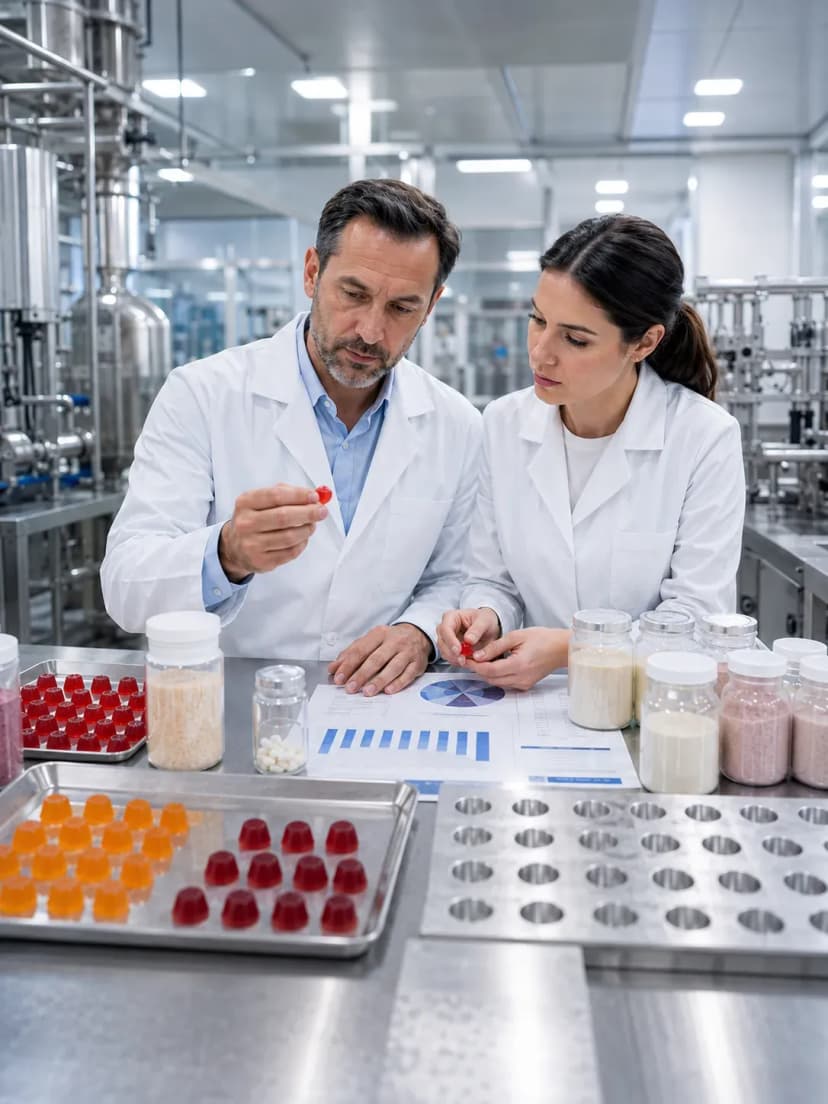
Led by Ph.D. formulation scientists with decades of pharmaceutical and food-science experience, we specialize in oil based probiotic supplement development. We operate advanced high-shear emulsification systems, nitrogen-purged compounding vessels, and state-of-the-art analytical labs to deliver stable, high-potency, multi-active supplement formulations.
Ready to design your next complex supplement? Schedule an R&D consultation with our formulation scientists today to review your bioactive matrix and draft a custom development plan.
Book an R&D Consultation with our Scientist Team Explore our Custom Formulation Solutions
Recommended Manufacturing Solution
Explore our private label probiotic gummy manufacturing capabilities
Want to discuss your formulation?
Our experts help brands launch technically complex probiotic and functional gummies.