The Role of Citric Acid and pH in Pectin Gummy Gelation Kinetics
The Role of Citric Acid and pH in Pectin Gummy Gelation Kinetics
In traditional gelatin gummy manufacturing, the process is akin to making a complex soup: you boil the ingredients, pour them into a mold, and wait for them to cool.
In vegan gummy manufacturing utilizing High-Methoxyl (HM) Pectin, the process is not cooking; it is a rapid, highly volatile chemical reaction. The trigger for this reaction—the spark that transforms a boiling liquid into a solid, bouncy gummy—is acid.
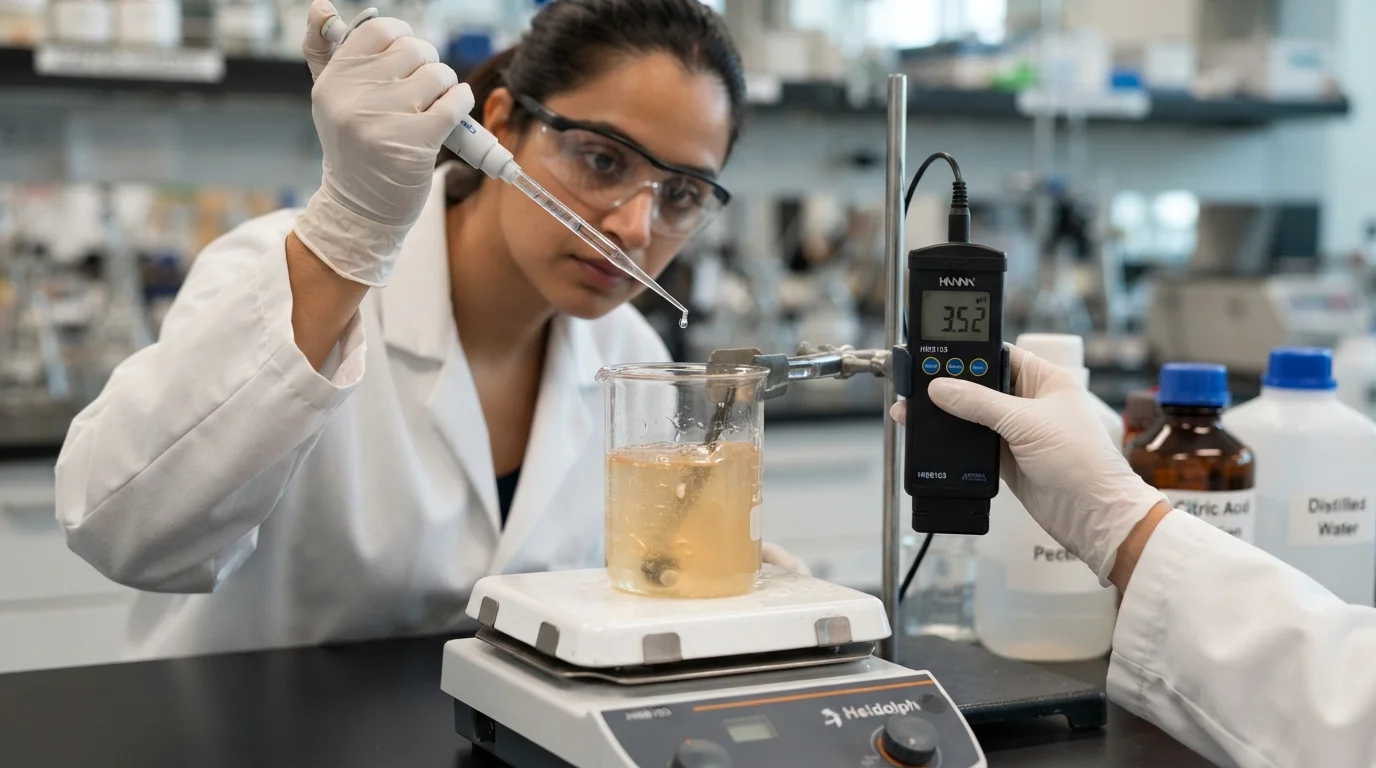
Understanding the precise pH in pectin gummy gelation is the line dividing a world-class manufacturing facility from a bankrupt one. This guide explores the unforgiving pectin gelation kinetics and the critical role of citric acid gummy manufacturing.
1. The Pectin Molecule: Why We Need Acid
To understand acidulating pectin gummies, we must look at the molecules.
HM Pectin molecules are long carbohydrate chains. In a neutral solution (like water), these chains carry a negative electrical charge. Because like charges repel each other, the pectin chains bounce away from one another, remaining a free-flowing liquid, regardless of how much sugar (Brix) you add or how hot it gets.
The Chemical Trigger
To force these pectin chains to stop repelling each other and bond together into a rigid 3D gel network, the formulator must neutralize that negative charge. This is achieved by rapidly lowering the pH of the slurry—injecting positively charged hydrogen ions (H+) via an acid, most commonly Citric Acid, Malic Acid, or Lactic Acid.
2. The Critical pH Window
Pectin gelation does not happen gradually. It happens in an incredibly narrow, highly volatile pH window.
- The Target Zone: For most commercial HM pectin grades used in gummies, the absolute critical pH range is 3.2 to 3.6.
- Too High (pH > 3.8): If the formulator doesn't add enough acid, the negative charges are not fully neutralized. The slurry will remain a liquid or form a weak, pathetic, sloppy gel that cannot be demolded.
- Too Low (pH < 2.9): If the formulator adds too much acid, the pectin chains bond too rapidly and too tightly. The resulting gummy will be extremely hard, brittle, and highly prone to syneresis (weeping/leaking water) because the tight matrix physically squeezes the moisture out of the gummy.
3. The Danger of Pre-Gelation (Setting in the Pipes)
Because pectin forms a thermo-irreversible gel (meaning it won't melt back down if you reheat it), the timing of the acid injection is the most dangerous part of the manufacturing process.
The Legacy Manufacturing Flaw
In older, open-kettle manufacturing (designed for gelatin), formulators would mix the acid directly into the massive cooking vat. With pectin, the moment the acid hits the slurry and the pH drops to 3.4, the entire 500-liter vat will turn into a solid, immovable block of rubber within minutes. This ruins the batch, destroys the pumps, and shuts down the factory for days of manual cleaning.
The Modern Solution: Inline Acid Dosing
To achieve true vegan gummy pH control, elite Contract Manufacturing Organizations (CMOs) utilize advanced, automated continuous-cooking lines.
- The pectin, sugar, and active ingredients are cooked and held in the main tanks at a safe, non-gelling pH (e.g., pH 4.5).
- The slurry is then pumped through the piping toward the depositing head (the nozzles that shoot the liquid into the molds).
- At the very last possible microsecond—often just inches before the depositing nozzles—a highly calibrated micro-dosing pump injects a concentrated liquid solution of Citric Acid directly into the slurry stream.
- An inline static mixer instantly homogenizes the acid into the slurry, dropping the pH to 3.4 just as the liquid hits the mold, allowing the gummy to set perfectly inside the mold cavity, not inside the machinery.
4. The Buffering Challenge of Active Ingredients
The final layer of complexity arises when functional ingredients are added to the matrix.
Many botanical extracts (like Maca root or Ashwagandha) and essential minerals (like Calcium Carbonate or Magnesium) possess high natural buffering capacities. This means they chemically resist changes in pH. If a formulator adds a highly buffered botanical to the slurry, the standard dose of citric acid will fail to drop the pH to the critical 3.4 target, and the gummy will not set.
The formulation team must conduct rigorous titration studies on the active ingredients in the lab before production, calculating the exact amount of excess acid required to overwhelm the buffer and trigger the pectin gelation.
Flawless Execution with Probiota Innovations
At Probiota Innovations, we treat pectin gelation as a precise, mathematically driven discipline. Our world-class facility is equipped with state-of-the-art inline acid dosing systems and continuous pH monitoring arrays.
Our PhD chemists meticulously map the buffering curves of your chosen functional ingredients, ensuring that your vegan gummies achieve a perfect, repeatable, and beautifully stable gel structure across every single commercial batch.
Explore our Advanced Pectin Manufacturing Capabilities
Frequently Asked Questions (FAQ)
1. Why use Citric Acid instead of other acids? Citric Acid (derived from citrus fruits) is the industry standard because it provides a clean, sharp, familiar tartness that perfectly complements most fruit flavors. However, Malic Acid (which provides a lingering, smoother sourness like green apples) or Lactic Acid (which is milder and often used in dairy/vanilla profiles) are also frequently used depending on the desired flavor profile.
2. Does the acid make the gummy taste sour? Yes. Because HM pectin requires a low pH (high acidity) to gel, a pectin gummy is inherently tart. This is why pectin gummies are almost always fruit-flavored. Masking this tartness to create a sweet, non-fruit flavor (like caramel or coffee) in a pectin gummy is incredibly difficult.
3. What is Sodium Citrate used for in gummy manufacturing? Sodium Citrate is a buffer. Formulators add it to the slurry to intentionally slow down the gelation process. It gives the liquid slurry a slightly wider time window to flow through the pipes and settle smoothly into the molds before the acid drops the pH and locks the gel into a solid state.
4. If a batch pre-gels in the kettle, can it be saved? If it is a true HM pectin gel, no. Because the gel is thermo-irreversible, applying more heat will only burn it, not melt it. The batch is entirely lost, which highlights why automated inline acid dosing is critical for commercial profitability.
Recommended Manufacturing Solution
Want to discuss your formulation?
Our experts help brands launch technically complex probiotic and functional gummies.