Sugar-Free Gummy Formulations: Comparing Maltitol, Erythritol, and Allulose Matrices
Sugar-Free Gummy Formulations: Comparing Maltitol, Erythritol, and Allulose Matrices
The consumer demand for "Sugar-Free" and "Keto-Friendly" dietary supplements has exploded. However, removing sugar from a gummy is a monumental engineering challenge.
In a traditional gummy, sugar (sucrose and glucose) is not just a sweetener; it is the structural scaffolding. It provides bulk, controls water activity (aw), prevents microbial growth, and dictates the chewiness of the final product.
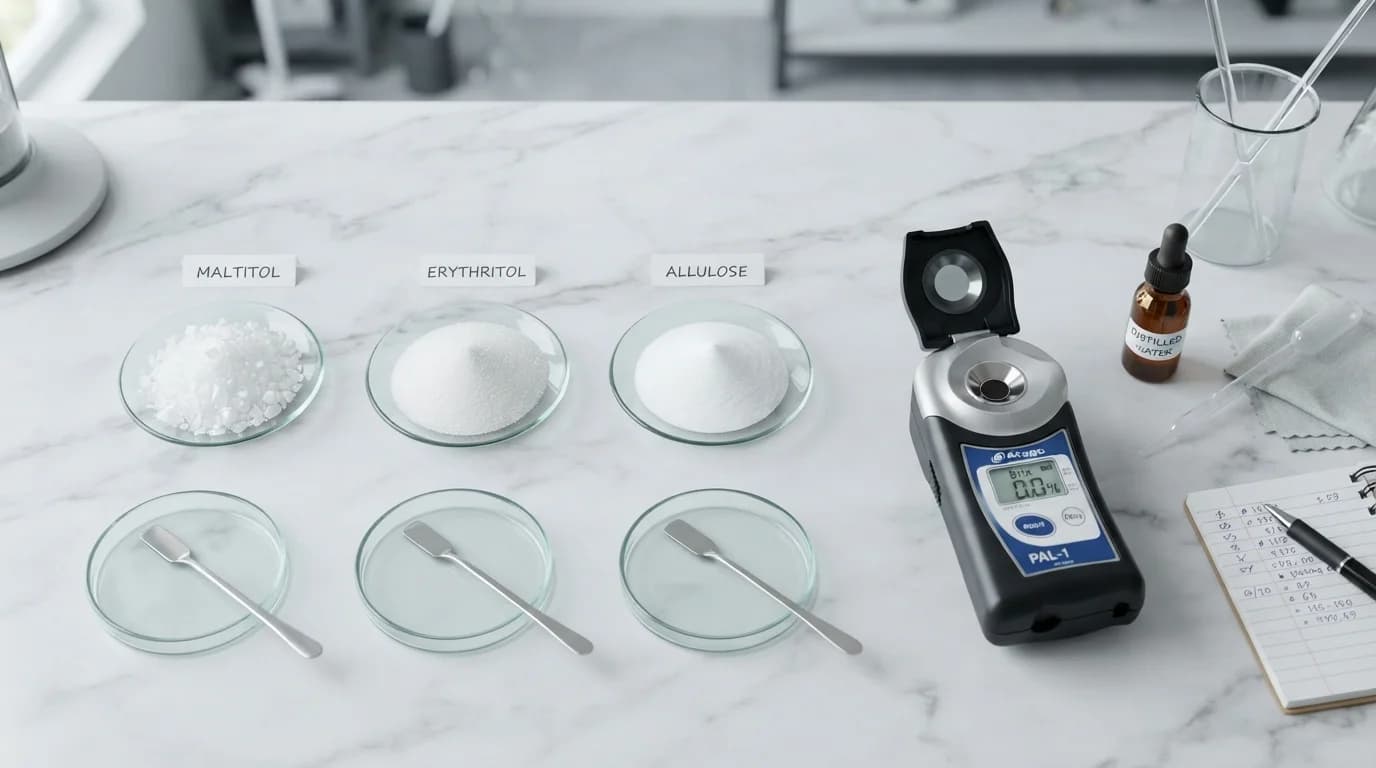
When transitioning to sugar free gummy formulations, Contract Manufacturing Organizations (CMOs) must replace that scaffolding with alternative bulking agents. The three most prominent contenders in modern food science are Maltitol, Erythritol, and Allulose.
This guide provides a deep technical comparison of these matrices, analyzing their impact on polyols gummy manufacturing.
1. Maltitol: The Industry Workhorse
Maltitol is a sugar alcohol (polyol) produced by hydrogenating maltose obtained from starch. It is currently the most widely used bulking agent in the sugar-free gummy industry.
The Advantages of Maltitol Gummies
- The Structural Twin: From an engineering perspective, maltitol behaves almost exactly like traditional sucrose. It has a high molecular weight, allowing it to provide the dense bulk necessary to replace sugar at a 1:1 ratio.
- Sweetness Profile: It is approximately 90% as sweet as sucrose and possesses a very clean flavor profile without the metallic or bitter aftertaste associated with artificial sweeteners like Stevia or Sucralose.
- Pectin Compatibility: Maltitol interacts excellently with High-Methoxyl (HM) pectin, allowing formulators to hit the precise 78-82% Brix levels required for rapid, thermo-irreversible gelation on starchless mogul lines.
The Disadvantages of Maltitol
- Gastrointestinal Distress: This is the critical flaw. Maltitol is not fully digested by the human body. If consumed in large quantities, it ferments in the lower intestine, causing severe bloating, gas, and a well-documented laxative effect.
- Glycemic Impact: While lower than sugar, maltitol still has a moderate glycemic index (around 35) and contributes calories, meaning it can still spike blood sugar, making it less ideal for strict ketogenic or diabetic demographics.
2. Erythritol: The Keto Favorite
Erythritol is another sugar alcohol, but it occurs naturally in some fruits and fermented foods.
The Advantages of an Erythritol Gummy Matrix
- Zero Glycemic Impact: Erythritol has a glycemic index of zero and contributes almost zero calories (0.2 kcal/g). This makes it the absolute gold standard for strict Keto and diabetic-friendly formulations.
- Digestive Tolerance: Unlike maltitol, erythritol is rapidly absorbed in the small intestine and excreted unchanged in the urine. Therefore, it rarely causes the severe laxative effects or bloating associated with other polyols.
The Engineering Challenges of Erythritol
Erythritol is notoriously difficult to use as the primary bulking agent in a gummy.
- The Crystallization Threat: Erythritol has incredibly low solubility compared to sucrose. If used in high concentrations, it will rapidly crystallize out of the gummy matrix as it cools, turning the gummy into a hard, crunchy, unmarketable rock.
- The Cooling Effect: Erythritol possesses a strong "endothermic" heat of solution, meaning it creates a distinct minty or cooling sensation on the tongue. While great for a mint-flavored gummy, this cooling effect clashes horribly with warm flavors like cherry, orange, or botanical extracts.
- The Formulation Fix: To use erythritol, formulators must blend it with highly soluble fibers (like Polydextrose or Soluble Tapioca Fiber) to prevent crystallization and mask the cooling effect.
3. Allulose: The Future of Sugar-Free?
Allulose (D-Psicose) is a "rare sugar" that exists in minuscule quantities in nature (e.g., in figs and raisins). It is structurally almost identical to fructose.
The Advantages of an Allulose Gummy Formulation
- The Best of Both Worlds: Allulose provides the perfect structural bulk and browning (Maillard reaction) characteristics of real sugar, but it passes through the body largely unmetabolized, contributing nearly zero calories and zero glycemic impact.
- Flawless Texture: Because it is a true sugar (not a sugar alcohol), it does not cause the crystallization issues of erythritol, nor does it cause the severe gastrointestinal distress of maltitol. It produces a soft, chewy, brilliant pectin gummy.
The Challenges of Allulose
- Cost and Availability: Allulose is currently significantly more expensive than maltitol or traditional sugar, and the global supply chain is still scaling up.
- Regulatory Friction: While the US FDA has declared that Allulose does not need to be counted as a "Total Sugar" or "Added Sugar" on the Supplement Facts panel, it is not yet permitted for use in several major international markets (like the European Union or Australia/FSANZ) due to its novelty, restricting global export strategies.
The Probiota Innovations Formulation Strategy
There is no "perfect" sugar-free ingredient. Formulating a premium, stable, and highly palatable sugar-free gummy requires a symphony of blended ingredients.
At Probiota Innovations, our PhD formulators rarely rely on a single bulking agent. We engineer advanced matrices—often blending soluble dietary fibers (like FOS or IMO) with precise ratios of highly tolerated polyols or rare sugars. This strategy mitigates gastrointestinal issues, prevents crystallization, guarantees low water activity (aw), and delivers a gummy that rivals traditional sugar in both texture and taste.
Explore our Advanced Sugar-Free Manufacturing Capabilities
Frequently Asked Questions (FAQ)
1. Is "Sugar-Free" the same as "Zero Calories"? No. While ingredients like Erythritol and Allulose provide near-zero calories, polyols like Maltitol still contain roughly half the calories of standard sugar (approx. 2.1 kcal/g). A maltitol gummy is sugar-free, but it is definitely not calorie-free.
2. Why do I need to put a laxative warning on my label? If your formulation utilizes a significant amount of certain sugar alcohols (like Maltitol or Sorbitol), regulatory bodies like Health Canada and FSANZ (Australia) strictly mandate an advisory warning on the label stating that excess consumption may have a laxative effect. The US FDA does not federally mandate this warning for all polyols, but it is considered an industry best practice to protect consumers.
3. Are artificial sweeteners like Sucralose or Aspartame used in gummies? They can be, but they are generally used only as "high-intensity sweeteners" in microscopic doses to boost the overall sweetness profile. Because they are hundreds of times sweeter than sugar, they provide zero physical bulk. You still need a bulking agent (like fiber or a polyol) to physically build the gummy matrix.
4. Can an Indian CMO manufacture Allulose gummies for the US market? Yes. As long as the specific brand of Allulose used by the Indian CMO holds a valid FDA GRAS (Generally Recognized As Safe) notification, the finished gummies can be legally imported and sold in the United States.
Recommended Manufacturing Solution
Want to discuss your formulation?
Our experts help brands launch technically complex probiotic and functional gummies.