Mastering Brix Levels in Functional Gummies: Sweetness, Stability, and Crystallization
Mastering Brix Levels in Functional Gummies: Sweetness, Stability, and Crystallization
In the culinary world, sugar is primarily a flavor agent. In the highly engineered world of functional gummy manufacturing, sugar (or its sugar-free equivalents) is a critical structural building block.
When Contract Manufacturing Organizations (CMOs) discuss the "sugar" content of a gummy during the formulation phase, they are rarely talking about sweetness. They are talking about Brix—the measurement of Total Soluble Solids (TSS).
Mastering Brix in gummies is the absolute prerequisite for achieving shelf-stability, optimal texture, and preventing catastrophic manufacturing failures like syneresis (weeping) or "sanding" (unwanted crystallization). This guide explores the complex thermodynamics of Brix levels functional gummies require for commercial success.
What is Brix?
Degrees Brix (°Bx) is a measurement of the dissolved sugar-to-water mass ratio of a liquid.
- If a solution is 80° Brix, it means 100 grams of the solution contains 80 grams of dissolved solids (sucrose, glucose, etc.) and 20 grams of water.
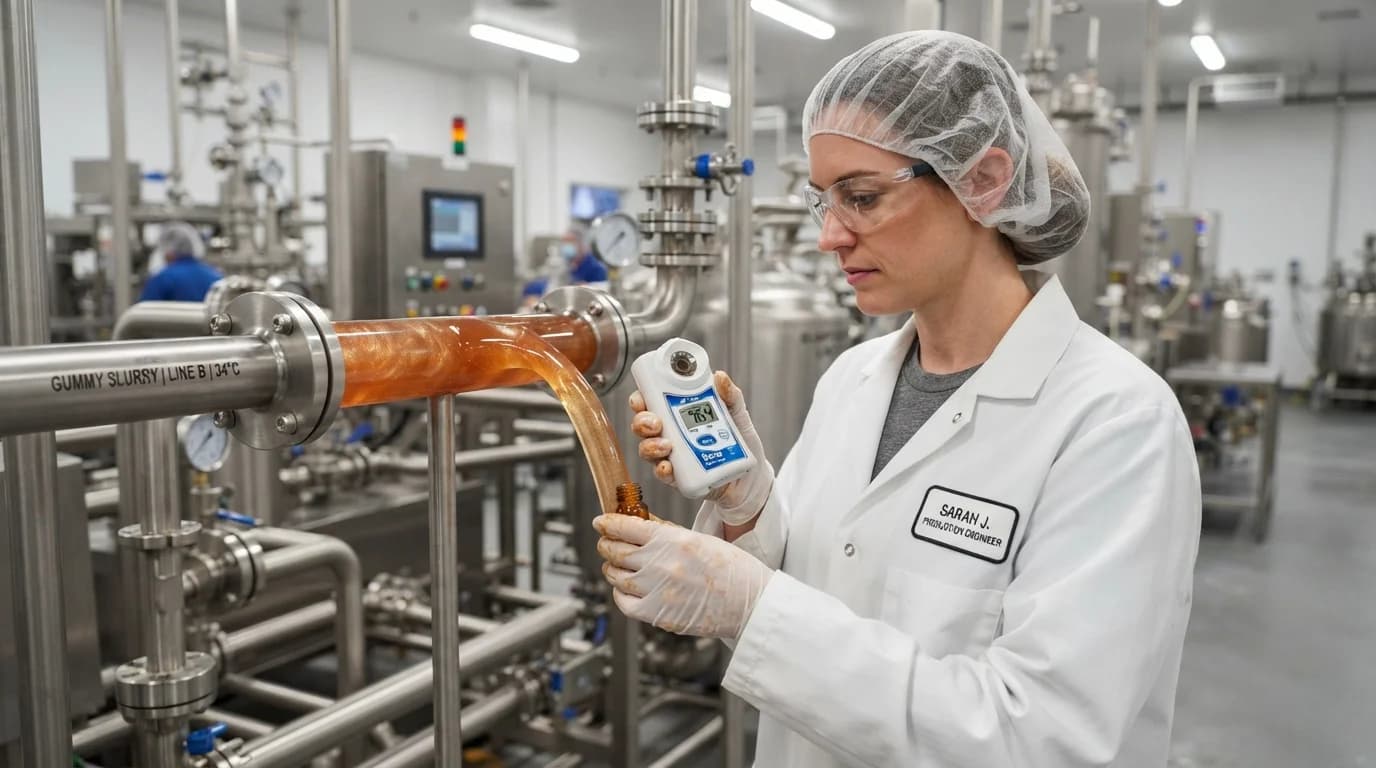
- In gummy manufacturing, Brix is monitored continuously using a device called a refractometer, which measures how light bends as it passes through the slurry.
The Three Pillars of Brix Engineering
Controlling the Total Soluble Solids gummies contain impacts three critical vectors of the final product.
1. Microbiological Stability (Water Activity)
As discussed in previous guides, maintaining a low Water Activity (aw < 0.65) is mandatory to prevent mold and bacterial growth over a 24-month shelf life.
- The Brix Mechanism: Brix is the primary lever for lowering aw. By boiling the gummy slurry to a high Brix level (typically 78% to 82% for pectin gummies), the massive concentration of dissolved solids physically binds the free water molecules, rendering the gummy "osmotically hostile" to microbes and naturally self-preserving.
2. Gelling Kinetics (The Pectin Network)
If you are formulating a vegan gummy using High-Methoxyl (HM) pectin, Brix is not optional; it is the trigger for gelation.
- The Brix Mechanism: Pectin molecules naturally repel each other. To force them to bond into a 3D gel network, the formulator must introduce a high concentration of dissolved solids (high Brix) to dehydrate the pectin chains, pushing them closer together.
- If the Brix drops below 76% when the acid is added, the HM pectin will fail to gel, resulting in a liquid mess in the molds.
3. Preventing Sugar Crystallization Gummies
This is the most technically challenging aspect of Brix management. If a gummy has too high a concentration of a single type of sugar, that sugar will attempt to return to its natural, solid crystalline state over time.
- The Failure (Graining/Sanding): If crystallization occurs inside the gummy matrix, the gummy becomes opaque, brittle, and crunchy. If it occurs on the surface, it causes the gummy to weep moisture and become sticky.
- The Solution (The Doctoring Ratio): Formulators prevent crystallization by manipulating the ratio of different sugars. They rarely use 100% sucrose (table sugar). Instead, they use a blend—typically a ratio of Sucrose to Glucose Syrup (often 40:60 or 50:50).
- The glucose syrup (which contains longer chain saccharides) acts as an interfering agent, physically blocking the sucrose molecules from aligning and forming crystals, even at incredibly high Brix levels (80%+).
The Manufacturing Challenge: Reaching Target Brix
Hitting a target of 80% Brix is a severe engineering challenge.
- The Boiling Point Elevation: As you dissolve more solids into water, the boiling point of the solution increases. To boil off enough water to reach 80% Brix at standard atmospheric pressure, the temperature of the slurry must exceed 110°C (230°F).
- The Active Ingredient Threat: At 110°C, the intense heat will rapidly degrade sensitive functional ingredients like Vitamin C, Folate, or botanical phytonutrients.
- The Vacuum Solution: Premium CMOs overcome this by using advanced vacuum cookers. By applying a strong vacuum to the kettle, the atmospheric pressure is lowered, which lowers the boiling point of the slurry. This allows the manufacturer to rapidly boil off the water and hit 80% Brix at a much cooler temperature (e.g., 85°C to 90°C), protecting the active payload from thermal destruction.
The Probiota Innovations Expertise
At Probiota Innovations, we treat Brix not as a measurement of sweetness, but as a critical structural parameter. Our world-class facility utilizes fully automated, continuous vacuum cooking systems with inline, real-time refractometers.
Our PhD formulation team meticulously calculates the precise sucrose-to-glucose (or sugar-free polyol) ratios required to prevent crystallization, ensuring your functional gummies maintain a flawless, translucent texture and absolute microbial stability from the first day of production to the end of their shelf life.
Explore our Advanced Formulation Science Capabilities
Frequently Asked Questions (FAQ)
1. Does a high Brix level mean the gummy will be overly sweet? Not necessarily. While sucrose is very sweet, glucose syrup is significantly less sweet. Furthermore, in functional gummies, the intense tartness of the acid (required to set the pectin) and the often bitter or earthy notes of the botanical extracts (like Ashwagandha) provide massive flavor counterbalances, masking the perceived sweetness of the high Brix matrix.
2. How do you measure Brix for sugar-free gummies? The process is exactly the same. Sugar-free gummies utilize polyols (like Maltitol, Sorbitol, or Erythritol) or soluble fibers (like Allulose) as the dissolved solids instead of sucrose. The refractometer still measures the total dissolved solids in the solution to ensure the slurry hits the 78-82% target required for stability and pectin gelation.
3. What happens if the Brix is too low (e.g., 70%)? Three things will happen: First, if using HM pectin, the gummy will be extremely soft or fail to set entirely. Second, the water activity (aw) will be too high, making the product highly susceptible to mold. Third, the excess moisture will likely migrate to the surface (syneresis), making the gummy sticky and unmarketable.
4. Why is my gummy crunchy on the inside after 6 months? This is a classic crystallization failure (often called graining). The formulation likely had too much sucrose and not enough glucose syrup (or other interfering agent). Over time, the sucrose molecules aligned and formed hard crystals within the matrix.
Recommended Manufacturing Solution
Learn how we scale private label probiotic gummies for global brands
Want to discuss your formulation?
Our experts help brands launch technically complex probiotic and functional gummies.