Technical Challenges in Manufacturing Vegan Gummy Supplements: Pectin Gelation Explained
Technical Challenges in Manufacturing Vegan Gummy Supplements: Pectin Gelation Explained
The dietary supplement industry is undergoing a massive, consumer-driven shift toward plant-based products. For brands, offering a vegan gummy is no longer a niche strategy; it is a mandatory baseline for market penetration.
However, transitioning from traditional animal-derived gelatin to a plant-based matrix is not a simple ingredient swap. It is a fundamental shift in polymer chemistry. Vegan gummy manufacturing is notoriously difficult, plagued by high scrap rates, inconsistent textures, and rapid setting times that can freeze an entire production line in minutes.
The core of this challenge lies in mastering hydrocolloids. This guide explores the intricate science of pectin gelation explained, detailing the specific challenges vegan gummies present and how elite Contract Manufacturing Organizations (CMOs) overcome them.
1. The Hydrocolloid Shift: Gelatin vs. Pectin
To understand the challenge, you must understand the difference in the gelling mechanism.
- Gelatin (Animal): Gelatin is a protein derived from collagen (pig or cow). It forms a gel through a simple thermal process. When the hot gelatin solution cools, the protein chains intertwine to form a flexible, thermo-reversible network. It is incredibly forgiving; if the mixture cools too quickly, you can simply reheat it to melt it again.
- Pectin (Plant-Based): Pectin is a complex carbohydrate (polysaccharide) extracted from plant cell walls, most commonly citrus peels or apple pomace. Pectin does not gel simply by cooling. It requires a precise, simultaneous convergence of three critical factors: Solids (Brix), pH, and Temperature.
If any one of these three variables is off by a fraction of a degree or percentage point, the pectin will either pre-gel in the kettle (ruining the batch) or fail to gel in the mold (resulting in a liquid mess).
2. Mastering the Pectin Trinity: Brix, pH, and Temperature
Plant based gummy formulation using High-Methoxyl (HM) pectin—the industry standard for firm gummies—requires orchestral precision.
The Brix Requirement (Total Soluble Solids)
Pectin molecules naturally repel each other in solution because they carry a negative electrical charge. To force them together to form a gel network, you must introduce a massive amount of dissolved solids (Brix), typically sugars like sucrose or glucose syrup.
- The Science: The sugar acts as a dehydrating agent. It binds the free water molecules in the solution, forcing the pectin chains closer together.
- The Target: HM pectin typically requires a minimum Brix level of 78% to 82% to gel properly. Reaching this high solid content requires powerful, high-vacuum continuous cookers to boil off the excess water rapidly without caramelizing the sugars or burning the active ingredients.
The pH Requirement (Acidification)
Even with high Brix, the pectin chains still repel each other due to their negative charge.
- The Science: To neutralize this charge and allow the pectin chains to bond (via hydrogen bonding and hydrophobic interactions), the formulator must rapidly drop the pH of the slurry by injecting a precise dose of acid (usually citric acid or malic acid).
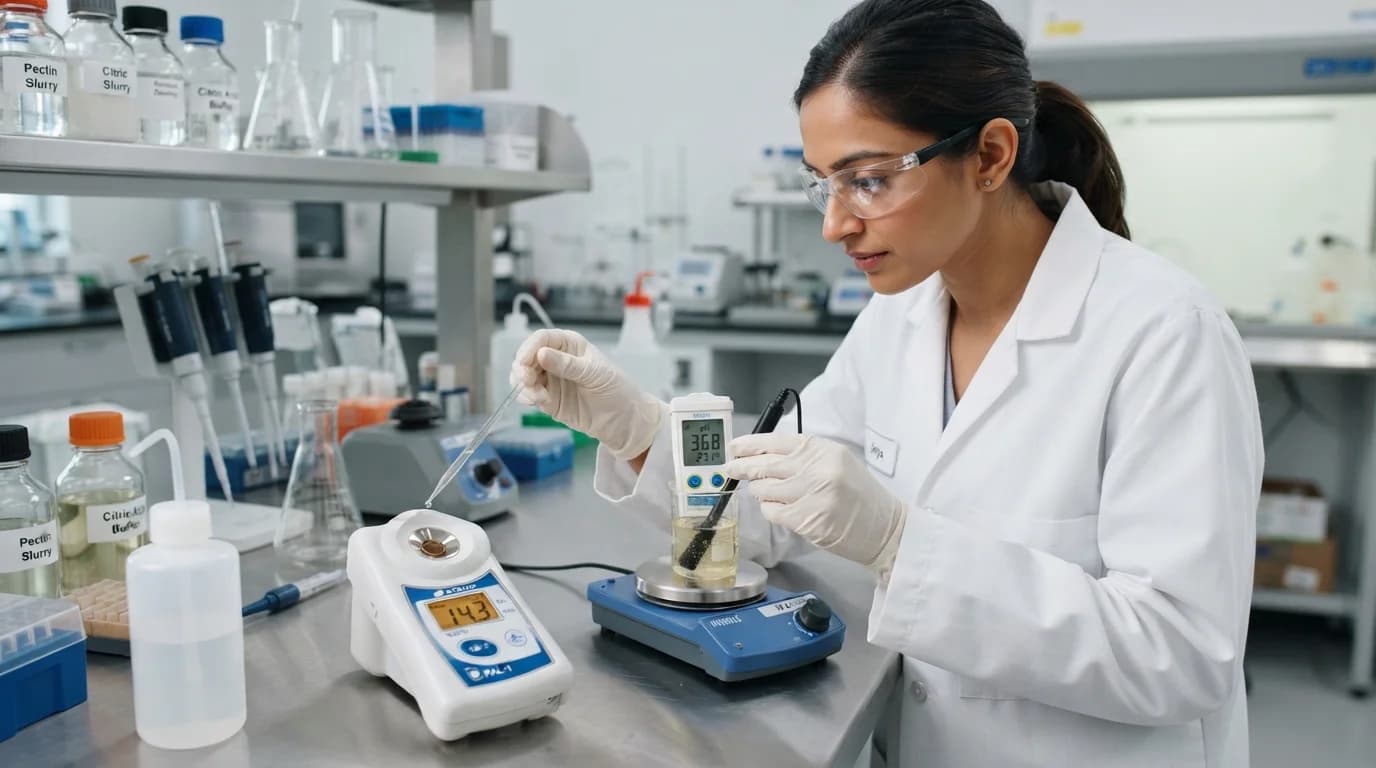
- The Target: The critical pH window for HM pectin gelation is incredibly narrow, typically between 3.2 and 3.6. If the pH is too high (e.g., 3.8), the gummy will be unacceptably soft or fail to set entirely. If the pH is too low (e.g., 2.9), the gel will become brittle and prone to syneresis (weeping water).
The Temperature Requirement
Because pectin forms a thermo-irreversible gel, timing is everything.
- The Danger Zone: Once the acid is injected and the pH drops into the critical zone (3.2-3.6), the pectin will begin to set almost instantly as the temperature drops below its gelling point (the pectin setting temperature, which varies based on the specific grade of pectin but is often around 85°C to 95°C).
- The Engineering Challenge: The acid must be injected at the very last possible microsecond before the slurry is deposited into the molds. If the acid is added too early while the slurry is still in the holding tank or the piping, the batch will pre-gel into a solid rubber mass, destroying the equipment and the batch.
3. The Active Ingredient Variable
The precision required for pectin gelation is further complicated by the functional payload.
When adding botanical extracts, vitamins, or minerals, the formulator introduces new variables.
- Buffering Effects: Many active ingredients (like certain calcium salts or botanical powders) possess natural buffering capacities. When added to the slurry, they resist the pH drop. The formulator must calculate the exact amount of extra acid required to overcome this buffer and hit the precise 3.2 - 3.6 target.
- Water Activity (aw): Adding bulky active ingredients alters the free water in the matrix. Formulators must ensure the final Water Activity remains below 0.65 to guarantee microbial stability and shelf life, which often requires tweaking the ratio of different sugars or introducing humectants like glycerin.
The Probiota Innovations Engineering Standard
The margin for error in vegan gummy manufacturing is effectively zero. It cannot be done reliably using old-school, open-kettle gelatin equipment.
At Probiota Innovations, we have engineered our facility specifically for advanced pectin science. We utilize fully automated, continuous-cooking lines with inline, micro-dosed acid injection systems. This ensures the slurry remains perfectly liquid through the piping and only gels exactly when deposited into our starchless silicone molds.
Our PhD formulation team maps the pH buffering capacity of every active ingredient before we scale, ensuring that your vegan gummy is not only compliant and efficacious, but boasts a perfect, repeatable texture every single batch.
Explore our Advanced Vegan Formulation Capabilities
Frequently Asked Questions (FAQ)
1. Is pectin the only way to make a vegan gummy? No, but it is the best. Other hydrocolloids like Agar-Agar or Carrageenan are plant-based, but they often produce a brittle, "snappy" texture that consumers dislike, or they suffer from poor flavor release. Pectin provides the cleanest chew, the best flavor release, and the highest heat stability.
2. What does "thermo-irreversible" mean? It means that once the pectin gel is formed, it cannot be melted back down by simply reheating it (unlike gelatin, which is thermo-reversible). This makes manufacturing much harder (if you mess up, the batch is ruined), but it makes the final product vastly superior for global shipping, as it will not melt in hot climates.
3. Why do some vegan gummies taste very sour? Because HM pectin requires a highly acidic environment (pH 3.2 - 3.6) to gel, the base matrix is inherently tart. Formulators often lean into this by making fruit flavors (like citrus or berry) that naturally complement the tartness. Masking that tartness to create a sweet, non-fruit flavor (like vanilla or chocolate) in a pectin gummy is extremely difficult.
4. Can an Indian CMO manufacture high-quality pectin gummies? Elite Indian CMOs are actually global leaders in pectin technology. Because India has a massive domestic vegetarian population, the demand for non-gelatin pharmaceutical formats drove intense early investment into pectin polymer science and starchless mogul technology, putting premium Indian facilities years ahead of many legacy US manufacturers.
Recommended Manufacturing Solution
Want to discuss your formulation?
Our experts help brands launch technically complex probiotic and functional gummies.