Water Activity and Shelf-Life Validation for TGA-Listed Gummy Supplements
Water Activity and Shelf-Life Validation for TGA-Listed Gummy Supplements
For international manufacturers supplying the Australian market, the Therapeutic Goods Administration (TGA) demands a level of scientific rigor that vastly exceeds standard food production. When a functional gummy is entered into the Australian Register of Therapeutic Goods (ARTG) as a Listed Medicine (AUST L), the brand is legally guaranteeing that the product will remain safe, potent, and structurally sound until its expiration date.
The single most critical thermodynamic metric determining that survivability—especially in Australia's harsh, high-heat climate (ICH Zone IVa)—is Water Activity (aw).
This technical guide explores the profound impact of water activity TGA gummies and how mastering aw control is the foundation of flawless shelf life validation Australia gummies.
Demystifying Water Activity (aw)
A widespread, and often catastrophic, error made by amateur formulators is confusing Moisture Content with Water Activity.
- Moisture Content: The total volume of water present in the gummy matrix (typically 15% to 20% by weight). It primarily affects the texture (chewiness) and weight of the product.
- Water Activity (aw): A measurement (on a scale of 0.0 to 1.0) of the free, unbound water within that matrix. It is the ratio of the vapor pressure of water in the gummy to the vapor pressure of pure water at the same temperature.
Why aw is the True Indicator of Stability
It is possible to have a gummy with a relatively high overall moisture content, but if that water is tightly chemically bound to sugars or the pectin structure, the aw will be low.
Free water (high aw) is the enemy of stability.
- Microbial Proliferation: Free water is utilized by bacteria, yeast, and mold to reproduce.
- Chemical Degradation: Free water acts as a solvent, accelerating the hydrolysis (breakdown) of sensitive active ingredients like vitamins and botanical extracts.
TGA Listed Gummy Supplements: The Safety Thresholds
To pass TGA scrutiny and establish a robust 24-month shelf life without relying on heavy chemical preservatives, aw control gummy manufacturing must target specific safety thresholds.
- aw > 0.85: High risk. Supports the growth of pathogenic bacteria (like Staphylococcus aureus). Entirely unacceptable for TGA-listed supplements.
- aw 0.70 - 0.85: Medium risk. Supports the vigorous growth of yeasts and molds. Unless chemically preserved, these gummies will likely spoil during shelf-life testing.
- aw < 0.65: The Safety Zone. At this level, the growth of almost all pathogenic bacteria, yeasts, and molds is completely inhibited.
Premium Contract Manufacturing Organizations (CMOs) engineer their pectin gummies to achieve an aw of 0.60 to 0.65. At this level, the gummy is "osmotically hostile" to microbes. It is naturally self-preserving, ensuring it passes the rigorous microbial limits testing required by the TGA at the end of its shelf life.
Water Activity and Active Ingredient Assay
The TGA requires that a Listed Medicine contains the exact amount of the active ingredient claimed on the label (within tight tolerances) for the duration of its shelf life.
If a gummy has an aw of 0.75, the abundant free water will interact with sensitive water-soluble vitamins (like Vitamin C or B-Complex). Over 12 to 24 months, especially in the elevated heat of the Australian climate, this free water accelerates chemical degradation. When the TGA audits the product and runs an HPLC assay, the vitamin levels will have plummeted below the label claim, resulting in immediate regulatory action, recall, and cancellation of the AUST L listing.
By driving the aw below 0.65, formulators lock the water molecules away, dramatically slowing the chemical degradation of the active payload and ensuring the assay remains potent at month 24.
Formulation Engineering: How to Lower aw
Lowering the aw of a gummy without turning it into an inedible hard candy is a complex exercise in polymer science.
- Brix Optimization: Formulators increase the Total Soluble Solids (Brix)—using sucrose, glucose, or sugar-free alternatives like maltitol and soluble fibers—to approximately 78-82%. These dissolved solids physically bind the water molecules, removing them from the "free" state.
- Humectants: Incorporating specific ingredients like vegetable glycerin (which must be verified plant-based/halal/kosher) or sorbitol. Humectants are highly hygroscopic; they attract and trap water, lowering the aw while keeping the gummy matrix soft and palatable.
- Pectin Matrix Control: Utilizing high-methoxyl (HM) pectin and precise pH control to create a tight, thermo-irreversible gel network that physically encapsulates the moisture and prevents it from migrating to the surface (syneresis).
Validating for the TGA
During Accelerated Stability Testing (40°C / 75% RH for 6 months), the CMO must measure the aw of the gummies at each interval. If the packaging (the bottle and induction seal) is inadequate, moisture from the humid chamber will penetrate the bottle, causing the gummy's aw to drift upward, leading to eventual failure.
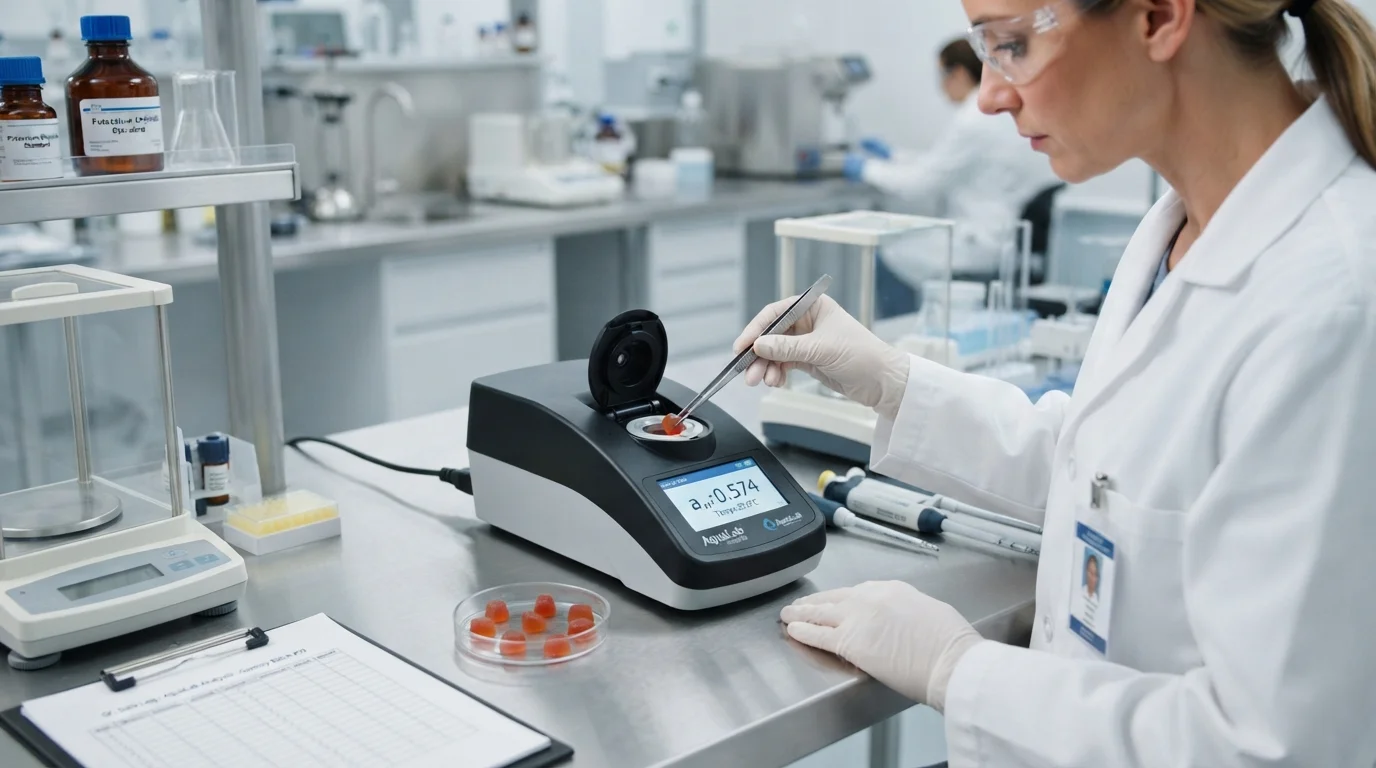
At Probiota Innovations, we utilize advanced AquaLab water activity meters on our production floor and in our stability chambers. We engineer our pectin matrices specifically for the harsh Australian climate (Zone IVa), providing our brand partners with the ironclad Australian gummy stability requirements data needed to confidently maintain their TGA listings.
Discover our Advanced Formulation and Stability Testing Capabilities
Frequently Asked Questions (FAQ)
1. Does the TGA mandate a specific water activity limit for gummies? The TGA does not explicitly publish a singular "maximum aw" number for all gummies. However, they mandate that the product must be safe from microbial contamination and maintain its chemical potency for its entire shelf life. Because science dictates that an aw above 0.65 leads to mold and degradation, maintaining a low aw is the universally accepted, de facto requirement for cGMP compliance.
2. Can I just add preservatives instead of lowering the water activity? You can use TGA-permitted preservatives (like Potassium Sorbate), but modern consumers aggressively reject artificial preservatives. Engineering a low aw allows the brand to make "Preservative-Free" and "Clean Label" claims, which are highly lucrative in the Australian market.
3. Why do probiotic gummies need an even lower water activity? Probiotics are living organisms held in a dormant state. If the free water (aw) is too high (e.g., above 0.60), the moisture will penetrate the probiotic's protective coating, prematurely activating the bacteria. Without a food source in the gummy, they will quickly die, causing the product to fail its CFU claim at expiration.
4. How does packaging affect water activity during shelf life? If a gummy is packed in a cheap, highly permeable plastic bottle, ambient humidity from the Australian environment will pass through the plastic over time, raising the gummy's aw and causing it to spoil. High-barrier packaging (like thick PET or HDPE) with proper induction sealing is critical to maintaining the low aw established during manufacturing.
For an in-depth understanding of the core concepts, read our comprehensive guide on Target Water Activity in Gummy Manufacturing.
Looking for a manufacturing partner? Explore Our Core Manufacturing Capabilities.
Recommended Manufacturing Solution
Explore our export-ready nutraceutical manufacturing solutions
Want to discuss your formulation?
Our experts help brands launch technically complex probiotic and functional gummies.