Kosher Supplement Gummies Shelf-Stability: Water Activity (aw) Control and Testing Protocols
Kosher Supplement Gummies Shelf-Stability: Water Activity (aw) Control and Testing Protocols
When manufacturing functional nutraceuticals for export to regions with challenging climates, such as Israel and the broader Middle East, religious compliance and product survivability must be engineered in tandem. While achieving Pareve kosher status is a matter of strict ingredient sourcing, guaranteeing kosher gummies shelf stability is a matter of rigorous polymer science and thermodynamics.
The silent killer of gummy supplements in warm climates is not just the ambient heat, but moisture. Specifically, the management of a metric known as Water Activity (aw).
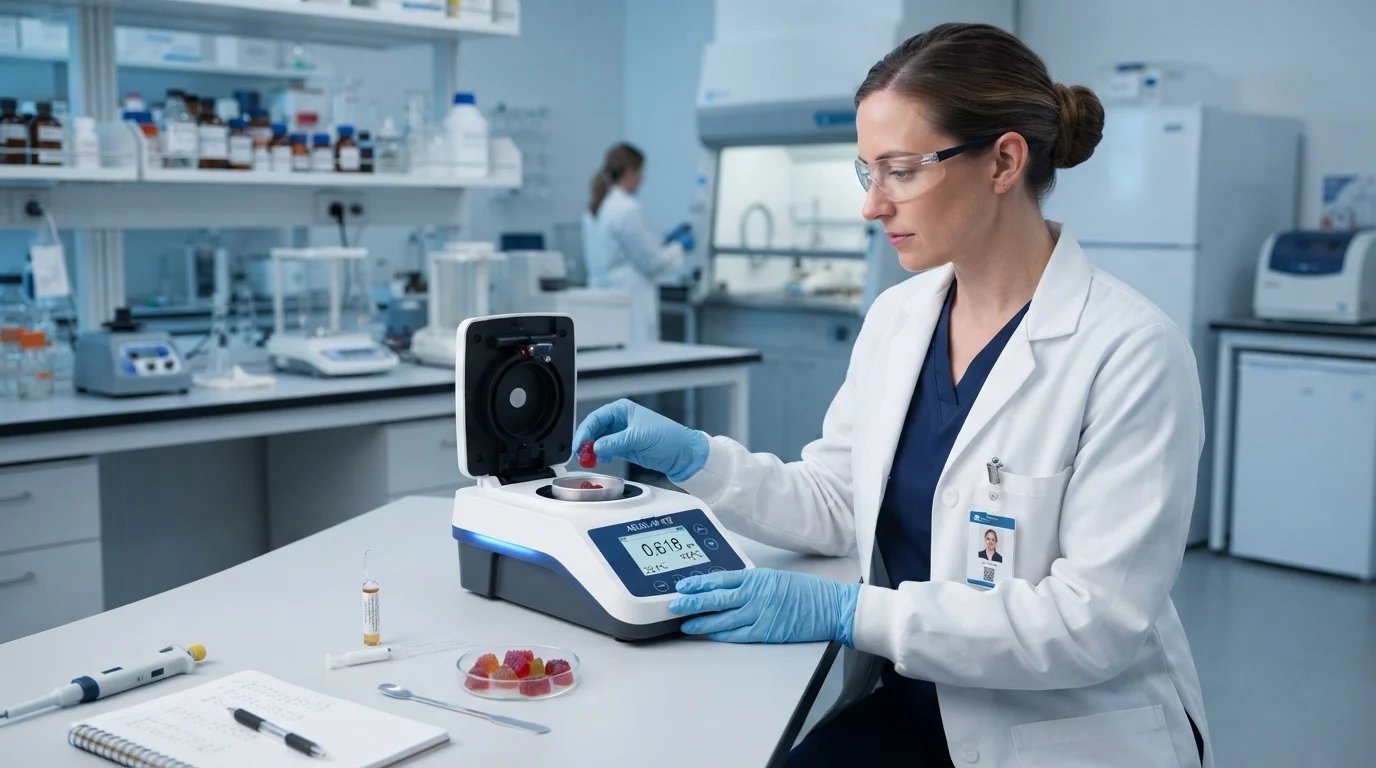
This technical guide explores the critical importance of water activity kosher gummies, how to control it during formulation, and the shelf life testing kosher gummies require to pass rigorous import audits.
Moisture Content vs. Water Activity (aw)
A common and devastating mistake made by amateur formulators is conflating moisture content with water activity.
- Moisture Content: This is the total, absolute volume of water present in the gummy. It dictates the weight and, to some extent, the texture (chewiness) of the product.
- Water Activity (aw): This is a thermodynamic metric representing the ratio of the vapor pressure of water in the gummy to the vapor pressure of pure water at the same temperature. In practical terms, it measures the free, unbound water available to participate in chemical reactions or support microbial growth.
Why aw is the Critical Metric
You can have a gummy with a relatively high overall moisture content, but if that moisture is tightly bound to sugars or the pectin matrix, the water activity will be low.
For aw control kosher supplements, the golden rule is maintaining an aw below 0.65 (and ideally below 0.60 for probiotic formulations).
- Microbial Safety: Most pathogenic bacteria cannot grow at an aw below 0.85. Yeasts and molds generally cease proliferation below 0.65. By controlling aw, the gummy becomes naturally self-preserving, eliminating the need for controversial chemical preservatives.
- Active Ingredient Protection: High free water acts as a solvent, accelerating the degradation of sensitive active ingredients like Vitamin C, or prematurely activating live probiotic strains, causing them to die off before consumption.
Formulation Strategies for aw Control
Achieving a low aw in a kosher, plant-based (pectin) matrix requires precise orchestration of the formula's solids.
1. Brix Optimization
The Brix scale measures the concentration of dissolved solids, primarily sugars (like kosher-certified sucrose or glucose syrup). By driving the Brix level up during the boiling phase to approximately 78-82%, formulators physically bind the water molecules to the sugar molecules, drastically reducing the free water available (lowering the aw).
2. Utilizing Kosher Humectants
Humectants are highly hygroscopic substances that attract and trap water.
- Vegetable Glycerin: A highly effective humectant. However, procurement must ensure the glycerin is 100% plant-derived (e.g., from palm or coconut) and holds a valid kosher certificate, verifying it contains absolutely no animal-derived tallow.
- Sorbitol: Often used in sugar-free formulations, kosher-certified sorbitol binds water effectively while keeping the gummy matrix soft and chewable.
3. Pectin Selection and Matrix Binding
Unlike gelatin, which relies on a protein network, pectin forms a carbohydrate network. Selecting the precise grade of high-methoxyl (HM) pectin and dialing in the exact pH (3.2 - 3.6) ensures a tight, thermo-irreversible gel that locks moisture in place, preventing it from migrating to the surface (syneresis) when exposed to high Israeli summer temperatures.
Kosher Gummy Stability Protocols and Testing
To legally import gummies into Israel, the Ministry of Health (MOH) often requires data proving the product's 24-month viability.
Kosher gummy stability protocols mandate rigorous testing in environmentally controlled chambers.
- Accelerated Stability Testing (ICH Guidelines): The gummies are placed in a chamber set to 40°C ± 2°C and 75% ± 5% Relative Humidity (RH) for a period of six months. This simulates two years of real-time aging.
- Parameter Verification: At the 1, 3, and 6-month marks, the gummies are tested for:
- Organoleptic Integrity: Have they melted, faded, or become excessively sticky?
- Active Assay: Has the dosage of the functional ingredient (e.g., Ashwagandha extract or Probiotic CFUs) degraded below label claims?
- Water Activity Drift: Has the aw crept up above the 0.65 threshold due to moisture absorption from the humid chamber?
Conclusion: Engineering for the Extreme
Producing a gummy that is both strictly kosher and highly stable in the Middle Eastern climate is the ultimate test of a contract manufacturer's capabilities. It requires an uncompromising approach to both religious supply chain auditing and advanced polymer thermodynamics.
At Probiota Innovations, our PhD-led formulation team and state-of-the-art laboratory facilities specialize in engineering low-aw, heat-stable pectin gummies. We provide the robust stability data and flawless kosher documentation required to dominate the Israeli market.
Explore our Advanced Manufacturing Capabilities
Frequently Asked Questions (FAQ)
1. What happens if the water activity (aw) in a gummy is too high? If the aw exceeds 0.65, the free water provides an environment for yeast and mold to grow, leading to rapid spoilage. Furthermore, high free water accelerates the chemical degradation of active ingredients like vitamins and causes live probiotics to die off prematurely.
2. Is vegetable glycerin always kosher? No. While it implies a plant origin, it must be verified. Some glycerin is derived from animal fats (tallow) which is strictly non-kosher. Even if derived from plants, the processing facility must be audited to ensure the equipment isn't shared with non-kosher animal fats. A valid kosher certificate is mandatory.
3. Does pectin hold up better to heat than gelatin? Yes, significantly better. Gelatin gummies melt at around 30°C-35°C, making them highly vulnerable in Israeli summers. Pectin forms a thermo-irreversible gel that typically will not melt until temperatures reach 60°C-70°C, ensuring the gummy maintains its shape and texture during transit and storage.
4. What is accelerated stability testing? It is a protocol where the product is subjected to elevated heat and humidity (usually 40°C and 75% RH) in a specialized chamber for six months. This intense environment simulates the chemical and physical degradation that would occur over two years of normal shelf life, allowing brands to quickly validate their expiration dates.
For an in-depth understanding of the core concepts, read our comprehensive guide on Target Water Activity in Gummy Manufacturing.
Looking for a manufacturing partner? Explore Our Core Manufacturing Capabilities.
Recommended Manufacturing Solution
Partner with us for globally compliant supplement production
Want to discuss your formulation?
Our experts help brands launch technically complex probiotic and functional gummies.