Low Water Activity Gummies for GCC Markets: Formulation Strategies and Halal Compliance
Low Water Activity Gummies for GCC Markets: Formulation Strategies and Halal Compliance
Formulating gummy supplements for the Gulf Cooperation Council (GCC) countries—such as Saudi Arabia, UAE, and Qatar—presents a unique dual challenge. Not only must the product be flawlessly halal-certified, but it must also survive one of the harshest climates on the planet.
The secret to achieving extreme shelf life and halal compliant low moisture gummies lies in mastering a critical metric: Water Activity (aw).
Understanding Water Activity (aw) vs. Moisture Content
Before diving into formulation strategies, we must distinguish between moisture content and water activity.
- Moisture Content is the total amount of water present in the gummy.
- Water Activity (aw) is the ratio of the vapor pressure of water in a material to the vapor pressure of pure water at the same temperature. Essentially, it measures the unbound, free water that is available for microorganisms (bacteria, yeast, mold) to use for growth, or for chemical reactions (like probiotic degradation) to occur.
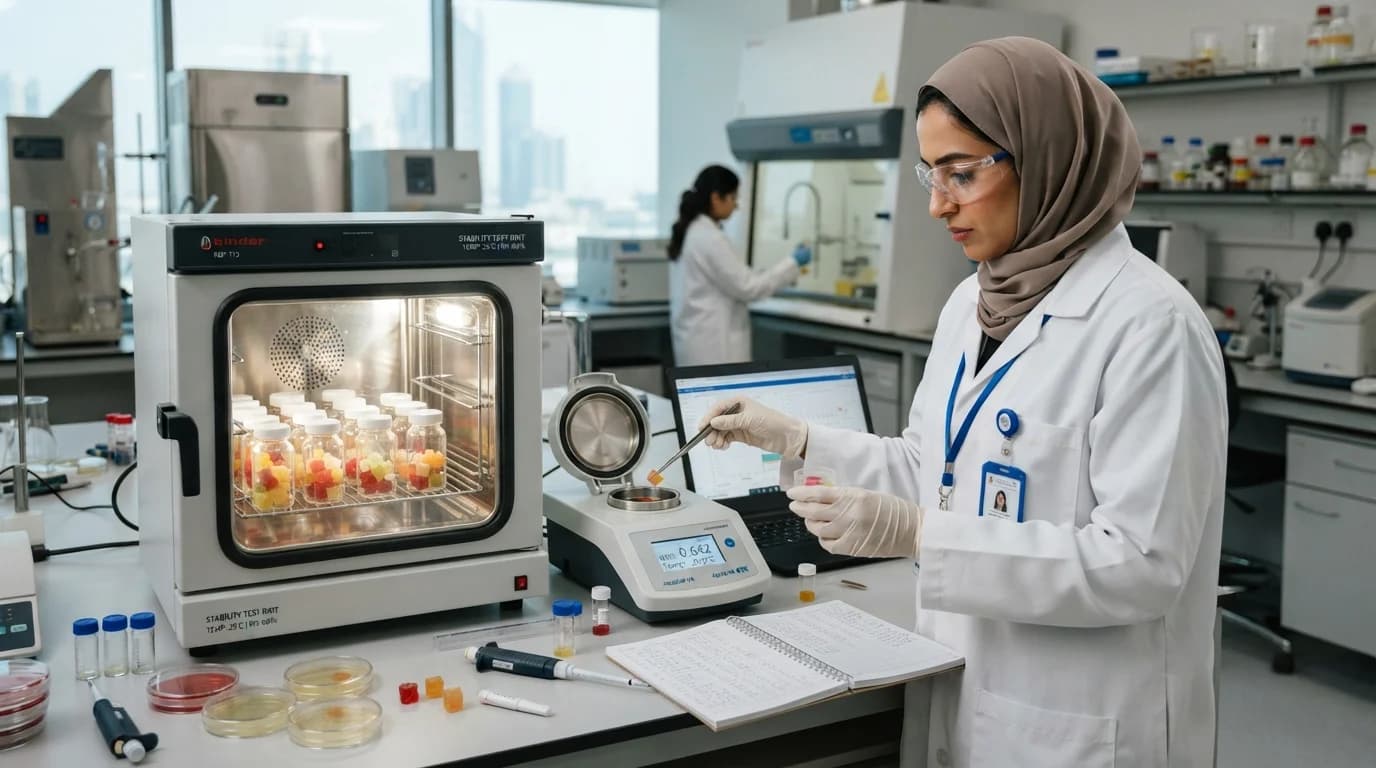
For water activity GCC gummy export, aiming for an aw below 0.65 is critical to prevent microbial spoilage, and pushing below 0.60 is necessary to protect sensitive active ingredients like probiotics.
Low aw Halal Gummies Formulation Strategies
Achieving a low water activity in a pectin matrix without making the gummy unpleasantly tough or crystallized requires sophisticated formulation science.
1. Optimizing the Brix Level
The Brix scale measures the concentration of dissolved solids (primarily sugars). Higher Brix means less free water. To achieve low water activity gummies GCC, formulators must target a final Brix of 78-82%. This high concentration of solids physically binds the water molecules, drastically lowering the aw.
2. Humectant Utilization
Humectants are hygroscopic substances that attract and hold water molecules. By incorporating halal-certified humectants like vegetable glycerin or sorbitol, formulators can bind the free water, lowering the aw while still keeping the gummy soft and chewy.
3. Pectin Selection
Unlike gelatin, which relies on a protein matrix to trap water, pectin is a polysaccharide. Selecting the correct grade of high-methoxyl (HM) or low-methoxyl (LM) pectin, paired with the precise pH buffer, ensures a tight gel network that locks moisture in place, preventing it from migrating and causing stickiness in extreme heat.
Halal Compliance in Low Moisture Gummies
When engineering these shelf stable gummies Middle East, every ingredient used to lower the water activity must remain strictly halal.
- Vegetable Glycerin: Must be derived purely from plant oils (like palm or coconut), completely avoiding any animal fats (tallow).
- Sugar Alcohols (Sorbitol/Maltitol): Used frequently in sugar-free, low-aw formulations, these must be produced via halal-compliant enzymatic processes without haram solvents.
- Polishing Agents: To further lock in moisture and prevent the gummies from sticking together in the heat, a halal-certified carnauba wax and MCT oil polish is applied to the exterior.
Superior Shelf Stability with Probiota Innovations
At Probiota Innovations, we engineer our pectin gummies at a molecular level. By precisely controlling water activity, we produce high-dose, halal-certified gummies that remain stable, delicious, and microbially safe throughout their 24-month shelf life in the GCC.
Learn more about our Advanced Manufacturing Capabilities
Don't let high water activity destroy your product in the Middle East.
Partner with the experts in heat-stable, low-aw gummy formulation.
Contact Our Formulation Scientists Today
For an in-depth understanding of the core concepts, read our comprehensive guide on Target Water Activity in Gummy Manufacturing.
Looking for a manufacturing partner? Explore Our Core Manufacturing Capabilities.
Recommended Manufacturing Solution
Secure your supply chain with our Halal gummy contract manufacturing
Want to discuss your formulation?
Our experts help brands launch technically complex probiotic and functional gummies.