The Future of Functional Gummies: AI-Driven Formulation and Next-Gen Delivery
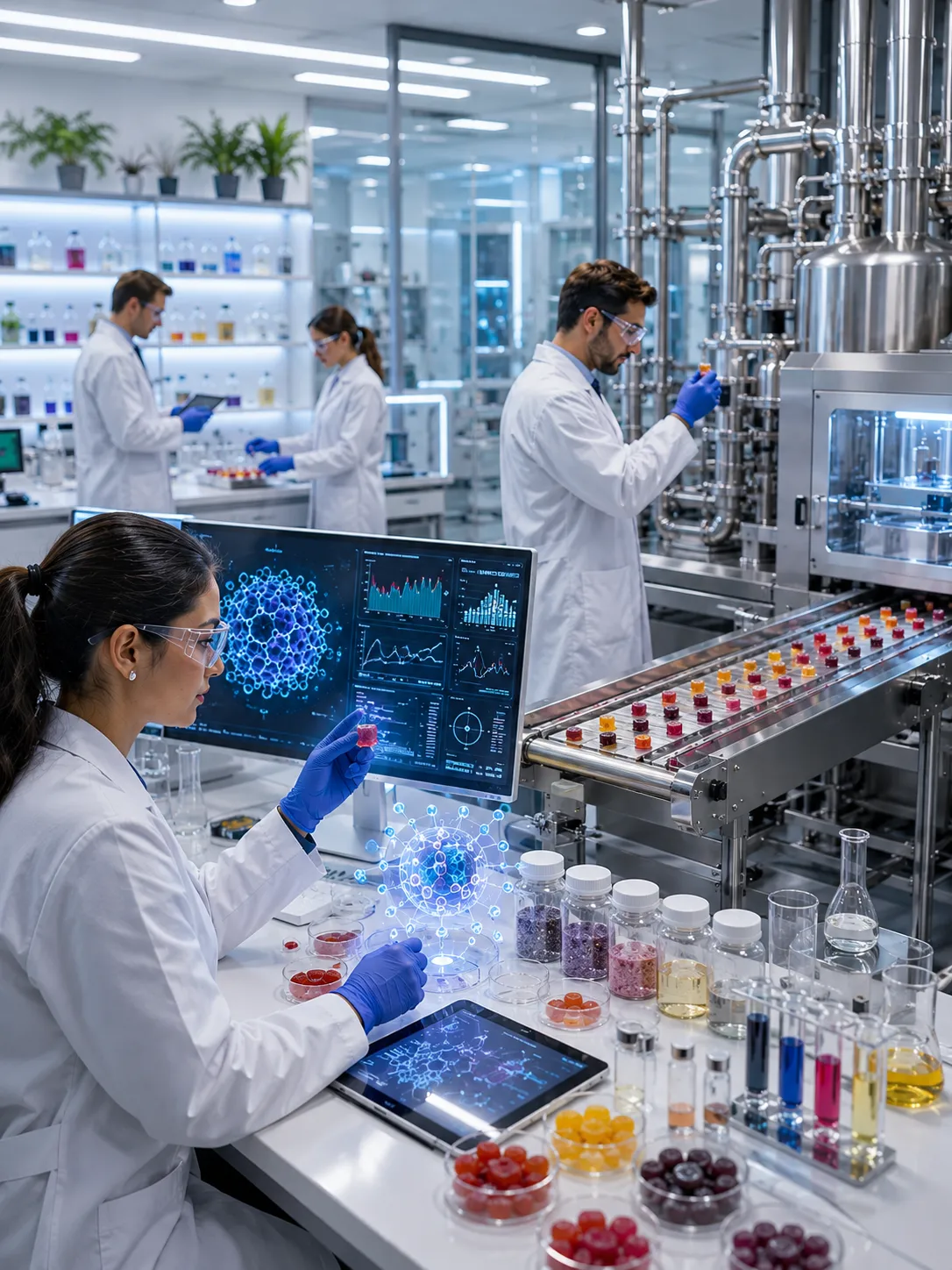
The Future of Functional Gummies: AI-Driven Formulation and Next-Gen Delivery
The functional gummy market has spent the last decade conquering the supplement industry. It successfully transitioned from a novelty format for children’s vitamins into the dominant delivery system for adult nootropics, sports nutrition, and complex botanicals.
However, the "Pectin 1.0" era - where the primary innovation was simply switching from gelatin to vegan pectin - is over.
The market is now entering a hyper-accelerated phase of technological evolution. Driven by the convergence of artificial intelligence, advanced nanotechnology, and radical new manufacturing architecture, the functional gummy of 2030 will barely resemble the products on the shelf today.
If you are building a B2B or D2C wellness brand, resting on standard formulations is a fast track to obsolescence. Here is the technical roadmap for the future of functional gummies and the next-generation delivery systems that will define the next decade of nutraceuticals.
1. AI-Driven Algorithmic Formulation
Historically, formulating a new gummy was an agonizing process of trial and error. A food scientist would mix a batch, wait 48 hours for it to cure, test the Water Activity (aw), and realize the pH was wrong. They would adjust the buffer and start again. Developing a stable, great-tasting Turmeric gummy could take six months and forty pilot batches.
The Machine Learning Pivot
The industry is rapidly adopting AI-Driven Formulation Algorithms.
- Advanced manufacturers are feeding decades of hydrocolloid chemistry data into machine learning models.
- The AI cross-references the molecular weight of thousands of active ingredients against specific pectin profiles, acid buffers, and temperature curves.
- The Result: When a brand requests a highly complex stack (e.g., 200mg of Saffron + 100mg of Magnesium + 50mg of CBD), the AI predicts the exact thermodynamic failure points of the gel before a single kettle is turned on. It generates a perfectly optimized, stable formulation in seconds, cutting R&D lead times from 6 months to 2 weeks.
2. Next-Gen Delivery: Liposomal and Nano-Emulsions
The greatest physical constraint of the gummy format is the "Active Load" limit. A 3-gram gummy can only hold roughly 300mg of raw powder before the pectin structure fails.
The future is not about making larger gummies; it is about making the ingredients microscopically smaller and exponentially more bioavailable.
Liposomal Encapsulation
While liposomes exist today, their application in gummy matrices is about to explode. By encasing active ingredients (like Vitamin C or Curcumin) in microscopic spheres of fat (phospholipids), the nutrient bypasses digestive degradation in the stomach and is absorbed directly into the intestinal cell walls.
- A 50mg dose of Liposomal Curcumin in a future gummy will provide the exact same clinical blood-plasma levels as a 500mg dose of crude powder today. This frees up massive physical space inside the gummy for multi-ingredient stacking.
Nano-Emulsions
For lipid-soluble (oil-based) actives like Omega-3s or CBD, manufacturers are utilizing sonic nano-emulsification. The oil droplets are shattered via ultrasonic waves into nano-particles less than 100 nanometers wide. At this microscopic size, the oil becomes fully water-soluble, allowing it to seamlessly integrate into the pectin base without any separation, greasiness, or flavour degradation.
Learn about Vegan & Pectin Gummies
3. 3D Printing and Hyper-Personalization
As discussed in our breakdown of Personalized Nutrition, the current model relies on algorithmic kitting (putting different pre-made gummies into a single pouch).
The ultimate evolution of personalization is 3D Gummy Printing.
The Point-of-Sale Manufacturing Line
Within the next decade, pharmacies and high-end wellness clinics will not hold thousands of bottles of inventory. They will house multi-nozzle, sterile 3D food printers.
- A consumer scans their smartwatch or provides a rapid blood-prick biomarker test.
- The AI determines their exact daily deficiency (e.g., low D3, high cortisol, low zinc).
- The 3D printer instantly extrudes a single, multi-layered, 5-gram gummy containing the exact milligram dose of the 12 specific nutrients that individual needs on that specific day.
While the high-volume continuous depositing line will always remain the king of mass retail, 3D printing will completely disrupt the ultra-premium, D2C subscription market.
4. The Clean Label Extremity: Upcycled and Synthetic Biology
The definition of "Clean Label" is shifting. Today, it means "No Artificial Dyes or Synthetics." Tomorrow, it will mean "Zero Agricultural Footprint."
Precision Fermentation
Consumers are becoming hyper-aware of the environmental devastation caused by mass agriculture (e.g., deforestation for palm oil or the massive water footprint of botanical farming). The future of active ingredient sourcing is Synthetic Biology and Precision Fermentation.
- Instead of planting 10,000 acres of Marigolds to extract Lutein for vision gummies, manufacturers will use genetically engineered yeast in a sterile fermentation tank to synthesize the exact Lutein molecule identically, rapidly, and with zero agricultural land use.
- This guarantees absolute, 100% purity (zero heavy metals, zero pesticides) and an unbreakable, climate-proof supply chain.
Explore Export-Ready Manufacturing
FAQ
Will AI replace human formulation scientists? No. AI is a predictive tool that rapidly accelerates the initial R&D phase by eliminating obvious chemical failures. However, flavour, texture, and the "bite" profile are profoundly human sensory experiences. The AI cannot taste the bitterness of Ashwagandha; a master food scientist is still required to balance the complex, high-acid flavour masking profiles.
Are liposomal gummies legal for global export? Generally, yes, as the phospholipid delivery vehicles (often derived from sunflower lecithin) are standard, approved food ingredients. However, because liposomes dramatically increase the bioavailability of the active ingredient, brands must be careful not to trigger toxicity limits for certain fat-soluble vitamins in highly regulated markets like the EU.
When will 3D gummy printing become commercially viable? The technology exists today, but the "throughput" (the speed of printing) is currently too slow and too expensive to replace a mass-market retail supply chain. Expect it to become a dominant force in the high-ticket, D2C personalized subscription sector by 2028-2030.
Partner with the Vanguard of Manufacturing
The brands that dominate the next decade of wellness will not be the ones selling generic white-label vitamin C. They will be the brands that leverage advanced technology to deliver unparalleled clinical efficacy in a flawless, personalized format.
At Probiota Innovations, we do not chase trends; we engineer the future. We are actively investing in next-generation hydrocolloid research, advanced liposomal suspension technologies, and data-driven R&D matrix modeling. We provide visionary brands with the bleeding-edge manufacturing infrastructure required to disrupt the global nutraceutical market today, and lead it tomorrow.
Request a Project Brief Explore Functional Gummy Manufacturing
Recommended Manufacturing Solution
Learn how we scale private label probiotic gummies for global brands
Want to discuss your formulation?
Our experts help brands launch technically complex probiotic and functional gummies.