
Water Activity (aw < 0.60) vs. Moisture Content: Preventing Syneresis & Probiotic Death in Pectin Gummies
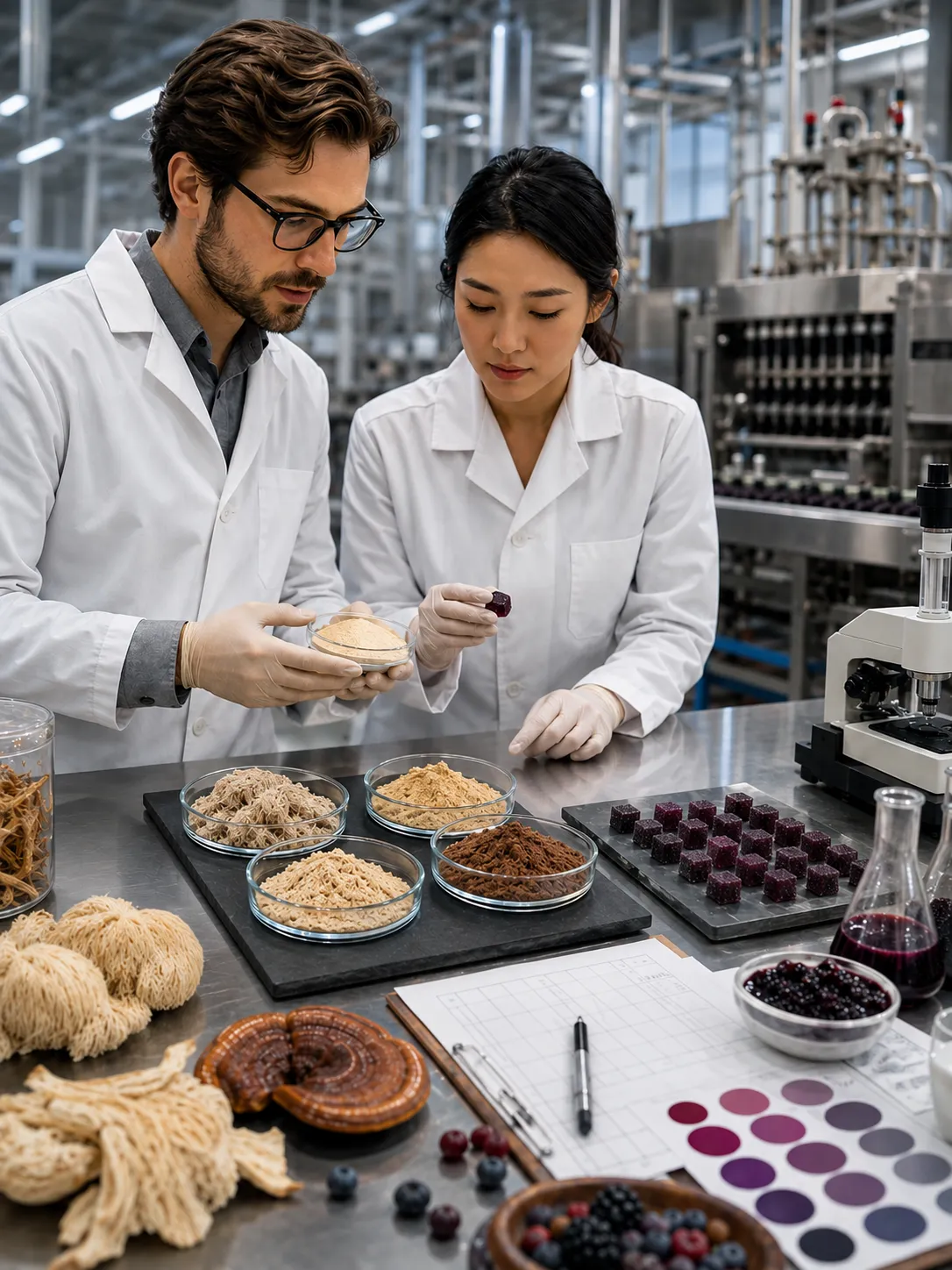
Key Takeaway / Executive Summary (Position 0): In nutraceutical gummy manufacturing, Water Activity ($a_w$), not total moisture percentage, is the definitive parameter controlling microbial safety, physical texture, and probiotic viability. Maintaining a target water activity of $a_w \le 0.60$ (ideally $0.55–0.62$) halts microbial proliferation, prevents destructive gummy syneresis (weeping/sweating), and prevents premature spore germination, guaranteeing a 24-month shelf life.
A common and costly misconception among food supplement formulators is treating Moisture Content (%) and Water Activity ($a_w$) as interchangeable metrics.
A gummy formulation can have an acceptable moisture content of $12%$ yet fail quality stability audits due to a high water activity ($a_w = 0.72$), leading to mold outbreaks, sticky agglomeration, bottle gas generation, and rapid probiotic death. Conversely, an expertly engineered gummy with $16%$ moisture can achieve an ultra-stable water activity of $a_w = 0.58$ through strategic polyol and hydrocolloid water-binding.
This technical engineering guide explains the biophysical differences between moisture content and water activity, moisture sorption isotherms, syneresis prevention mechanisms, and process control levers across continuous drying tunnels.
1. Biophysical Principles: Moisture Content vs. Water Activity ($a_w$)
To ensure quality control under US FDA 21 CFR 111 and USP <1112> (Application of Water Activity Determination to Nonsterile Pharmaceutical Products), formulators must master both definitions:
┌─────────────────────────────────────────────────────────────────────────────────────────┐
│                    MOISTURE CONTENT VS. WATER ACTIVITY ($a_w$)                          │
├──────────────────────────────┬────────────────────────────┬─────────────────────────────┤
│ Dimension / Characteristic   │ Total Moisture Content (%) │ Water Activity ($a_w$)      │
├──────────────────────────────┼────────────────────────────┼─────────────────────────────┤
│ Scientific Definition        │ Quantitative mass of water │ Energy status / chemical    │
│                              │ relative to total sample   │ potential of "free" water   │
│ Mathematical Formula         │ $\frac{\text{Mass of } H_2O}{\text{Total Mass}} \times 100$ | $a_w = \frac{p}{p_0} = \frac{\text{Vapor Pressure of Product}}{\text{Vapor Pressure of Pure Water}}$│
│ Primary Measurement Method   │ Karl Fischer / Loss on Dry │ Chilled-Mirror Dew Point    │
│ Governs What in Gummies?     │ Yield, weight, chewiness   │ **Microbes, Syneresis, CFU**│
└──────────────────────────────┴────────────────────────────┴─────────────────────────────┘
Water activity ranges on a scale from $0.00$ (completely dry) to $1.00$ (pure distilled water). While bound water is chemically immobilized by hydrogen bonds to sugars, polyols, and pectin polymers, unbound "free" water ($a_w$) is available for chemical degradation reactions, enzymatic oxidation, and microbial proliferation.
2. Critical Water Activity Thresholds for Microbial Growth & Actives
┌─────────────────────────────────────────────────────────────────────────────────────────┐
│                    MICROBIAL & STABILITY WATER ACTIVITY LIMITS                           │
├──────────────────────────────┬────────────────────────────┬─────────────────────────────┤
│ Water Activity Range ($a_w$) │ Biological / Physical Risk │ Operational Implication     │
├──────────────────────────────┼────────────────────────────┼─────────────────────────────┤
│ $a_w > 0.91$                 │ Pathogenic Bacteria Growth │ *Salmonella, E. coli* grow  │
│ $a_w = 0.80 – 0.88$          │ Staphylococcus / Spoilage  │ Spoilage yeasts proliferate │
│ $a_w = 0.70 – 0.75$          │ Xerophilic Molds           │ Surface mold contamination  │
│ $a_w = 0.65 – 0.70$          │ Osmotolerant Yeasts        │ Sugar fermentation, gassing │
│ $a_w = 0.62 – 0.65$          │ Premature Spore Germination│ Probiotic spores germinate  │
│ **$a_w = 0.55 – 0.60$**      │ **OPTIMAL STABILITY ZONE** │ **No Microbes, Zero Weep**  │
│ $a_w < 0.50$                 │ Over-Drying / Case Hardening│ Gummy becomes brittle/hard  │
└──────────────────────────────┴────────────────────────────┴─────────────────────────────┘
Why Probiotics Die at High $a_w$:
- Vegetative Membrane Rupture: When $a_w > 0.65$, free water molecules hydrate lipid bilayers in bacterial membranes, triggering spontaneous metabolic activation. Without adequate nutrients in the gummy matrix, vegetative cells quickly starve and lyse.
- Premature Spore Germination: Dormant Bacillus endospores interpret elevated water activity as an environmental signal to shed their protective protein coat. Once germinated inside the acidic gummy candy, vegetative cells succumb to ambient temperatures.
3. The Science of Gummy Syneresis (Weeping & Sweating)
graph LR
    A[Unbalanced Formulation: Low Brix / High aw] --> B[Water Molecules Expelled from Pectin Lattice]
    B --> C[Surface Droplets Form on Gummy]
    C --> D[Dissolves Surface Sugars -> Sticky Liquid Slurry -> Gummies Fuse in Bottle]
Syneresis (commonly termed "weeping" or "sweating") occurs when the three-dimensional pectin gel network contracts and expels interstitial water to the gummy surface.
Primary Formulation Causes of Syneresis:
- Excessively Low pH ($\text{pH } < 3.10$): Severe acidity causes over-hydrolysis of pectin chains, collapsing the junction zones.
- Insufficient Total Soluble Solids ($< 78^\circ\text{Bx}$): Inadequate sugar/polyol solids leave unbound water free to migrate.
- Improper High-Methoxyl / Low-Methoxyl Ratio: High-ester pectins require precise sucrose concentration ($\approx 65%$) and acid to gel; if solids are low, the network fails to immobilize water.
4. Engineering Low-$a_w$ Formulations on the Factory Floor
Probiota Innovations enforces strict continuous process controls to maintain $a_w \le 0.60$ across millions of units:
- Continuous Cooking to Target Brix: Pectin slurries are cooked in vacuum evaporation skids to an exact $80.0^\circ\text{Bx} \pm 1.0^\circ\text{Bx}$ prior to deposition.
- Humectant Optimization: Incorporating multi-functional polyols (Maltitol, Sorbitol, Glycerin) and Soluble Tapioca Fiber (FOS) that chemically bind water molecules via multiple hydroxyl ($-\text{OH}$) groups.
- Automated Climate-Controlled Curing Rooms: Post-depositing, gummies cure for 18–36 hours in cleanrooms held at $20^\circ\text{C} \pm 2^\circ\text{C}$ and $25% \pm 3%\text{ Relative Humidity}$, gradually driving free water out until equilibrium $a_w = 0.58$ is reached.
- Induction Sealing & Desiccant Canisters: Bottling lines feature in-line induction foil sealing to prevent post-packaging moisture re-absorption from high-humidity retail environments.
Frequently Asked Questions (FAQ)
Why is water activity ($a_w$) more important than total moisture percentage?
Total moisture percentage only measures the mass of water in the gummy, while water activity measures the energy status of "free" water. Microorganisms and chemical degradation reactions cannot use bound water; they strictly require free water ($a_w > 0.65$) to metabolize and reproduce.
What is the ideal water activity range for probiotic pectin gummies?
The gold-standard target range for probiotic pectin gummies is $a_w = 0.55\text{ to }0.62$. This range guarantees complete microbial safety, prevents syneresis, and keeps probiotic spores dormant.
How is water activity measured in commercial production?
Water activity is verified on every production batch using a calibrated Chilled-Mirror Dewpoint Hygrometer (such as an Aqualab meter), which measures the exact relative equilibrium humidity of the headspace directly above the homogenized gummy sample to an accuracy of $\pm 0.003,a_w$.
Looking for stable, non-weeping probiotic gummy manufacturing with documented $a_w$ stability? Explore our Private Label Probiotic Capabilities or consult with our formulation scientists.
Recommended Manufacturing Solution
Learn how we scale private label probiotic gummies for global brands
Want to discuss your formulation?
Our experts help brands launch technically complex probiotic and functional gummies.