
Spore-Forming Probiotics in Gummies: Thermal Survival Kinetics & Starchless Depositing of Bacillus coagulans
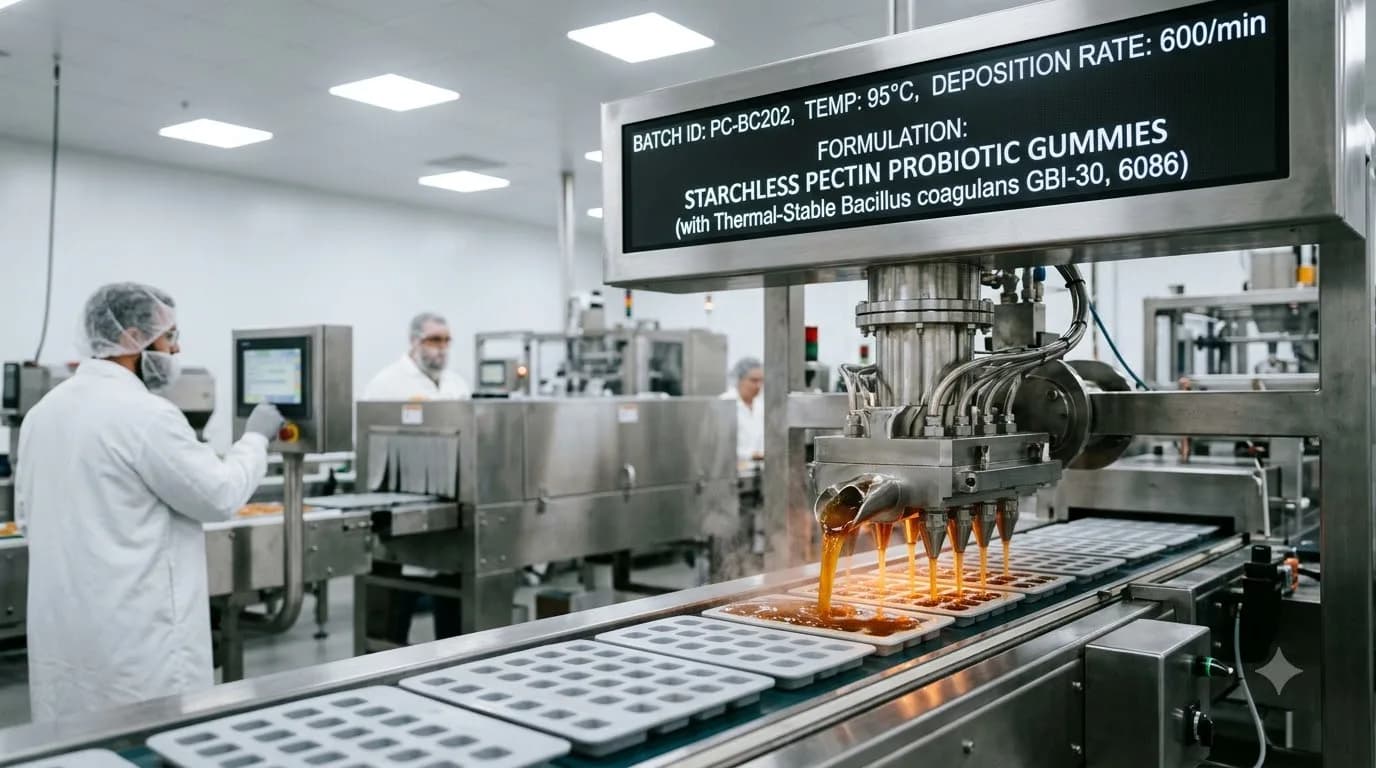
Key Takeaway / Executive Summary (Position 0): Spore-forming Bacillus coagulans provides unmatched thermal stability in gummy manufacturing, withstanding continuous cooking temperatures of $75–85^\circ\text{C}$ ($167–185^\circ\text{F}$) and low-pH acidic pectin matrices ($\text{pH } 3.2–3.5$). Unlike fragile vegetative Lactobacillus and Bifidobacterium strains that suffer 99% thermal death during gummy depositing, dormant B. coagulans endospores guarantee $> 90%$ CFU viability and 24-month ambient shelf life without refrigeration.
The global probiotic gummy market represents one of the fastest-growing categories in consumer wellness. However, for pharmaceutical formulators and bioprocess engineers, incorporating live microorganisms into a hot, acidic, water-containing gummy matrix is one of the most difficult challenges in modern food science.
Traditional vegetative probiotic genera—such as Lactobacillus acidophilus, Bifidobacterium lactis, and Lactobacillus rhamnosus—possess delicate phospholipid cell membranes that lyse and die when subjected to standard confectionery cooking temperatures ($> 70^\circ\text{C}$), acidic buffer environments ($\text{pH } < 3.8$), and high water activity ($a_w$).
The clinical and commercial solution is the strategic utilization of spore-forming probiotic strains, predominantly Bacillus coagulans and Bacillus subtilis.
This technical whitepaper details the biophysical architecture of bacterial endospores, thermal death kinetics ($D$-values and $z$-values), manufacturing dosing protocols, and real-time CFU retention data across continuous starchless depositing lines.
1. Biophysical Architecture of the Bacillus coagulans Endospore
The extreme resilience of Bacillus coagulans is directly attributable to its multi-layered protective spore coat structure formed during nutrient-depleted sporulation:
┌─────────────────────────────────────────────────────────────────────────────────────────┐
│                    BACILLUS COAGULANS ENDOSPORE MORPHOLOGY                              │
├──────────────────────────────────────┬──────────────────────────────────────────────────┤
│ Structural Layer                     │ Protective Biological Function                   │
├──────────────────────────────────────┼──────────────────────────────────────────────────┤
│ **Exosporium & Outer Spore Coat**    │ Dense proteinaceous shield resisting enzymes     │
│ **Inner Coat & Spore Cortex**        │ Thick peptidoglycan layer maintaining dehydration│
│ **Germ Cell Wall & Core Membrane**   │ Impermeable barrier against acids & free radicals│
│ **Dehydrated Spore Core**            │ Low water content ($\sim 10–25\%$); enriched with │
│                                      │ **Calcium Dipicolinate (Ca-DPA)** & SASPs        │
└──────────────────────────────────────┴──────────────────────────────────────────────────┘
The combination of core dehydration, Calcium Dipicolinate (Ca-DPA) chelation, and Small Acid-Soluble Spore Proteins (SASPs) saturating the bacterial DNA renders Bacillus coagulans virtually immune to thermal denaturation, osmotic pressure, and high-shear mixing.
2. Thermal Death Kinetics: B. coagulans vs. Vegetative Probiotics
To design an effective gummy depositing cycle, formulators must calculate the Decimal Reduction Time ($D$-value)—the time required at a given temperature to reduce microbial populations by 1 log ($90%$ reduction).
┌─────────────────────────────────────────────────────────────────────────────────────────┐
│                     COMPARATIVE THERMAL KINETICS ($D$-VALUES)                           │
├──────────────────────────────────────┬──────────────────────┬───────────────────────────┤
│ Microorganism / Strain Type          │ $D_{70^\circ\text{C}}$ (Minutes)│ $D_{85^\circ\text{C}}$ (Minutes) │
├──────────────────────────────────────┼──────────────────────┼───────────────────────────┤
│ *Lactobacillus acidophilus* (Veg.)   │ **0.15 – 0.40 min**  │ $< 0.01\text{ min (Instant death)}$│
│ *Bifidobacterium longum* (Veg.)      │ **0.10 – 0.30 min**  │ $< 0.01\text{ min (Instant death)}$│
│ *Bacillus coagulans* (Endospores)    │ **$> 120.0\text{ min}$**│ **$12.0 – 25.0\text{ min}$** │
│ *Bacillus subtilis* (Endospores)     │ **$> 180.0\text{ min}$**│ **$18.0 – 35.0\text{ min}$** │
└──────────────────────────────────────┴──────────────────────┴───────────────────────────┘
graph TD
    A[Cooked Pectin Slurry at 105°C] --> B[Vacuum Cooling Skid to 78°C - 82°C]
    B --> C[Inline Dynamic Dosing of Bacillus coagulans Spores]
    C --> D[Acid Injection & Color/Flavor Blending at 75°C]
    D --> E[Starchless Depositing into Silicone Molds]
    E --> F[Rapid Cooling Tunnel 15°C -> Zero CFU Degradation]
Key Manufacturing Rules for Probiotic Dosing:
- Dosing Point: Spores should never be added to the primary cooking kettle ($> 100^\circ\text{C}$). Dosing occurs in an in-line high-shear dynamic mixing manifold immediately before the depositor head at $75–82^\circ\text{C}$.
- Residence Time: Dwell time in the depositor hopper is strictly minimized to under 15 minutes.
- Acid Shock Prevention: Invert syrup, citric acid, and sodium citrate buffers are co-injected downstream of spore addition to avoid localized low-pH acid shock.
3. Comprehensive Probiotic Strain Comparison for Gummy Formulations
| Strain / Genera | Thermal Tolerance | Shelf-Life Viability ($25^\circ\text{C}$) | Gastric Acid Survival | Gummy Manufacturing Suitability |
|---|---|---|---|---|
| Bacillus coagulans | Exceptional ($> 85^\circ\text{C}$) | $> 95%$ at 24 Months | $> 90%$ at $\text{pH } 2.0$ | Optimal for High-Volume Production |
| Bacillus subtilis | Exceptional ($> 90^\circ\text{C}$) | $> 95%$ at 24 Months | $> 92%$ at $\text{pH } 2.0$ | Optimal for Gut-Immune Formulas |
| Lactobacillus rhamnosus | Poor ($< 55^\circ\text{C}$) | $< 10%$ at 6 Months | Moderate (Needs microencapsulation) | Requires 500%+ input overage / Cold cure |
| Bifidobacterium lactis | Poor ($< 50^\circ\text{C}$) | $< 5%$ at 6 Months | Low (Degrades in acid) | Not recommended for cooked gummies |
4. Real-Time Stability & Microbiological Assay Protocols
To meet US FDA 21 CFR 111 and international pharmacopeial standards, finished batches must undergo validated selective spore enumeration:
- Heat-Shock Assay (USP <61>/<62> Modified): Finished gummy samples are homogenized in phosphate-buffered saline (PBS) and subjected to a heat-shock step at $70^\circ\text{C}$ for 30 minutes to kill any incidental vegetative cells while germinating pure Bacillus spores for accurate plating.
- Water Activity Constraint: Finished product water activity is maintained between $a_w = 0.55$ and $0.62$. If $a_w$ exceeds $0.65$, spores risk premature germination inside the bottle, followed by vegetative cell death under ambient storage.
Frequently Asked Questions (FAQ)
At what manufacturing temperature should Bacillus coagulans spores be added?
Bacillus coagulans spores are dosed via an automated in-line metering manifold after primary cooking and vacuum cooling, at temperatures between $75^\circ\text{C}$ and $82^\circ\text{C}$, immediately prior to deposition into starchless molds.
Do Bacillus coagulans probiotic gummies require refrigeration?
No. Because Bacillus coagulans remains in a dormant endospore state inside the dry, low-water-activity ($a_w < 0.60$) gummy matrix, it maintains full CFU viability at ambient room temperature ($20–25^\circ\text{C}$) for 24 months without cold-chain storage.
How is Bacillus coagulans tested on the finished product Certificate of Analysis (COA)?
Testing is conducted using a validated heat-shock enumeration protocol (homogenization followed by $70^\circ\text{C}$ incubation for 30 minutes) and plated on Glucose Yeast Extract Agar (GYEA) or Nutrient Agar, with genetic identity confirmed via 16S rRNA gene sequencing.
Ready to formulate a clinically backed, heat-stable probiotic gummy? Explore our Private Label Probiotic Solutions or consult with our bioprocess science team.
Recommended Manufacturing Solution
Explore our private label probiotic gummy manufacturing capabilities
Want to discuss your formulation?
Our experts help brands launch technically complex probiotic and functional gummies.