Optimizing Pectin Formulations for Scalable, High-Quality Supplement Gummies
Optimizing Pectin Formulations for Scalable, High-Quality Supplement Gummies
Moving a pectin gummy formulation from the R&D benchtop to a high-volume commercial production line is one of the most technically demanding transitions in nutraceutical manufacturing.
Unlike gelatin, which is highly forgiving and gels simply by cooling down, pectin is a volatile hydrocolloid. It requires a precise symphony of chemistry and thermodynamics to form its matrix. If a formulation is not rigorously optimized for scale, it will result in pre-gelled pipes, weeping gummies, or total batch failure.
Here is how elite Contract Manufacturing Organizations (CMOs) optimize pectin formulations for scalable, defect-free production.
The Chemistry of High-Methoxyl (HM) Pectin
In supplement manufacturing, the standard gelling agent is High-Methoxyl (HM) Pectin, derived from citrus peels or apples. HM Pectin molecules naturally repel each other in solution. To force them to bond and create a 3D "egg-box" gel matrix, two exact conditions must be met simultaneously:
- Low pH (Acidic Environment): The electrical charges repelling the pectin molecules must be neutralized. This happens precisely between a pH of 3.2 and 3.6.
- High Dissolved Solids (Brix): There must be enough dissolved solids (sugar or sugar alcohols) to pull water away from the pectin molecules, forcing them to interact. This occurs at a brix level of 78% to 82%.
The Challenge of Scale: Pre-Gelation
On a small R&D benchtop, achieving this balance is easy. You mix the ingredients in a beaker, pour them into a silicone mold, and wait.
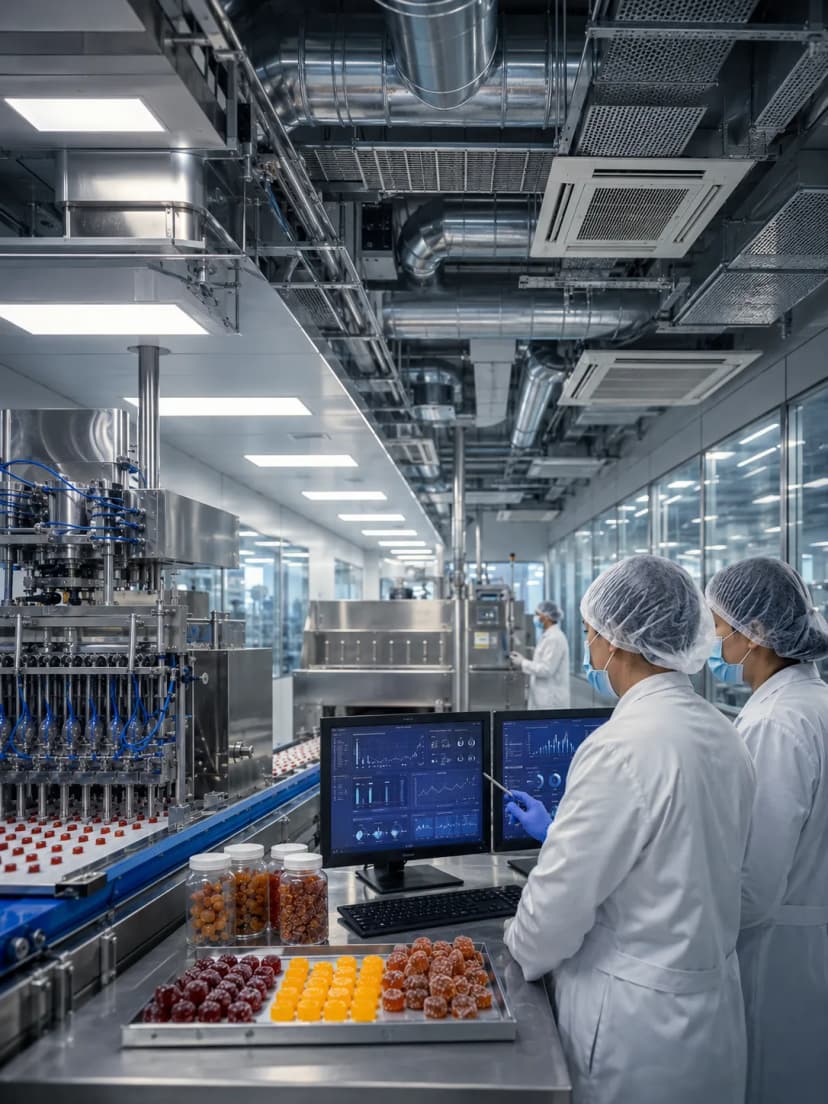
At commercial scale, you are dealing with thousands of liters of boiling syrup moving through hundreds of feet of stainless steel piping in a continuous cooking system. The ultimate enemy of scale is pre-gelation—when the pectin begins to set inside the pipes or the depositing nozzles before reaching the mold. If this happens, the line clogs, production halts, and the entire batch is destroyed.
Strategy 1: Inline Acid Dosing
To prevent pre-gelation, the acid catalyst (typically a buffered solution of Citric Acid and Sodium Citrate) is never added to the main mixing tank. The pectin syrup is cooked to the correct brix (around 80%) while remaining at a neutral pH, keeping it in a liquid state. The acid is injected via highly precise inline dosing pumps exactly milliseconds before the syrup reaches the depositing nozzles. This ensures the chemical reaction (gelation) only begins as the syrup hits the mold.
Strategy 2: Managing the "Setting Temperature"
Different HM pectins have different setting temperatures (the temperature at which the gel begins to form rapidly). Fast-set pectins gel at higher temperatures (often >85°C), while slow-set pectins gel at lower temperatures. For high-volume continuous depositing, CMOs must perfectly match the setting temperature of the pectin blend to the speed of the depositing stroke and the thermal dynamics of the cooling tunnel.
Optimizing for Active Ingredients
Adding active nutraceuticals (like botanicals, vitamins, or minerals) introduces chaos to the pectin matrix.
- Minerals (Calcium, Magnesium, Iron): Divalent cations interact aggressively with pectin. High mineral loads can instantly shock the pectin into pre-gelling. CMOs must use specialized chelated minerals or adjust the buffering salts to protect the pectin matrix.
- Botanical Powders: Adding high volumes of insoluble powders (like Ashwagandha root) changes the viscosity (thickness) of the syrup. The CMO must calibrate the shear-mixing speed and adjust the brix target to ensure the slurry remains thin enough to pass through the depositing nozzles without clogging.
At Probiota Innovations, our starchless mogul technology and continuous cooking systems are explicitly engineered to handle the volatile rheology of HM Pectin. We master the chemistry so your brand can scale globally without fear of batch failure.
Frequently Asked Questions (FAQ)
1. What is "Syneresis" or "Weeping" in pectin gummies? Syneresis occurs when the pectin matrix contracts and squeezes out free water, making the gummy look wet or "sweaty" in the bottle. It is usually caused by the pH being too low (too acidic) or the brix being too low during manufacturing.
2. Can you use Low-Methoxyl (LM) Pectin for gummies? Generally, no. LM Pectin requires calcium ions to gel rather than acid and high sugar. While useful in low-sugar jams or dairy products, it forms a brittle, unappealing texture that does not mimic the desired "chew" of a commercial supplement gummy.
3. Does scaling up affect the flavor of the gummy? If not managed properly, yes. Boiling the syrup for too long in large commercial tanks can flash off the volatile aromatic compounds of natural flavors. Elite CMOs use continuous cooking systems that expose the syrup to high heat for mere seconds, preserving the exact flavor profile developed on the benchtop.
Recommended Manufacturing Solution
Want to discuss your formulation?
Our experts help brands launch technically complex probiotic and functional gummies.