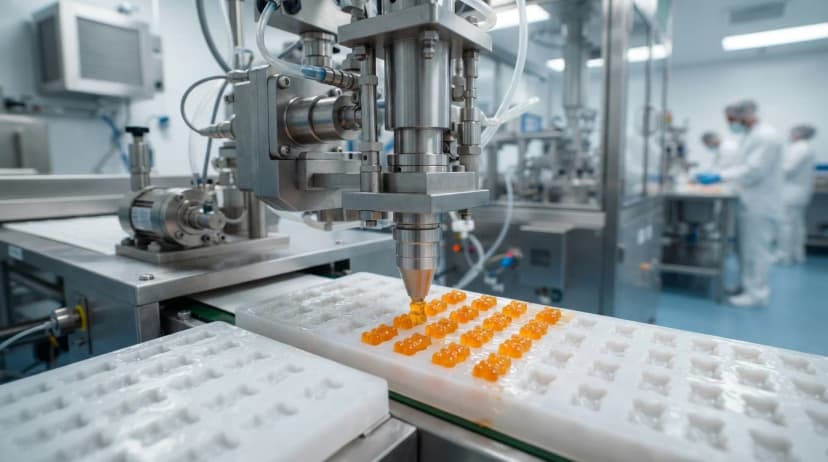
Understanding Excipients in Gummy Manufacturing: Carnauba Wax vs MCT Oil Polishing
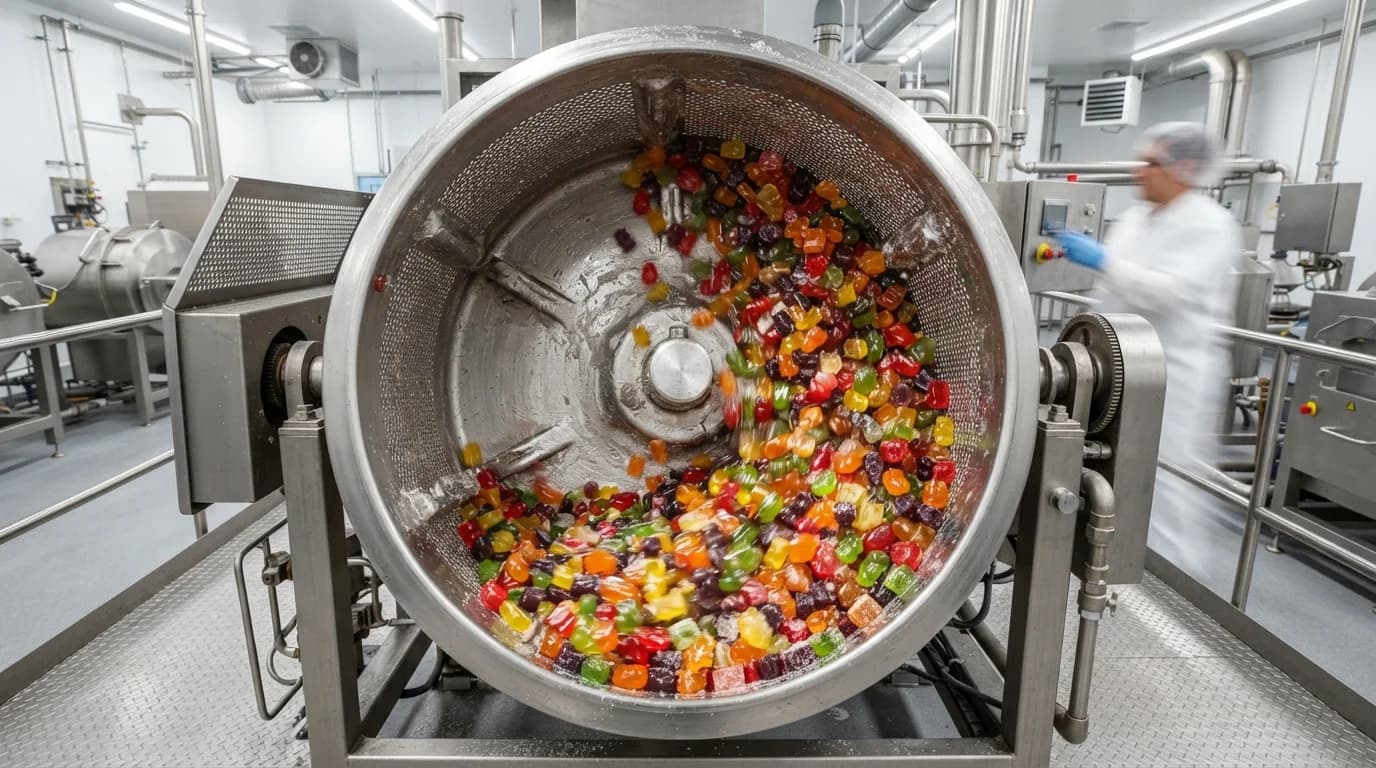
Understanding Excipients in Gummy Manufacturing: Carnauba Wax vs MCT Oil Polishing
The gummy manufacturing process does not end when the product is ejected from the mold. Whether it is a starch-molded gelatin bear or a starchless vegan pectin drop, the gummy emerges slightly tacky and highly susceptible to ambient moisture.
If these raw gummies were dumped directly into a retail bottle, they would rapidly fuse into a solid, unyielding mass during transport. To prevent this, Contract Manufacturing Organizations (CMOs) execute a critical final step: Polishing (or Coating).
This guide explores the role of gummy excipients in the polishing phase, specifically comparing the industry standards of Carnauba wax gummies and MCT oil gummies, and how they solve the problem of preventing gummy clumping.
The Purpose of Polishing
The polishing drum (or oiling drum) is a massive rotating cylinder. Raw gummies are tumbled inside while a precisely metered blend of oils and waxes is sprayed over them. This process achieves three critical objectives:
- Anti-Caking (Preventing Clumping): This is the primary function. The microscopic layer of oil/wax acts as a physical lubricant, preventing the sticky surfaces of the gummies from adhering to one another inside the bottle.
- Moisture Barrier: While not a substitute for proper formulation (low Water Activity), the hydrophobic (water-repelling) layer of wax provides a vital first line of defense, slowing down the absorption of ambient humidity and protecting the gummy from syneresis (weeping).
- Aesthetics (The Shine): The polish transforms a dull, matte gummy into a brilliant, translucent, premium-looking product that pops on the retail shelf.
The Contenders: Choosing the Right Polish
The exact formulation of the gummy polishing agents is often a closely guarded trade secret of the CMO, tailored to the specific hydrocolloid (pectin vs. gelatin) and the target climate. However, the core ingredients remain consistent.
1. Carnauba Wax (The Hard Barrier)
Carnauba wax is derived from the leaves of the Copernicia prunifera palm grown in Brazil. It is one of the hardest natural waxes in the world.
- The Advantage: Carnauba provides an incredibly hard, glossy, and durable finish. Because of its high melting point (approx. 82°C / 180°F), it provides exceptional heat stability. It creates a robust physical barrier that aggressively prevents gummies from fusing, even in hot export climates. It is universally accepted as a clean-label, vegan ingredient.
- The Application Challenge: Because it is so hard, it cannot be sprayed as a pure solid. It must be melted and blended with a carrier oil to be effectively dispersed over the gummies in the polishing drum.
2. MCT Oil (The Clean Carrier)
Medium-Chain Triglycerides (MCT) oil, usually fractionated from coconut or palm kernel oil, is highly popular in modern clean-label manufacturing.
- The Advantage: Unlike standard vegetable oils (like Canola or Sunflower), high-quality MCT oil is highly resistant to oxidation. It will not go rancid quickly, preserving the shelf life and flavor of the gummy. It provides a beautiful, clean shine and acts as an excellent carrier for suspending carnauba wax.
- The Keto Appeal: MCT oil carries a health halo, often associated with ketogenic diets and cognitive health, making it an attractive "Other Ingredient" on the supplement facts panel compared to generic vegetable oils.
3. Sugaring (The Alternative Polish)
Instead of oil/wax, some brands opt for a "sugar sanding" (coating the gummy in fine granulated sugar or citric acid).
- This provides a highly effective physical barrier against clumping and offers a pleasing, textured mouthfeel (often used for sour gummies). However, it adds significant sugar to the nutritional panel and can mask the beautiful translucency of a premium pectin gummy.
The Engineering of the Perfect Polish
Applying the polish is an exercise in extreme precision.
- The Over-Polishing Flaw: If the CMO applies too much oil/wax, the gummies become greasy. The excess oil pools at the bottom of the bottle, staining the label and creating a repulsive consumer experience.
- The Under-Polishing Flaw: If the CMO applies too little, the anti-caking barrier is incomplete. The gummies will inevitably stick together during hot summer transit.
- The Micro-Dosing Solution: Premium CMOs utilize advanced, automated spray nozzles inside the polishing drum that atomize the Carnauba/MCT blend into a microscopic mist, ensuring a perfect, uniform, ultra-thin coating across tens of thousands of gummies simultaneously.
Polished to Perfection with Probiota Innovations
At Probiota Innovations, we understand that the consumer's first physical interaction with your brand is pulling a gummy out of the bottle. It must not be sticky, and it must not be greasy.
We utilize proprietary, clean-label polishing blends—leveraging high-grade Carnauba wax and oxidation-resistant MCT oils. Our automated polishing drums ensure precise, micro-dosed application, guaranteeing that your export-ready pectin gummies boast a brilliant, non-stick, premium finish that survives global logistics intact.
Explore our Complete Manufacturing and Finishing Capabilities
Frequently Asked Questions (FAQ)
1. Is Carnauba wax safe to eat? Yes. Carnauba wax is widely recognized as safe (GRAS) by the FDA and other global regulatory bodies. It is indigestible and simply passes through the human body. It is the exact same wax used to coat apples in the grocery store and to provide the hard shell on M&M's and Skittles.
2. Can I use Beeswax instead of Carnauba wax? Yes, beeswax is a common polishing agent and provides a good shine. However, it is not vegan. Brands utilizing pectin to create a 100% plant-based, vegan-certified gummy must avoid beeswax and use Carnauba wax instead.
3. Why do some gummies taste rancid after a year? This is often a failure of the polishing agent, not the gummy itself. If a cheap CMO uses standard, easily oxidized vegetable oils (like soybean or canola oil) for the polish, that thin layer of oil is exposed to oxygen in the bottle. Over time, it oxidizes (goes rancid), creating a terrible smell and taste upon opening the bottle. High-quality MCT oil prevents this.
4. Do sugar-free gummies use the same polishing agents? Generally, yes. The MCT oil / Carnauba wax blend works perfectly well on sugar-free polyol matrices (like Maltitol or Erythritol) to prevent clumping and provide a protective moisture barrier.
Recommended Manufacturing Solution
Explore our private label probiotic gummy manufacturing capabilities
Want to discuss your formulation?
Our experts help brands launch technically complex probiotic and functional gummies.