Choosing the Right Bottle Material (PET vs HDPE) for Low Water Activity Gummies
Choosing the Right Bottle Material (PET vs HDPE) for Low Water Activity Gummies
When formulating a premium functional gummy, massive resources are expended engineering the perfect low Water Activity (aw) to ensure microbial stability and active ingredient viability. However, if that highly engineered gummy is placed into the wrong plastic bottle, the ambient environment will inevitably conquer the formulation.
In the dietary supplement industry, the packaging is the primary physical barrier defending the product. The two dominant plastics utilized are PET (Polyethylene Terephthalate) and HDPE (High-Density Polyethylene).
Choosing between PET vs HDPE gummies packaging is not merely an aesthetic decision; it is a critical thermodynamic calculation based on Moisture Vapor Transmission Rates (MVTR). This guide breaks down the science of gummy bottle materials and how to select the correct barrier for your formulation.
The Threat: Moisture Vapor Transmission Rate (MVTR)
No plastic is perfectly impermeable. Over a 24-month shelf life, microscopic amounts of oxygen and moisture vapor will pass directly through the solid plastic walls of the bottle. This rate of permeation is measured as the Moisture Vapor Transmission Rate (MVTR).
If a bottle has a high MVTR, too much ambient humidity will penetrate the packaging. The internal desiccant will quickly saturate, the gummies will absorb the excess moisture, the aw will spike, and the gummies will melt (syneresis) or mold.
Low water activity gummy packaging requires a bottle material with a sufficiently low MVTR to protect the product.
1. PET (Polyethylene Terephthalate)
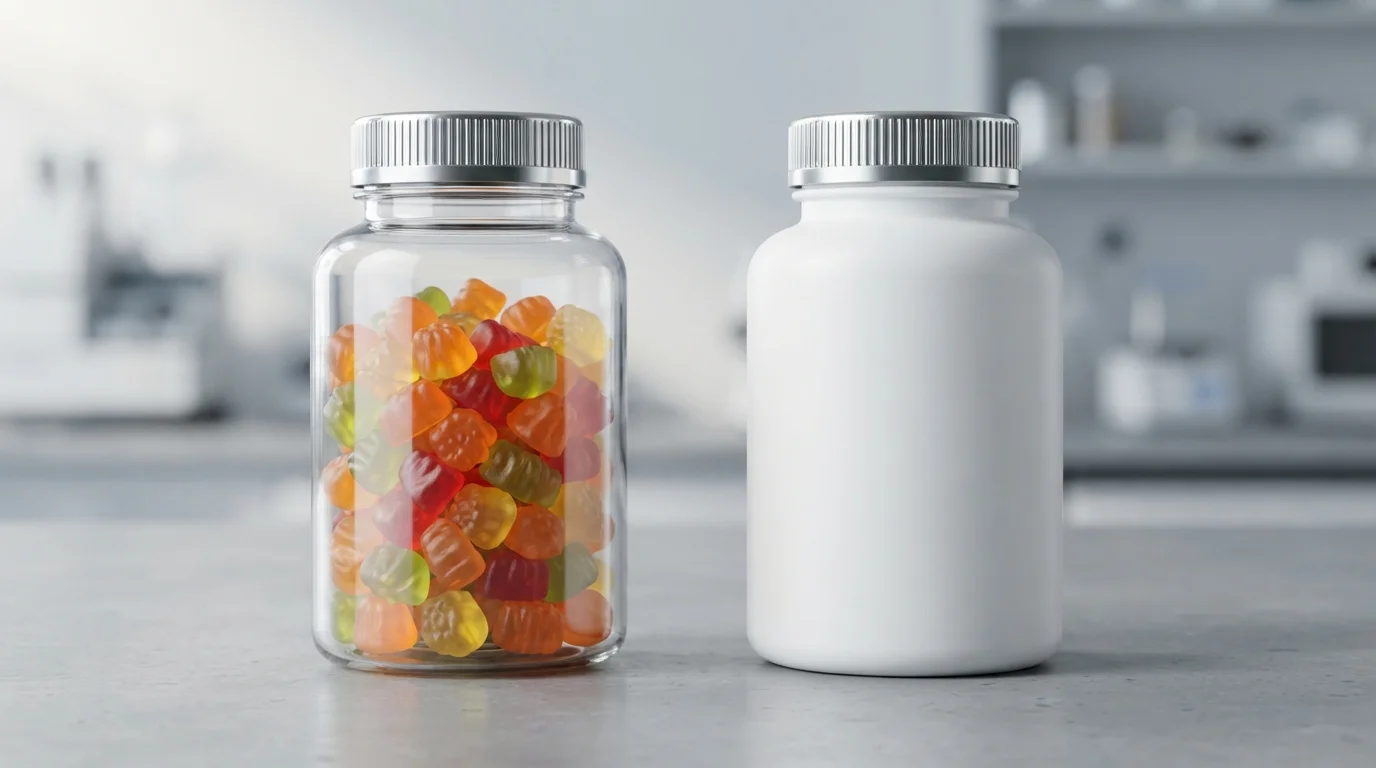
PET is the clear, glass-like plastic used for water bottles and premium supplement packaging.
The Advantages of PET
- Visual Appeal: PET's primary advantage is absolute clarity. For beautifully colored, starchless pectin gummies, PET allows the consumer to see the premium quality of the product immediately, driving retail sales.
- Oxygen Barrier: PET is a vastly superior barrier to oxygen compared to HDPE. If your gummy contains oxygen-sensitive active ingredients (like Omega-3 fish oils, which turn rancid when oxidized, or sensitive Vitamin C), PET is often the mandatory choice.
The Disadvantages of PET
- Moisture Barrier: While decent, PET has a significantly higher MVTR (poorer moisture barrier) than HDPE. If you are exporting clear PET bottles to a highly humid climate (like Florida or Southeast Asia), you must use thicker-walled PET bottles and upsize the internal desiccant packet to compensate for the moisture that will inevitably permeate the plastic.
- Rigidity: PET is highly rigid. If dropped, especially in cold environments, it is more prone to cracking than HDPE.
2. HDPE (High-Density Polyethylene)
HDPE is the opaque, slightly flexible plastic (typically white) used for milk jugs and standard pharmaceutical pill bottles.
The Advantages of HDPE
- The Ultimate Moisture Barrier: HDPE possesses a phenomenally low MVTR. It is an exceptional barrier against moisture vapor. For highly hygroscopic gummies or formulations utilizing sensitive probiotics that die rapidly in the presence of free water, HDPE provides a much safer, more robust thermodynamic fortress than PET.
- Light Protection: Because HDPE is opaque (especially when pigmented white or dark colors), it completely blocks UV light. If your gummies contain light-sensitive vitamins (like Riboflavin/B2) or natural colorants that fade under fluorescent retail lights, HDPE protects them perfectly.
- Durability and Cost: HDPE is highly impact-resistant (it won't shatter) and is generally slightly cheaper to procure at scale than heavy-wall PET.
The Disadvantages of HDPE
- Zero Clarity: The consumer cannot see the gummies. Brands must rely entirely on the label artwork to convey the quality and format of the product.
- Poor Oxygen Barrier: HDPE is highly permeable to oxygen. It should not be used for highly oxidizable lipids (like raw Omega-3s) without specific oxygen-scavenging desiccants.
Making the Strategic Choice
The decision requires balancing marketing desires with chemical realities.
- Choose PET when: The gummies are visually stunning (translucent pectin), contain oxygen-sensitive actives, and are being sold in temperate climates (Zone II), or when you have mathematically compensated with sufficient desiccants for humid climates.
- Choose HDPE when: The gummies are highly sensitive to moisture (e.g., live probiotics, specialized sugar-free matrices), contain light-sensitive vitamins, or are being exported directly into brutal, high-humidity climates (Zone IVa) where a moisture failure is unacceptable.
The Probiota Innovations Packaging Matrix
At Probiota Innovations, we do not guess at packaging. Our formulation scientists and packaging engineers work in tandem.
We analyze the specific aw, oxygen sensitivity, and light degradation curves of your custom formulation. Based on your target export markets, we calculate the exact MVTR required and recommend the optimal dietary supplement packaging plastics—whether that is thick-walled clear PET for retail impact or robust opaque HDPE for maximum shelf-life security.
Explore our Advanced Packaging and Turnkey Solutions
Frequently Asked Questions (FAQ)
1. Can I get colored PET bottles? Yes. PET can be tinted (e.g., amber, cobalt blue, or emerald green). This provides a premium aesthetic and significantly improves UV light protection compared to clear PET, while still allowing the consumer to see the silhouette of the gummies inside. Amber PET is a very popular compromise for premium formulations.
2. Are both PET and HDPE recyclable? Yes. Both are highly recyclable. PET is Resin Identification Code #1, and HDPE is #2. They are the most widely accepted plastics in municipal recycling programs globally, making them both excellent choices for brands prioritizing sustainability.
3. Does the thickness of the bottle matter? Immensely. A very thin, cheap PET bottle will have a high MVTR and offer poor moisture protection. A heavy-wall (thicker plastic) PET bottle will have a significantly lower MVTR and offer much better protection. Premium CMOs source heavy-wall bottles for functional gummies.
4. What about glass bottles for gummies? Glass provides an absolute, perfect barrier to both moisture and oxygen (zero MVTR). However, glass is rarely used for commercial gummies because it is extremely heavy (massively increasing freight costs), prone to shattering during transport and on automated filling lines, and makes induction sealing much more difficult. Plastic remains the industry standard.
For an in-depth understanding of the core concepts, read our comprehensive guide on Target Water Activity in Gummy Manufacturing.
Looking for a manufacturing partner? Explore Our Core Manufacturing Capabilities.
Recommended Manufacturing Solution
Learn how we scale private label probiotic gummies for global brands
Want to discuss your formulation?
Our experts help brands launch technically complex probiotic and functional gummies.