The Role of Desiccants in Gummy Packaging: Preventing Moisture Migration
The Role of Desiccants in Gummy Packaging: Preventing Moisture Migration
Formulating a brilliant, shelf-stable functional gummy is a massive achievement in polymer chemistry. However, if that perfect gummy is placed into inferior packaging, the formulation science is rendered useless within months.
Gummies are dynamic, moisture-sensitive matrices. They constantly interact with the environment inside the bottle. If the relative humidity inside the bottle rises, the gummy absorbs that moisture.
This guide explores the critical, often overlooked strategy of preventing moisture migration gummies face on the retail shelf, focusing specifically on the indispensable role of desiccants gummy packaging.
The Threat: Hygroscopicity and Water Activity
To understand the packaging requirement, we must revisit Water Activity (aw). Elite Contract Manufacturing Organizations (CMOs) engineer gummies to have a low aw (e.g., < 0.65). This low aw makes the gummy safe from microbial growth (mold).
However, high-quality pectin gummies are heavily loaded with sugars and humectants (like glycerin). These ingredients are highly hygroscopic—they actively attract and absorb water from their surroundings.
The Failure Cascade
If ambient moisture (from a humid warehouse or a consumer's bathroom cabinet) enters the bottle, a failure cascade begins:
- Absorption: The hygroscopic sugars on the surface of the gummy absorb the moisture from the air.
- Syneresis/Melting: The surface becomes sticky, the sugar coating dissolves, and the gummies fuse into an unmarketable block.
- Microbial Bloom: The water activity (aw) on the surface of the gummy spikes above 0.70. Within weeks, visible mold or yeast begins to grow, resulting in a total product recall.
The Solution: Desiccant Technology
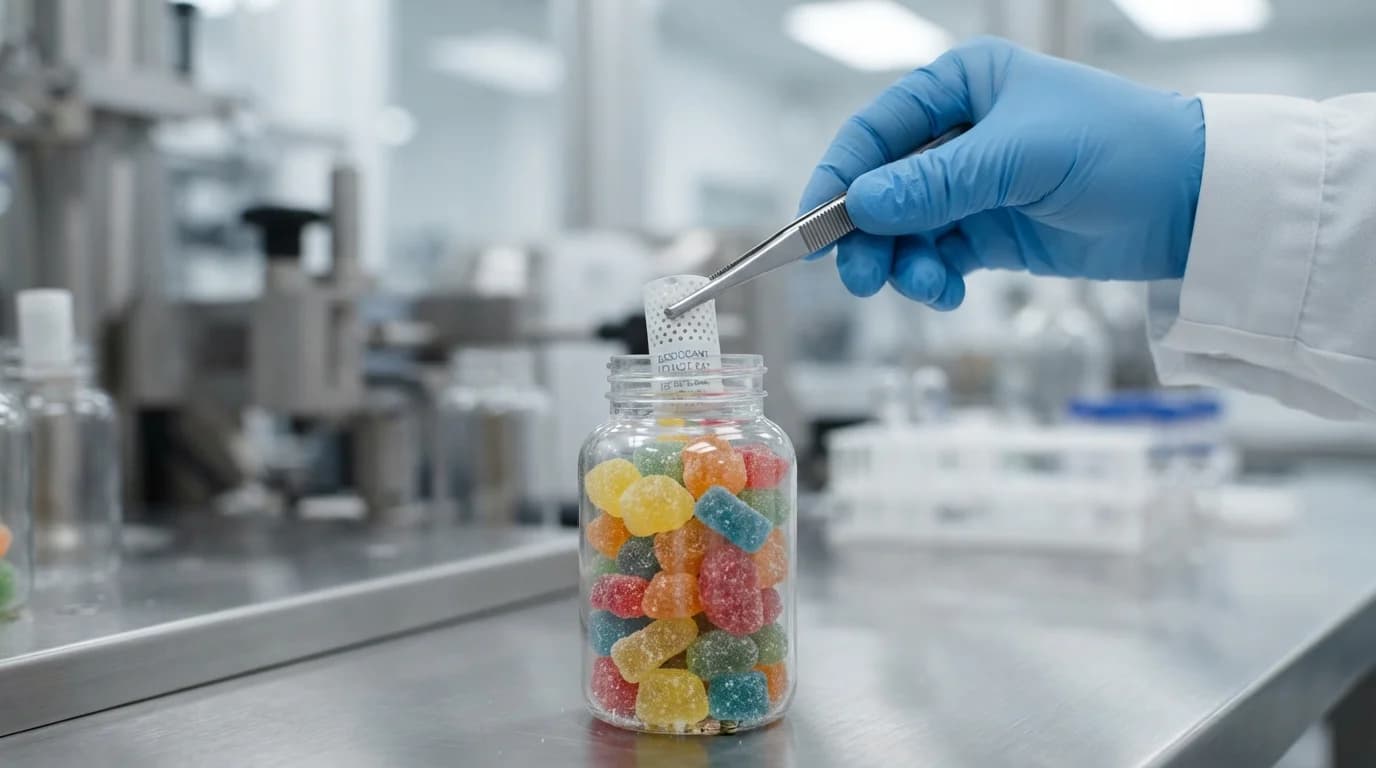
A desiccant is a highly porous, hygroscopic substance that induces or sustains a state of dryness (desiccation) in its vicinity. In gummy packaging, the desiccant acts as a sacrificial moisture sponge. It absorbs the ambient moisture before the gummy can.
Types of Desiccants Used in Supplements
- Silica Gel: The most common and cost-effective desiccant. It is highly porous silicon dioxide. Silica gel gummies packets are excellent at absorbing moisture across a wide range of temperatures, making them the industry standard for general gummy packaging.
- Molecular Sieve: These are synthetic zeolites with incredibly precise pore sizes. They absorb moisture much faster and can drive the humidity inside the bottle to a much lower level than silica. They are often used for highly moisture-sensitive active ingredients, like live probiotics.
- Bentonite Clay: A natural, inexpensive alternative to silica. It is effective but generally slower at absorbing moisture and performs poorly at higher temperatures compared to silica or molecular sieves.
Engineering the Micro-Environment
Simply dropping a desiccant packet into a bottle is not enough. The packaging engineer must calculate the precise micro-environment required.
Sizing the Desiccant
The CMO must calculate the Moisture Vapor Transmission Rate (MVTR) of the specific plastic bottle being used (e.g., PET vs. HDPE) and factor in the claimed shelf life (e.g., 24 months).
- If the bottle allows 1 gram of moisture to permeate through the plastic over 24 months, the desiccant packet must be sized to absorb more than 1 gram of water to protect the gummies. Using a 1-gram silica packet when a 3-gram packet is mathematically required will lead to product failure in month 18.
Formatting the Desiccant
Desiccants come in various forms to suit different automated packaging lines:
- Packets/Sachets: The standard drop-in.
- Canisters: Rigid plastic cylinders with porous ends. These are often preferred for high-speed automated packaging lines because they drop cleanly and don't misfeed as easily as soft packets.
- Desiccant Caps: The desiccant material is built directly into the lid of the bottle. This eliminates the risk of a consumer accidentally swallowing a packet, providing a premium, safer user experience.
The Complete Barrier System
It is critical to understand that a desiccant is a finite resource. Once it is saturated with water, it stops working.
Therefore, a desiccant is only effective when paired with a high-barrier bottle (like thick-walled PET or HDPE) and, most importantly, a flawless induction seal. If the induction seal fails, the desiccant will try to dehumidify the entire warehouse, become fully saturated within hours, and leave the gummies completely unprotected.
Probiota Innovations: Total Packaging Security
At Probiota Innovations, we do not allow packaging failures to ruin our formulation science.
Our packaging engineers utilize advanced MVTR calculations and ICH stability data to specify the exact desiccant type and volume required for your specific gummy formulation and target market climate. We utilize automated, high-speed desiccant inserters combined with 100% verified induction sealing, ensuring the micro-environment inside your bottle remains perfectly dry from our facility to the consumer's hands.
Explore our Advanced Packaging and Turnkey Solutions
Frequently Asked Questions (FAQ)
1. Do all gummies need a desiccant? Most functional, high-quality pectin gummies should use a desiccant, especially if they are exported or have a 24-month shelf life. Very cheap, low-moisture gelatin gummies might survive without one, but it is a massive risk for premium functional products.
2. Are silica gel packets toxic if swallowed? Standard silica gel is generally non-toxic and chemically inert. It is a choking hazard, not a poison. However, consumers should obviously be advised not to eat it. This is why many premium brands are moving toward desiccant canisters or desiccant-lined caps.
3. What happens if the desiccant is too large? Over-desiccating a gummy can also be a problem. If the desiccant pulls too much moisture out of the gummy matrix itself, the gummy will dry out, become hard, chewy, and lose its pleasant texture. The desiccant size must be precisely mathematically matched to the bottle and the product.
4. Can I use a cotton ball instead of a desiccant? Absolutely not. Cotton is used in dry capsule/tablet manufacturing to prevent the pills from breaking during transport (dunnage). Cotton is not a desiccant; it does not actively absorb moisture from the air to lower humidity. Using cotton with gummies can actually trap moisture against the gummy surface, accelerating mold growth.
Recommended Manufacturing Solution
Explore our private label probiotic gummy manufacturing capabilities
Want to discuss your formulation?
Our experts help brands launch technically complex probiotic and functional gummies.