Comparing Kosher vs Halal Gummy Production: Technical Differences for Dual-Certified Facilities
Comparing Kosher vs Halal Gummy Production: Technical Differences for Dual-Certified Facilities
For nutraceutical brands aiming for total global market penetration—spanning the United States, Israel, and the Middle East—securing both Kosher and Halal certifications is the ultimate strategic advantage. It signals uncompromised purity, strict supply chain transparency, and rigorous quality control.
However, from an engineering and manufacturing standpoint, these two religious dietary laws are not identical. Comparing kosher vs halal gummy production reveals critical nuances. While there is significant overlap, managing a dual certified gummy manufacturing facility requires sophisticated auditing, ingredient segregation, and deep technical expertise.
This guide explores the technical differences kosher halal gummies present and how elite facilities navigate these complex requirements.
The Overlapping Core: The Rejection of Porcine Ingredients
The most prominent similarity between Kosher (Kashrut) and Halal dietary laws is the absolute prohibition of porcine (pig) derivatives.
In traditional gummy manufacturing, porcine gelatin is frequently used because it produces excellent texture and is inexpensive. For a facility seeking either kosher or halal status, porcine gelatin is universally banned. Furthermore, any equipment that has processed porcine gelatin must undergo extreme, religiously supervised purification (such as Kashering with boiling water) before it can ever be used for compliant production, though many top-tier facilities simply ban porcine materials entirely to eliminate the risk.
Technical Difference 1: The Bovine Gelatin Dilemma
While both laws ban pigs, their treatment of bovine (cow) derivatives creates significant divergence.
- Halal Perspective: Bovine gelatin can be halal if the animal is slaughtered according to Islamic law (Zabiha). Many global halal certification bodies will accept bovine gelatin if accompanied by a valid certificate.
- Kosher Perspective: Bovine gelatin can be kosher if the animal undergoes a highly specific slaughter (Shechita) and rigorous inspection (Bedika) to ensure no internal defects (Glatt). Finding kosher gelatin is incredibly difficult and exponentially more expensive than halal gelatin.
- The Intersection Challenge: Even if a facility sources halal bovine gelatin, it is almost never certified kosher. Therefore, a dual-certified facility cannot use it.
The Unified Solution: Plant-Based Pectin
To achieve true kosher halal production comparison parity, advanced CMOs abandon animal derivatives entirely.
By formulating with pectin (a carbohydrate extracted from citrus peels or apples), the manufacturer achieves a product that is inherently Pareve (neutral/kosher) and undeniably Halal. This 100% plant-based approach simplifies the supply chain, eliminates the grueling slaughter audits, and satisfies both regulatory bodies simultaneously.
Technical Difference 2: Alcohol and Solvents
The most significant facility requirements kosher halal divergence occurs in the handling of alcohol (ethanol).
- Halal Perspective: Islam strictly forbids the consumption of intoxicants (Khamr). In manufacturing, the use of ethanol as a solvent to extract natural flavors or botanical actives is heavily scrutinized. Most strict halal certifying bodies (like JAKIM or SFDA equivalents) demand that final products contain absolutely 0.0% alcohol, meaning extraction processes must utilize alternative solvents like water or halal-certified glycerin.
- Kosher Perspective: Judaism does not prohibit alcohol consumption. However, the source of the alcohol is highly regulated. Ethanol derived from grapes (wine) or aged in wine casks is strictly non-kosher unless produced under constant Rabbinical supervision. Ethanol derived from synthetic sources or grain (corn) is generally permissible.
The Dual-Compliance Strategy
To satisfy both, a dual-certified facility must demand natural flavors and botanical extracts that are processed entirely without ethanol, utilizing only water, supercritical CO2, or certified plant-derived glycerin as solvents. This satisfies the halal ban on intoxicants and bypasses the kosher complications of grape-derived alcohol.
Technical Difference 3: Meat and Dairy Separation
- Kosher Perspective: The cornerstone of Kashrut is the absolute separation of meat and dairy. A facility producing a dairy gummy (e.g., using whey protein) cannot run that product on the same line as a meat product (e.g., collagen) without massive, Rabbinically supervised cleaning (Kashering). Furthermore, a dairy gummy cannot be consumed by a kosher observer immediately after a meat meal.
- Halal Perspective: Halal law has no restriction against mixing halal meat and dairy.
The Dual-Compliance Strategy
Again, formulating the gummy as strictly Pareve (vegan/plant-based) is the only efficient path forward. A pectin-based gummy containing no dairy or animal derivatives is universally accepted by both Jewish and Islamic consumers and requires no complex line-segregation beyond standard pharmaceutical CIP (Clean-In-Place) sanitation.
Probiota Innovations: Masters of Dual-Compliance
Operating a facility that satisfies both OK Kosher/Star-K and JAKIM-equivalent Halal auditors requires an immaculate, transparent, and highly automated supply chain.
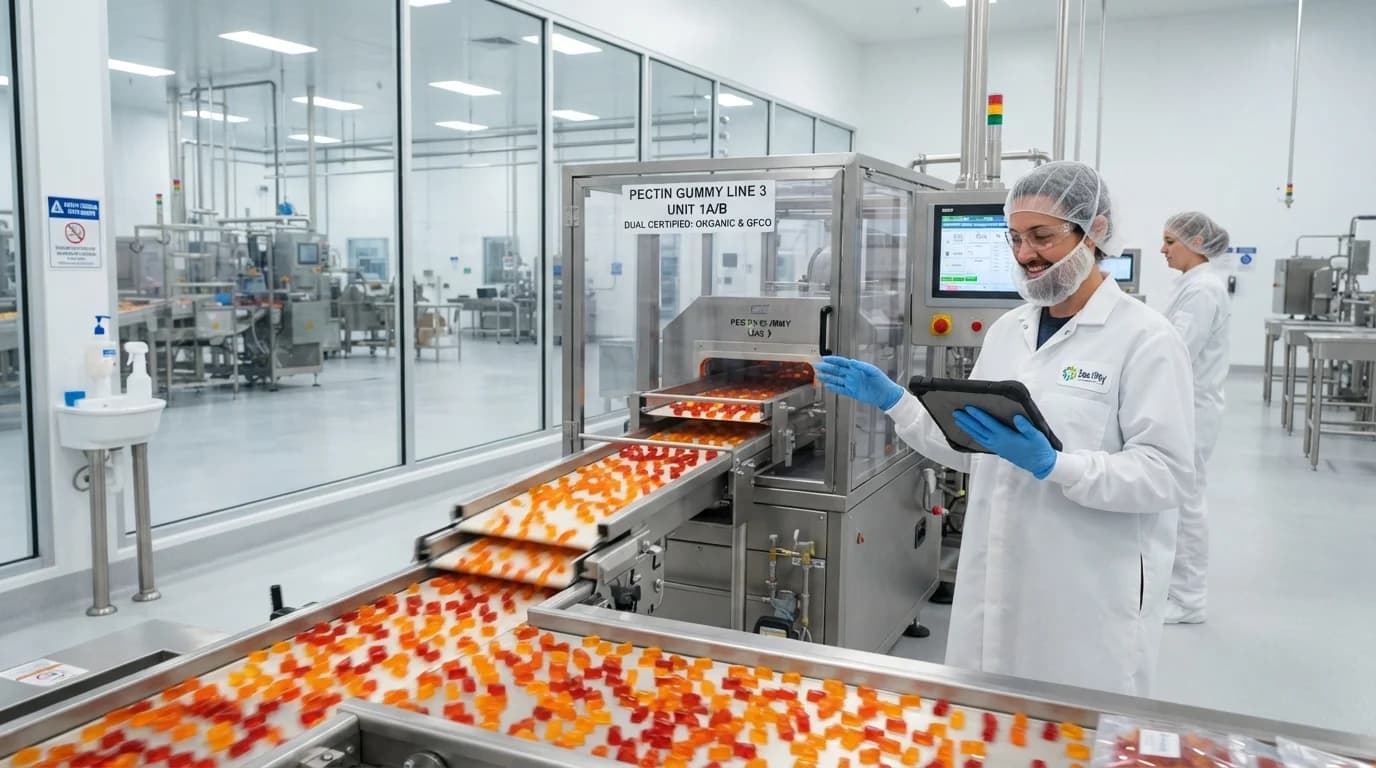
At Probiota Innovations, we specialize in high-brix, heat-stable pectin gummy manufacturing. By engineering our products to be 100% plant-based and utilizing advanced starchless mogul technology (which eliminates cross-contamination risks), we provide brands with turnkey, dual-certified gummies ready for dominant global distribution.
Explore our Export-Ready Nutraceutical Manufacturing Solutions
Frequently Asked Questions (FAQ)
1. Can a gummy be Kosher but not Halal? Yes. For example, a kosher gummy might use a natural flavor extracted using synthetic, non-grape ethanol. This is perfectly acceptable under kosher law, but the presence of the ethanol solvent would render it non-halal (haram) under strict Islamic regulations.
2. Can a gummy be Halal but not Kosher? Yes. A gummy utilizing halal-certified bovine gelatin is perfectly acceptable for Muslim consumers. However, because that gelatin did not undergo the specific, highly rigorous kosher slaughter (Shechita) and inspection (Bedika), it is strictly non-kosher.
3. Why is pectin the best solution for dual-certified facilities? Pectin is a carbohydrate extracted from fruit. It is 100% plant-based. This completely bypasses the complex, expensive, and high-risk auditing required for animal-derived gelatin, satisfying both kosher requirements for Pareve (neutral) status and halal requirements for animal-free sourcing.
4. Does starchless mogul technology help with dual certification? Immensely. Traditional starch moguls reuse cornstarch, which can harbor trace contaminants from previous runs, triggering compliance failures during audits. Starchless technology uses silicone molds that are washed with boiling water and steam between every single run, guaranteeing absolute purity and preventing cross-contamination.
For an in-depth understanding of the core concepts, read our comprehensive guides on Is Pectin Halal? and Halal Certification for Pectin Gummies.
Looking for a manufacturing partner? Learn More About Our Halal Gummy Manufacturing Capabilities.
Recommended Manufacturing Solution
Want to discuss your formulation?
Our experts help brands launch technically complex probiotic and functional gummies.